
“The Bible Says . . .”
Sunday Sermonette #4

The Holy Bible means a lot to people of the Abrahamic faiths – Jews, Christians, and (to some extent) Muslims. Different parts of the Bible mean more to some believers than to others. Jewish people follow the guidance of the Old Testament to a greater or lesser extent, depending on where they land in the orthodox/conservative/reform/reconstructionist spectrum. Christians rely on Biblical teachings in both the Old and New Testaments, varying by denomination on the strictness with which they interpret the guidance in scripture and the traditions of the faith. To Muslims, elements of the Old Testament (Torah, Psalms) are respected as a version of earlier divine messages before these messages were perfected in the Qur’an (or Quran or Koran) as dictated to Muhammad by the archangel Gabriel. Muslims also acknowledge elements of the New Testament, but they see Jesus as one of the great prophets, along with Noah, Abraham, Moses, and Muhammad.
I’m thinking about this today because we hear a lot in our political discourse about what “the Bible” says about things like the rights of women, medical care, the environment, homosexuality, government, and general moral codes. This has a lot of meaning for people who fall into the categories I mentioned in the first paragraph of this essay.
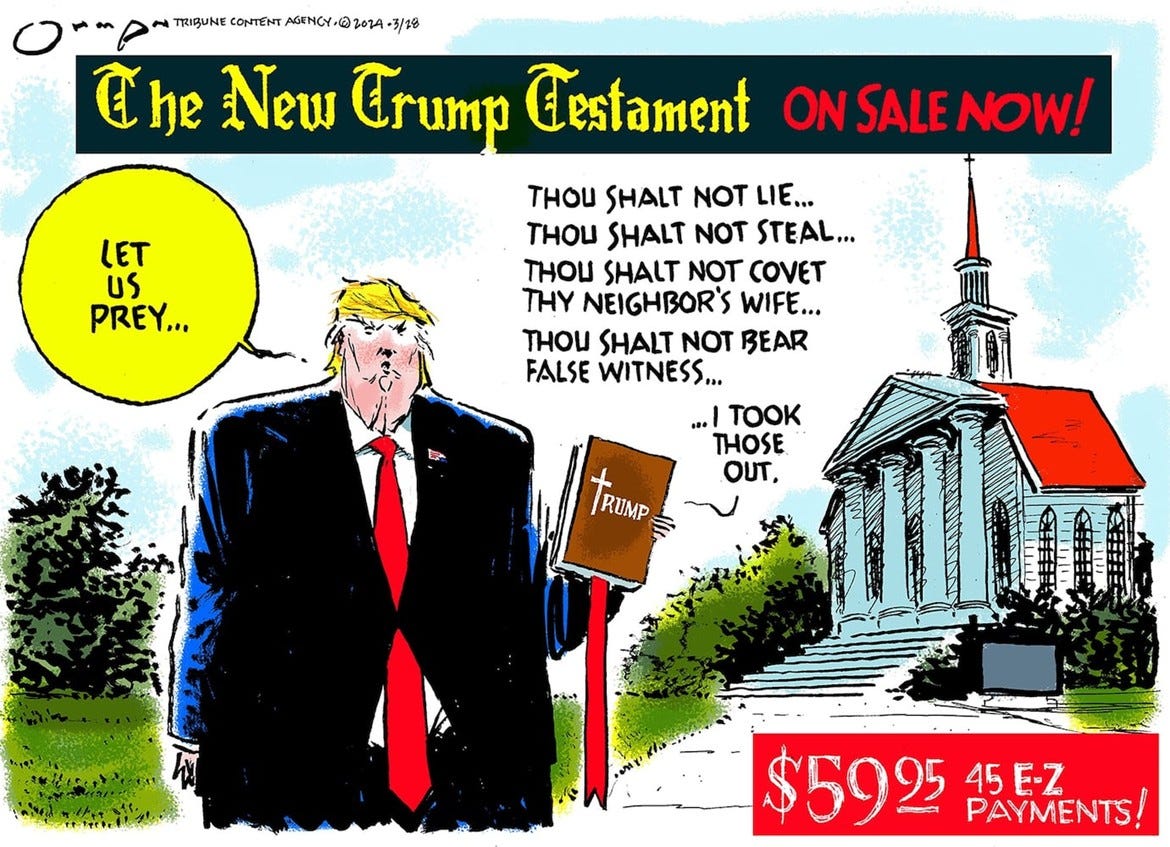
However, to nonbelievers, the Bible is no more a binding ethical code than the Boy Scout Law, which goes like this:
A Scout is:
Trustworthy,
Loyal,
Helpful,
Friendly,
Courteous,
Kind,
Obedient,
Cheerful,
Thrifty,
Brave,
Clean, and
Reverent.
Fun fact: when my older brother Ken became a Boy Scout, I helped him memorize the Boy Scout Law. I can still recite it to this day.
And while we’re at it, here’s the Boy Scout Oath:
On my honor, I will do my best
To do my duty to God and my country
and to obey the Scout Law;
To help other people at all times;
To keep myself physically strong,
mentally awake, and morally straight.
Can you imagine observing someone’s conduct and then saying, “You can’t do that because it contravenes the Boy Scout Law?” The response you would get would go something like “I’m not a Boy Scout. Why are you telling me this?”
This is the same reaction non-believers have when they are told they have to behave in certain ways because “it’s in the Bible.” This is not persuasive, because to nonbelievers (loudly for those in the back) THE BIBLE IS A BUNCH OF IRON-AGE FAIRYTALES DRESSED UP AS MORAL GUIDANCE, FEATURING A MYTHICAL SKY-DUDE INVENTED TO SCARE PEOPLE INTO OBEDIENCE.
We have to acknowledge the circularity of the arguments for basing national law on The Bible.
Lawmaker cites the Bible: “We should make X illegal because the Bible forbids it.”
Underlying assumption: Everyone agrees that the Bible is authoritative.
Reality: Many citizens (including atheists, Jews, Muslims, and various sects of Christianity) do not recognize the Bible as binding.
Circularity appears:
To justify the law, you must first assume universal acceptance of the bible
But the law is being imposed on people who don’t accept that authority
Therefore, the argument begs the question, which means it assumes what it’s trying to prove.
As an aside, I want to note that virtually everyone in public life uses “begs the question” incorrectly. It does not mean “raises the question.” If you want to say something “raises the question,” there’s an easy way to say that. You can say something “raises the question.” The proper use of “begging the question” is acknowledging the logical fallacy of assuming the very thing an argument is trying to prove. It’s called “begging the question” because it asks (or begs) for acceptance rather than proving it. In the original Latin, it is petitio principii – “assume the starting point.”
I may or may not be a pedant.
Back to my point for today. I would not object to schools posting the Boy Scout Law as general guidance for socially acceptable behavior. Major belief systems all include variations of the guidance provided by the Boy Scouts.
Sinclair Lewis is often cited as saying, “When fascism comes to America, it will be wrapped in the flag and carrying a cross,” although this exact statement cannot be traced to any of his writings or speeches. But in his book It Can’t Happen Here, he makes a number of statements that capture this thought.
On the manipulation of patriotism:
“He [the fictional politician in his book] would appear as a man of the people, glorifying the flag, the army, the Constitution—though he cared for none of them. In his speeches he would sound every note of pride, loyalty, and courage that his audience expected.”
On patriotic spectacles and rallies:
“[He] knew the people would respond to parades, flags, banners, songs—anything that made them feel part of a great movement. He displayed his devotion to the nation at every opportunity, while his policies served only his ambition.”
On exploiting religion:
“He knew the churches would be useful. By speaking in terms of moral duty and invoking God’s blessing on his policies, he could convince many that resistance to him was unpatriotic or sinful.”
On the appeal to mass sentiment:
“The people, weary of hardship, would see in his fiery words the solution to all their troubles, forgetting that the solution was really power for himself and nothing more.”
On the manipulation of fear and resentment:
“By promising to protect the honest, hardworking citizens from enemies within—communists, outsiders, troublemakers—he gained loyalty. Every threat, real or imagined, became a reason to rally behind him, to trust his judgment, and to accept his edicts unquestioningly.”
Note: Well, this essay kind of got away from me. I didn’t start out planning to cite Sinclair Lewis, but the references fit. I think I need to read this book. (I started to write “reread” but I don’t think I’ve ever read it. I took the quotes in this piece from online summaries of the book.)
Love the Sinclair Lewis quotations. 😊
😎