
Star Wars Redux

The current Republican President is a very simple man, really. Like every toddler, when he sees that someone else has a bright shiny bauble, he wants one too.
FYI: I’ve decided to refer to the current President by his party affiliation rather than by his name. He as an individual is not America’s problem; the problem is that the Republican Party, which once had principles, is now using him as a vehicle to power. They don’t agree about what they will do with that power – that’s why they’re having their budget hearings literally in the middle of the night because, you know, like all toddlers they think that if they can’t see you, you can’t see them. I want to make the Republican Party own every bit of his madness.
Anyway.
During his many conversations with Israeli Prime Minister Benjamin (Bibi) Netanyahu, the current Republican President has learned about Israel’s Iron Dome – the mobile air defense system designed to intercept and destroy short-range rockets and artillery shells fired from distances of two to 45 miles. Because Bibi has this, the current Republican President wants one too. But he’ll call it the “Golden Dome” because sure, that’s better. Just look at the tacky and garish disaster that now passes for the Oval Office.
There are several problems with the current Republican President’s interest in keeping up with the Netanyahus:
The United States is WAY bigger than Israel, making a dome-type defense system much more difficult. For comparison, Israel is about the size of New Jersey, America’s fifth-smallest state.
Israel’s enemies (the ones most likely to lob a short-range rocket or artillery shell in Israel’s direction) are on Israel’s borders, within the two to 45 mile radius. Only Canada and Mexico are close enough to the United States to be intercepted by an Iron Dome-type system. And these countries are not likely to decide to shell the United States – at least not right now. Although that could change — the current Republic President has only been in office for a few months.
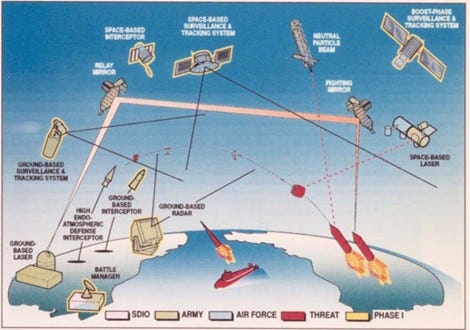
What the current Republican President is talking about is a ballistic-missile defense system, involving defense against nuclear attacks from countries around the world and based on advanced satellite warning systems and defenses. This is an extraordinarily sophisticated proposal – and we’ve been here before.
In 1983, President Reagan proposed a ballistic missile defense program similar to what the current Republican President wants. Reagan tacked this proposal to the end of an unrelated nationally televised Presidential speech. The next morning, the New York Post headline was “Star Wars to Zap Red Nukes” – a riff on the popular movie that had come out in 1977.
I know a little bit about this program. When Reagan gave this speech, I was working for Science Applications International Corporation (SAIC), a defense contractor competing for one of the initial million-dollar contracts to begin research into the Strategic Defense Initiative (SDI), the official name for what everyone else called Star Wars. Contracts for the initial phase were awarded in a “horse race” bidding process — basically, a race to see who could come up with a program overview the fastest. The company (or companies) that won this initial competition qualified for an extension of the contract to develop the next phase (or phases) of the program. Because I worked on this proposal, I became aware of some of the problems associated with developing such a nuclear defense. SAIC, by the way, was one of the victors in the horse race — the successful competitors for follow-on SDI projects. I left the company a couple of years later, but we were still floating on SDI contracts. The program was cancelled by the 1990s without coming anywhere close to developing a space-based missile defense system.
Technical Problems
Immature or unproven technology: Many of SDI’s components—such as space-based lasers, particle beams, and kinetic energy interceptors—were in early research stages or purely theoretical.
This is probably less of a problem in the current era, although the technological challenges will still be significant
Targeting and tracking: The system would have required near-instantaneous identification, tracking, and interception of multiple incoming warheads and decoys traveling at high speeds. This level of precision was beyond the computing and sensor capabilities of the time.
This is still a problem: it is currently unfeasible to deploy the thousands of satellites in precise orbits that would be required to intercept missiles in their boost phase (the first few minutes after launch)
Countermeasures: The Soviets (and any adversary) could deploy cheap and effective countermeasures, such as decoys, chaff, or maneuverable reentry vehicles, to overwhelm or bypass the defense.
This is the same problem encountered in the 1980s.
Space-based vulnerability: Satellites and space-based weapons would be difficult to protect and could be destroyed relatively easily using anti-satellite weapons or ground-based lasers.
This is the same problem encountered in the 1980s.
Cost vs. response: The attacker could use relatively inexpensive missiles or decoys to defeat an enormously expensive defensive system—what critics called the "cost-exchange ratio" problem.
This is the same problem encountered in the 1980s.
Psychological Problems
False sense of security: There were concerns that even a partial system might give leaders or the public a dangerous illusion of safety, potentially lowering the nuclear threshold.
This is the same problem encountered in the 1980s.
Destabilization fears: The notion that one side could be invulnerable to retaliation challenged the concept of mutual assured destruction (MAD), which had underpinned nuclear deterrence for decades.
This is the same problem encountered in the 1980s.
Diplomatic Problems
Violation of existing treaties: The 1972 Anti-Ballistic Missile (ABM) Treaty prohibited national missile defense systems. SDI was seen by many as incompatible with this treaty, leading to international tension.
Although the United States broke out of the ABM Treaty under a previous Republican president (Bush) in 2002, other treaty obligations conflict with the proposed “Golden Dome.”
Provoking an arms race: Rather than promoting peace, SDI risked accelerating the arms race as the USSR (and others) might feel compelled to develop new offensive systems or their own space-based weapons.
This is the same problem encountered in the 1980s.
NATO allies’ concerns: Many European allies worried that SDI would decouple U.S. and European security, making the U.S. less vulnerable while leaving Europe exposed to Soviet retaliation.
This is the same problem encountered in the 1980s.
Other Problems
Economic cost: Estimated costs ranged from hundreds of billions to over a trillion dollars over time. Critics argued the U.S. could not afford it, especially with other defense and domestic priorities.
This is the same problem encountered in the 1980s.
Scientific opposition: Many leading scientists, including those at MIT and members of the Union of Concerned Scientists, publicly challenged the feasibility and ethics of SDI.
It hasn’t happened yet (too soon and too obvious), but opposition will come from the same sources. This is one reason why the current Republican administration is defunding universities and firing government experts. First thing you do is get rid of all of the people who know how to do things.
Soviet misinterpretation: The USSR may have perceived SDI as an attempt to gain first-strike capability, leading to miscalculations or a preemptive strike during a crisis.
Here’s how this works. “First-strike capability” means that the attacking nation thinks that it can either negate a retaliatory attack or survive one. Strategic defense capability makes an adversary believe that the nation developing such capability is planning to reorient its defense strategy to engage in nuclear war, not to avoid one.
“First strike” has a different meaning from “first use.” In an existing conventional war, a nuclear-capable nation that is losing the conventional conflict may have a strategy of escalating to small-scale nukes. This is “first-use.” “First strike,” on the other hand, involves what has been called a BOOB attack (bolt out of the blue). Yes, this was named by men whose sense of humor is still in the adolescent range.
This time around, there are more nations with nuclear capability that could threaten the United States than there were in the 1980s. This multiplies the threat and also increases the chances of miscalculation or preemptive strike.
Technological misdirection: Critics argued that funding SDI drew attention and resources away from more practical arms control efforts and conventional defense improvements.
This proposal has been kicking around since the current Republican President’s first term in office, but his low-ball cost and time estimates for the completion of this project are laughable. He has no idea of the cost and timeline requirements for such a program. His notion that this is doable with $175 billion over three years or so is completely at odds with reality.
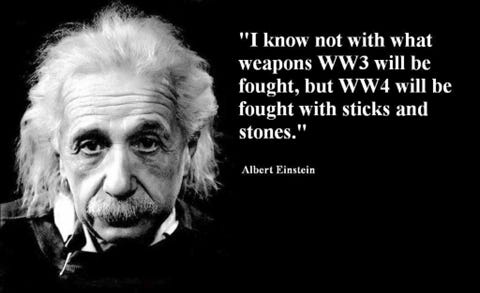
There is one additional element that we need to think about. Given the tech bros’ likely involvement in all of this, generative AI will be involved in all elements of this program, including the identification of threats. When this is handed over to Chat GPT, what are the chances that an incoming flock of Canada geese will be identified as a Russian (or Chinese or Pakistani or fill-in-the-blank) ICBM, provoking retaliatory strikes and thus starting World War III?
This is so obvious to those with a brain or who take the time to reason. Thanks for this analysis. More brains (or at least one with scientific and engineering knowledge) must apply.
Sigh. What could possibly go right?