SAVE Me

I have written about the Senate filibuster 10 times since I began writing this Substack in 2022. You can find the links to some of these articles at the end of this essay if you want to check them out.
I want to revisit this issue today because the SAVE Act (Safeguard American Voter Eligibility Act) is stymied in the United States Senate after having passed the House of Representatives by a partisan vote of 218-213. All House Republicans voted for the bill; one Democrat (Henry Cuellar of Texas) joined them. The bill is now before the United States Senate, where it is unlikely to pass because of Senate voting rules. The Senate is currently observing its Presidents’ Day State Work Period – when the Senators go home to the districts to do the other part of their job – meeting with constituents, attending luncheons with supporters and donors, and either defending or attacking the Trump administration in front of hometown crowds.
NOTE: If they are Republicans, they are likely avoiding meeting with the public because they’ll get yelled at.
I have another name for the bill which more directly captures its intent – Silencing American Voters Everywhere. You’re welcome.
Anyway.
When they return on Monday, they will face the prospect of dealing with the SAVE Act. Because of arcane and non-originalist Senate procedures, including the filibuster, the bill is unlikely to pass.
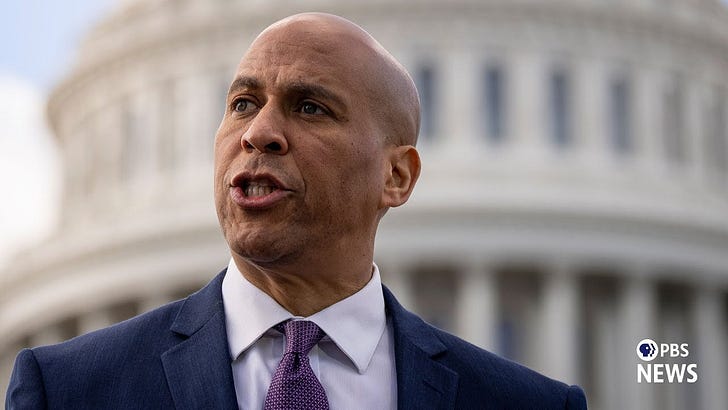
Here’s what I wrote about the filibuster on April 4, 2025, when Senator Cory Booker (D-NY) set the record for the longest Senate speech in American history to protest the policies of President Donald Trump:
The tradition of unlimited debate in the Senate was part of the original Constitutional plan. The Senate, smaller and thus more elite than the House, was expected to be a more deliberative body. One image was that the Senate was the saucer into which the hot tea was poured to cool off. Translation? The House might act in the heat of the moment – after all, the entire body was elected every two years – but cooler heads would prevail in the Senate. Another popular image was that the house was a Bureaucracy, but the Senate was a club.
When the House debates a bill, time for debate is carefully allocated – down to the minute – and managed by the bill’s sponsor. By contrast, Senate debate is limited only by the practical realities of bodily functions and the need to pass legislation.
If you want to understand the modern Senate, I recommend Kill Switch: The Rise of the Modern Senate by Adam Jentleson. His position as a Capitol Hill insider gives him a valuable perspective on a number of things, including the filibuster.
The word “filibuster” has an interesting origin. It comes from the Dutch word vrijbuiter, meaning “freebooter” or “pirate.” It passed into Spanish as filibustero, referring to pirates or mercenaries who engaged in unauthorized military expeditions in the 17th and 18th centuries.
By the mid-19th century, the term entered American political language, describing politicians who “hijacked” legislative proceedings to delay or obstruct action—much like pirates seizing control of a ship. It became associated with the U.S. Senate, where extended speechmaking was used as a tactic to block legislation.
Originally, the Senate’s rules did not provide for a procedure for the Senate to vote to end debate so that a question could be voted on. A filibuster took place in the first session of the Senate, when on September 22, 1789, Senator William Maclay of Pennsylvania wrote in his diary that the “design of the Virginians [. . .] was to talk away the time, so that we could not get the bill passed.”
Although the filibuster was rarely used during most of the nation’s history, in 1917 President Wilson urged the Senate to adopt a rule that would allow cloture to be used to limit a debate on measure; this was done after a group of twelve antiwar senators managed to kill a bill that would have allowed Wilson to arm merchant vessels in the face of unrestricted submarine warfare.
Cloture is a French word that means closing something. The French National Assembly first used this procedure, and it was introduced into the parliament of the UK in 1887. Subsequently it was adopted to the United States Senate. We should note that in Commonwealth countries it is sometimes referred to as a guillotine order. Yikes.
As originally established, debate in the Senate could be ended by a cloture vote that required the agreement of 2/3 of the Senators (67 individuals). As originally established, cloture didn’t end debate immediately, but it set in progress a number of steps that would end debate on some scheduled timeline. From 1917 to 1970, the Senate took a cloture vote nearly once a year, on average; during this time, there were 49 cloture votes.
For a variety of institutional reasons, the filibuster became routine after 1970, primarily because a series of filibusters over civil rights legislation was keeping the Senate from accomplishing its constitutional obligations of approving budgets and passing other legislation. Ironically, because a filibuster no longer brought the Senate to a complete halt, filibusters became politically easier for the minority to sustain, and the number of filibusters began to increase rapidly.
In 1975, the 2/3 cloture requirement was reduced to 3/5, meaning in practicality that passing legislation requires a supermajority; with today’s tight Senate margins, any Senator, even a member of the minority party, can gum up the works in the Senate simply by noting their intention to filibuster the legislation. No actual filibuster is required.
Now for this week’s question: What are the possible paths for this bill to take in the Senate?
The GOP currently has 53 seats in the Senate and could pass the bill if a simple majority were sufficient for the victory. But Senate rules require 60 votes, as I explained above, and the GOP is unlikely to get 7 non-Republicans to vote for it.
Republicans could try to pass this under the reconciliation rules, which allow bills to pass with a simple majority. Because these rules are reserved for bills with budgetary implications, the Senate parliamentarian is unlikely to allow them to apply.
The GOP could change the Senate rules to eliminate the filibuster. This was done for judicial nominees over the past decade. Hello, Justices Gorsuch, Kavanaugh, Barrett, and hundreds of federal judges in lower courts. But eliminating the filibuster – basically, allowing the Senate to pass legislation with a simple majority, as the House already does – would mean giving Democrats the same power when they take over the majority in the Senate.
Preventing this, by the way, is one important reason why the Republicans are so desperate to keep people from voting.
Republicans could also require the Democrats to actually perform a “Speaking Filibuster” a la Mr. Smith Goes to Washington. This would mean a tightly scheduled round-the-clock series of Democratic speakers who would have the capacity to talk the bill to death. In a normal Senate, where they actually want to get things done, the threat of a speaking filibuster would be enough to kill the piece of legislation. In today’s Senate, where the show is the reality, making the Democrats actually talk for days would be a victory for the Republicans.
I don’t think this bill is going to pass the Senate. Instead, the GOP will erect a Straw Man version of the bill and then campaign against what they will describe as the Democrats’ unwillingness to run fair elections and eliminate voter fraud.
Here are links to some previous essays that mention the filibuster, among other elements of Senate operations: