
SCOTUS Reforms

Things are moving so rapidly right now that it’s dizzying. In the month+ since President Biden’s disastrous performance on the debate stage on June 27, here’s what has happened: TFG (the Former Guy) was shot (probably) on July 13, he selected J.D. Vance to be his running mate on July 15, President Biden dropped out of the race for President and endorsed Vice President Kamala Harris to be his successor on July 21, Kamala has roared into her campaign, J.D. Vance continued to show that he is really #weird, President Biden proposed significant Supreme Court Reforms on July 29, the Olympics are happening in Paris (and Snoop Dogg is oddly front-and-center), TFG self-immolated on the stage when interviewed by black women on July 30, Israeli attacks killed a Hezbollah leader in Lebanon and a Hamas leader in Iran on July 30 and July 31, and a complicated prisoner swap involving four Americans held in Russia was concluded just before midnight on August 1.

Phew.
People smarter than me (many who actually have staff) have written copiously about all of these events. I imagine we are all reading and/or listening to everything we can to make sense of all of this. Selecting from this abundance of riches, I’ve decided to write about SCOTUS reforms – in part because it doesn’t involve the sort of soothsaying required by many of these topics. I don’t have much sooth to say about most of this, frankly.
So SCOTUS reform it is. The proposed reforms (in President Biden’s own words) are quite straightforward:
First, I am calling for a constitutional amendment called the No One Is Above the Law Amendment. It would make clear that there is no immunity for crimes a former president committed while in office. I share our Founders’ belief that the president’s power is limited, not absolute. We are a nation of laws—not of kings or dictators.
Second, we have had term limits for presidents for nearly 75 years. We should have the same for Supreme Court justices. The United States is the only major constitutional democracy that gives lifetime seats to its high court. Term limits would help ensure that the court’s membership changes with some regularity. That would make timing for court nominations more predictable and less arbitrary. It would reduce the chance that any single presidency radically alters the makeup of the court for generations to come. I support a system in which the president would appoint a justice every two years to spend 18 years in active service on the Supreme Court.
Third, I’m calling for a binding code of conduct for the Supreme Court. This is common sense. The court’s current voluntary ethics code is weak and self-enforced. Justices should be required to disclose gifts, refrain from public political activity, and recuse themselves from cases in which they or their spouses have financial or other conflicts of interest. Every other federal judge is bound by an enforceable code of conduct, and there is no reason for the Supreme Court to be exempt.
Because of the firehose of news we have been subject to (reread my first paragraph as a reminder), there hasn’t been as much public discussion of the suggested Supreme Court reforms as there might otherwise have been. Another reason for the lack of attention is that it is pretty obvious that none of this will be passed this year.
It’s hard to get anything passed in Congress these days. The Speaker of the House (GOP Representative Mike Johnson of Louisiana, in case you’ve forgotten) canceled the House work session scheduled for this week and sent lawmakers home for six weeks. When the House returns on September 9, they will have three weeks left to pass the 12 bills to fund the government (only six such bills have been passed) before the government runs out of money on September 30. As an indicator of the seriousness with which the House GOP approaches the business of governing, the House’s final vote before departing town last Thursday was a nonbinding GOP messaging bill, strongly condemning ‘border czar’ Kamala Harris. Gee, I wonder why they felt this was necessary. Can’t imagine why they would do this. It doesn’t look like they’ll have much time to consider SCOTUS reform. Some of them have talked about bring impeachment charges against the Vice President. Imagine that.
It is equally difficult to get things done in the Senate. The filibuster rule (created in the 20th century, although its defenders act as if the Founding Fathers debated this at the Constitutional Convention before including it in the document) requires that major legislation garner 60 votes in order to pass in that body. The current Democratic Party margin relies on four independents – Bernie Sanders, Kirsten Sinema, Angus King, and Joe Manchin (Independents who caucus with the Democrats) to give them their razor-thin 51-49 margin. Senator Menendez (NJ) has resigned in the wake of his felony conviction; when this resignation takes effect on August 20, the Democrat’s margin will be even thinner. The New Jersey governor is expected to appoint someone to fill this seat in short order. Because the governor is a Democrat, he will select a Democrat to fill this seat for the remainder of Menendez’s term – which expires in the first week of January 2025.
The fact that these proposals are unlikely to be passed (or even to receive any significant attention) this year doesn’t mean they are unimportant. Rather, they place a marker on the table to remind everyone that these reforms will be a major focus for the Democratic party when they control the levers of government to allow them to be passed.
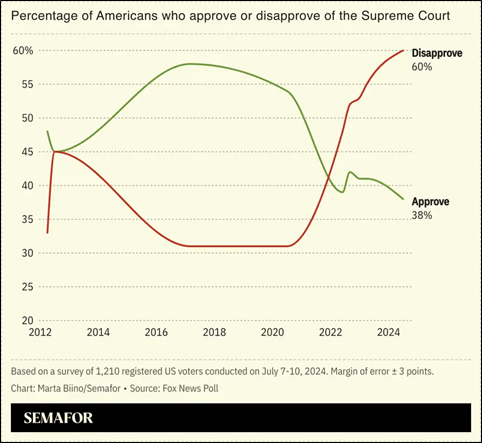
So let’s look at these proposals.
No One Is Above the Law (Constitutional Amendment)
This is clearly a reaction to the nutso immunity ruling issued by SCOTUS last month, essentially pretzeling themselves into a position that says a President can do pretty much whatever the heck he pleases while he is President – without criminal or civil repercussions. This decision is unrooted in the Constitution and is very much Against Public Policy.
This phrase means that an act (or a contract) so obviously goes against the public good that it must be condemned. For example, a contract that commits two parties to participate in a bribery scheme would be rendered void because the corruption it permits would be undeniably bad.
Having a president who is removed from civil or criminal consequences for offenses he committed while in office would invite a corrupt or criminal president to do whatever the hell he wants in office (with some very unclear exceptions. This would be Very Bad.
This is popular among the general public. The idea that a President is totally free to do whatever he wants (even send Seal Team Six to assassinate a political rival, which TFG’s attorney in SCOTUS oral arguments suggested could fall within the bounds of immunity) is totally outside of the checks-and-balances framework of our Constitutional system.
Passing a Constitutional Amendment is tough. That’s why we’ve only had 27 of them over more than 225 years (only 17 since the Bill of Rights in 1791). How are Constitutional amendments passed? There are only two players – the Congress and the States. This chart illustrates the options:
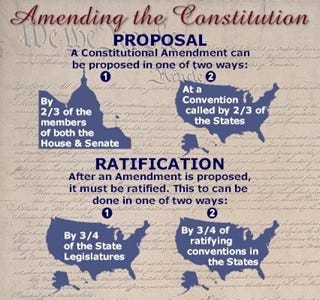
This is a heavy lift and it can take some time. We can all look at this chart and envision the obstacles to enacting this amendment. It shouldn’t be that hard, of course. We should not have a major political party that wants a President to have this type of immunity. But neither should we have a major political party that has sold its soul to TFG, so there’s that.
Term Limits for Supreme Court Justices
At first glance, this seems to confront the same requirement for a Constitutional Amendment that the first proposal encounters. The Constitution states that appointees to the Federal Courts “shall hold their offices during Good Behavior,” which has generally been interpreted to provide life tenure. Some scholars who support term limits believe that this can only be done through a Constitutional Amendment, which would encounter the same difficulties I mentioned earlier.
However, other scholars suggest a statutory remedy that would pass Constitutional muster. They propose that an active justice would transition to “Emeritus” status after 18 years of service. The lower Federal Courts (also bound by the “Good Behavior” language of Article III) already have such a procedure in place, in which judges achieve senior status while still retaining the title of ‘judge.’ These senior judges are available to step in when a Court is short-staffed or otherwise in need of some help. A ‘Justice Emeritus’ would still be a justice, thus circumventing the apparent Constitutional problem. They would continue to be paid the same as the active justices, so there’s a bit of a budgetary hit. But it’s peanuts.
The same scholars who are proposing this recommend that it not be applied to current justices, who would be called ‘Legacy Justices’ unless they choose to take Emeritus status. This means that it would not get rid of the current Justices we may not like – Alito and Thomas, for the most obvious examples, but also Roberts, Gorsuch, and Kavanaugh (all of whom manage to sit upright on the bench despite the absence of a spine).
An Enforceable Ethics Code
This seems the easiest proposal to support. After all, every other part of government (and every court besides the Supreme Court) has an enforceable code of ethics. People like Sam Alito and Clarence Thomas seem to believe that they have total immunity from corruption charges to go along with the immunity they want to give Presidents. Their lavish expenditures, failure to report gifts from wealthy individuals whose interests are before the Court even if they are not directly involved in the cases, and the high dudgeon with which they sputter their outrage that anyone would even SUSPECT them of being CORRUPT have brought this behavior to a new level of public attention – and of public distrust.
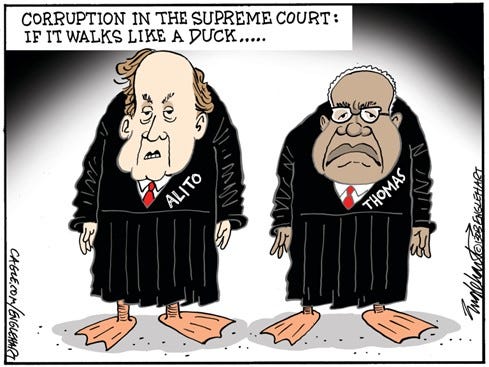
Justice Roberts and others who reject every effort by anyone anywhere to oversee the actions of justices of the Supreme Court (Roberts refused both a subpoena and an unofficial request to talk to Senators about this problem) are misunderstanding Article III of the Constitution, which in less than 400 words establishes the Judicial branch. Here are the operative sentences:
The judicial Power of the United States, shall be vested in one supreme Court, and in such inferior Courts as the Congress may from time to time ordain and establish. The Judges, both of the supreme and inferior Courts, shall hold their Offices during good Behaviour, and shall, at stated Times, receive for their Services, a Compensation, which shall not be diminished during their Continuance in Office.
That’s it. No mention of the number of justices, what they’ll be paid, what they’ll wear, whether they can have staff (or a building), what they’ll publish, how they’ll conduct their business, or anything like that. The structure of the Federal Court system was laid out a couple of years later, in the Judiciary Act of 1789, which filled this gap by providing that “the supreme court of the United States shall consist of a chief justice and five associate justices.” The Act also created federal District Courts and a Circuit Court, which would hear appeals from the district courts and would become the Courts of Appeals. From this framework grew the current Federal Court System, as you see in this chart.
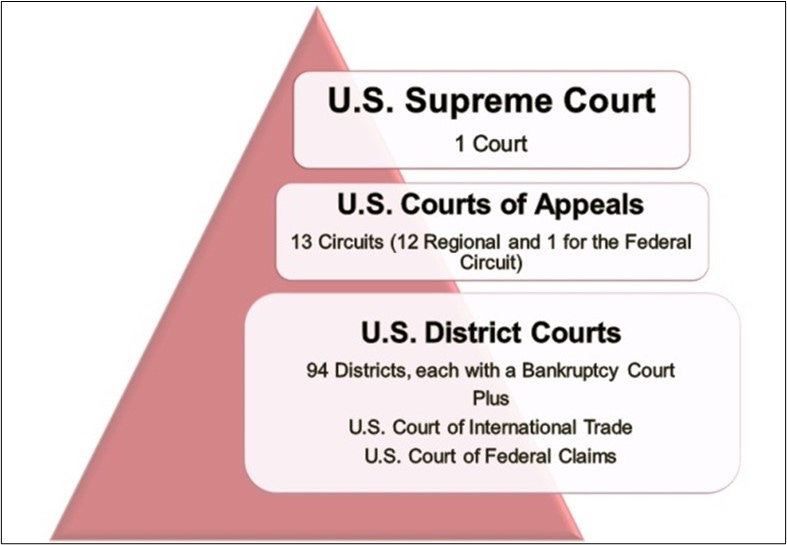
Every element of this system was created, funded, and regulated by Congress. Congress also passed a Code of Conduct that applies to all Federal Judges except the nine SCOTUS justices. This Code was originally passed by Congress in 1973 and has been amended several times. It was created and is enforced by the Judicial Conference of the United States, a policymaking body for the federal courts that meets twice a year to consider administrative and policy issues affecting the federal court system and to make recommendations to Congress concerning legislation involving the Judicial Branch.
When people have talked about the possibility of Ethics reform for the Supreme Court, one objection that is always made focuses on the issue of enforcement – we have seen that the Supreme Court is apparently unable to be self-regulating (take a bow, Clarence and Sam). The opponents of reform claim that separation of powers protects SCOTUS from regulation — forgetting that the other side of separation of powers is “checks and balances.” And no, this doesn’t mean receiving checks to enhance your bank balances. Proponents of Court ethics reform suggest that the Judicial Conference of the United States could be tasked with monitoring compliance with a Supreme Court ethics code in the same way they monitor the other federal courts.
SCOTUS reform is both necessary and possible – although neither rapid nor easy. Things worth doing are often neither rapid nor easy. They take time and investment – of money, attention, and persistence. But they are often worth doing. SCOTUS reforms are worth doing.
Vice President Harris immediately issued a written statement supporting the reforms after their announcement. Based on some of her past statements and statements from current advisors, there is some evidence that this issue would be a higher priority for her than it has been for President Biden. The real problem is, let’s face it – these proposals require bipartisan support. As I’ve already written, this support is unlikely to emerge in the immediate future.
But big changes don’t happen all at once. They generally start slowly and build momentum until at some time – often unpredictably – things seem to change rapidly. The Third Reich evolved over decades before it crescendoed in Auschwitz and Dachau. The Civil Rights movement evolved over even more decades before it crescendoed in the marches and legislation of the late 1950s and early 1960s. The movement to de-Confederate the South (primarily although not exclusively) moved slowly until it crescendoed after George Floyd was murdered in 2020.
In his last public address, March 3, 1968, Martin Luther King said the words that we all know so well:
Like anybody, I would like to live a long life. Longevity has its place. But I'm not concerned about that now. I just want to do God's will. And He's allowed me to go up to the mountain. And I've looked over. And I've seen the Promised Land. I may not get there with you. But I want you to know tonight, that we, as a people, will get to the promised land!
Some of us may not be around to see these SCOTUS reforms enacted. The actuarial tables tell me that, as a 77-year-old woman, I can expect to live almost 11 more years. That’s good, although it assumes that I’m not going to contract some fatal illness or fall out of a coconut tree before then. No guarantees. SCOTUS reform could take longer than 10 years. My children and grandchildren, however, could see the promised land. That’s worth working toward.
NOTE: In putting this essay together, I read the entirety of King’s “Promised Land” speech. If you haven’t read it recently (or if you hadn’t read it at all, like me), I recommend it. Here’s the link.
The man had a lot to say.
An excellent, thought provoking read. Thanks!
Never read the mountain speech in its entirety. Quite long but moving with a lot of mmmhmm’s resonating at the time, I’m sure. Wonderful. Court reform. I may not be with you, but one day it will come to be. Too important not to.