
Saints Alive!!!
Sunday Sermonette #6

For several years, I taught a current events class at Literacy for Life, an adult literacy program associated with the College of William and Mary. At about this time every year, my students had questions about Hallowe’en – as you might imagine. Many other cultures celebrate something like an All Saints Day – in Hispanic cultures, for example, you see celebrations for Día de los Muertos (Day of the Dead) on November 1 – but Hallowe’en as we know it – kids in costumes going from door to door asking for candy, adults going to costume parties, lots of satanic and demonic iconography, and so forth – is fundamentally American.
It’s hard to explain Hallowe’en to people who have not been raised in a culture that assumes Christianity as a universal language. Even nonbelievers in the United States know the rough outlines of Christian belief – two naked people in a garden, the guy who shoved animals onto a boat, someone else who was given some laws etched onto a couple of pieces of slate, Jesus (born to a Virgin, performs miracles, and then rises from the dead – which somehow guarantees us eternal life), and so forth. The Christian beliefs get caught up in the story of a fat red-nosed guy who lives above the Arctic circle, abuses child-labor laws, and trains deer to pull his flying sled. And somehow an egg-laying rabbit makes its way into the resurrection story. In this context, a sort-of Christian holiday that involves making vague threats to neighbors while extorting candy from them kind of makes sense.
But I digress.
This week we’ve seen the reemergence of the regular anti-Halloween news stories. Our neighbors are rabid anti-Halloweeners; their (12!) kids (all home-schooled!) are pretty much grown now, but a decade ago, when they were all at home, their house would be conspicuously dark during the evening of October 31, and for a few years, they put out a sign that said “No Trick-or-Treaters.” I’m sure they were appalled by some other neighbors up the street who converted their front yard to a cemetery during the Halloween season, complete with skeletal beings digging their way out of the graves, demonic eyes gleaming from the boxwoods, and various other spooky critters around.
One of my friends teaches a class on idioms in this same program, and I have subbed for her a couple of times. Once when I was in that class, one of the students brought up an idiom she had seen during the week – “speak of the devil,” which is what you might say if someone walks up to you just as you were talking about them to someone else.
I was able to give her some information about the origins of this idiom, which goes something like this. In the Middle Ages, the generally superstitious people of Europe were on the lookout for evil in the world – which they were convinced took the form of beings associated with the dead. The complete idiom was “Speak of the Devil and he appears.” It was considered bad form to utter the name of the devil, because they believed that saying his name would actually summon him.
Kind of like Beetlejuice.
Most people have moved on from a medieval understanding of the world. But not a subset of Christians in America. Here are a few examples I was able to dig up:
In Salem, MA, a group affiliated with a Christian ministry disrupted a “Witches Market” event, citing objections to the occult/pagan association of such events. They countered the evil influences by anointing altars with holy oil and attempting to disrupt seances.
In Vanity Fair, a Christian podcaster spoke against the demonic symbolism of Halloween, citing its spiritual danger. She also criticized the growing overlap she sees between Halloween and “LGBTQ-friendly costumes/activity.” I don’t know what that means.
On CBN, a self-identified former Satanist and a former witch warned Christians to stay away from the “dark festivities.”
Many Christian denominations celebrate All Saints Day on the Sunday closest to November 1 every year. In many congregations, the names of people who have died in the previous year are solemnly recited during the service, and this hymn is almost always sung:
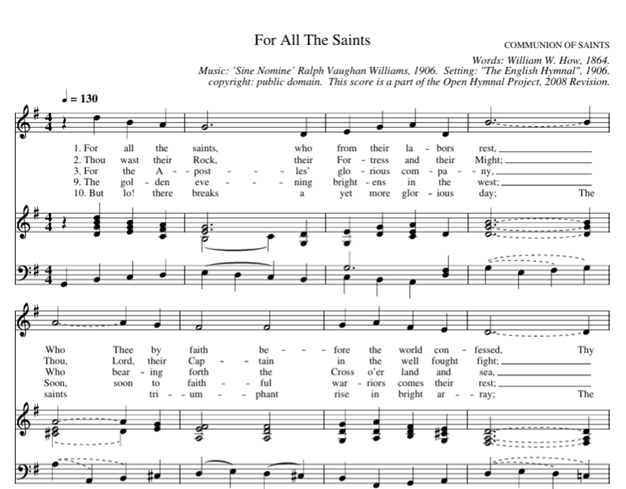
Sometimes congregations sing When the Saints Go Marchin’ In, although it’s never very pretty when a white congregation attempts this number while swaying and clapping on the 1st and 3rd beat.
IYKYK.
Yep. We are singing For All the Saints today as the opening hymn. ⛪
People are strange. That is all.