
You Can Get It At The Library -- But Not Everyone Does

I know it’s fashionable to dump on Jeff Bezos and the Washington Post right now, but the newspaper ran an article a couple of weeks ago about public libraries that I think you’ll find interesting. I am a lifelong fan of libraries. Some of my earliest memories involve trips to the library in the afternoon after school or on Saturdays. I usually visit my public library once every couple of weeks or so, I volunteer at a local genealogy library about one day a week (on average) (that’s where I am right now as I’m writing this), and I also volunteer at the Library of Virginia in Richmond several days a month.
The article focuses on a YouGov survey done for the Post earlier in the year asking all kinds of questions about who uses libraries.
But before you can understand a survey, you have to know the methodology employed. This is hardly ever available in the body of a newspaper article reporting the survey results, but you should be able to find this information if you dig a bit. Here’s what the Post tells us about this survey.
This was an online survey of 2,2 49 adult citizens conducted from April 17 to 23 with a full-sample margin of error of +/- 2.5%. Respondents were selected from YouGov’s opt-in Internet panel using sample matching.
A random sample (stratified by gender, age, race, education, geographic region, and voter registration) was selected from the 2019 American Community Survey. The sample was weighted according to gender, age, race, education, 2020 election turnout and Presidential vote, baseline party identification, and current voter registration status.
Demographic weighting targets come from the 2019 American Community Survey. Baseline party identification is the respondent’s most recent answer given prior to November 1, 2022, and is weighted to the estimated distribution at that time (33% Democratic, 31% Republican). The weights range from 0.054 to 6.51, with a mean of one and a standard deviation of 0.75.
When you follow all the crosstabs, you can draw a few conclusions. Top library users — those most likely to visit at least monthly — include adults under age 30, folks who attend religious services at least once a month, and Democrats. I’m going to provide the graphs the authors of the article used to present their major conclusions, with a few comments along the way to mark the things that stood out to me. You’ll make your own observations and draw your own conclusions.
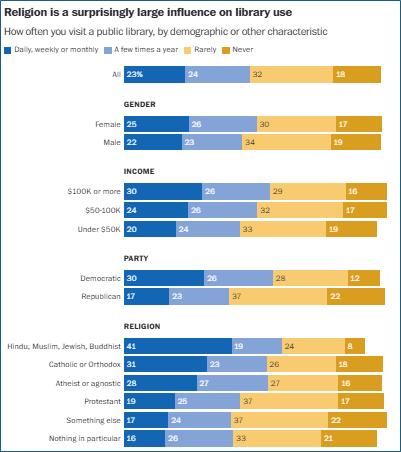
I’m a little dismayed that only about 25% of respondents to the survey visit the library regularly. Women are slightly more likely than men to use a public library. Interestingly, people with higher incomes use the library more than low-income folks. This is a bit surprising, as I think of libraries as a ‘great equalizer.’ It looks like I’m wrong about that. Democrats are substantially more likely than Republicans to use the library (imagine that!). Catholics use the library more than Protestants, but they both are outperformed by Hindu, Muslim, Jewish, or Buddhist people. Atheists and Agnostics fall (appropriately, I think) in the kind of wishy-washy middle.
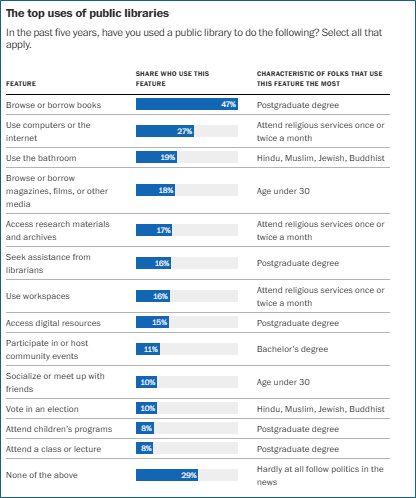
This question asks respondents to provide a yes/no question about how they have used the public library in the past five years. They could check as many of the boxes as they wanted. Then the survey organization identified the group that used this feature the most.
I’m not sure what this tells us. I could have checked all of the boxes except voting and attending children’s programs. I’m also unclear what it means that Hindus, Muslims, Jews, and Buddhists are more likely to have used a library restroom. This whole question proves, I think, that data does not equal useful information.
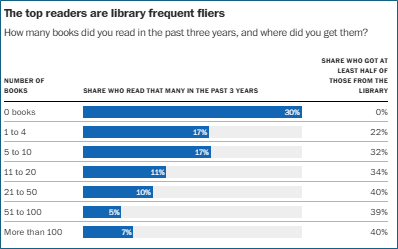
This chart tells us that people who read the most are also more likely to get their books from the library. The first things that’s shocking is that 30% of the people WHO RESPONDED TO A SURVEY ABOUT PUBLIC LIBRARIES admitted that they had read NO BOOKS in the past three years. Of the 7% of respondents who reported reading more than 100 books over the past three years (I plead guilty, your honor!), 40% said they got at least half of those from the library. I fall into this category, although I get an increasing number of books for my Kindle from free books available through Amazon Prime.
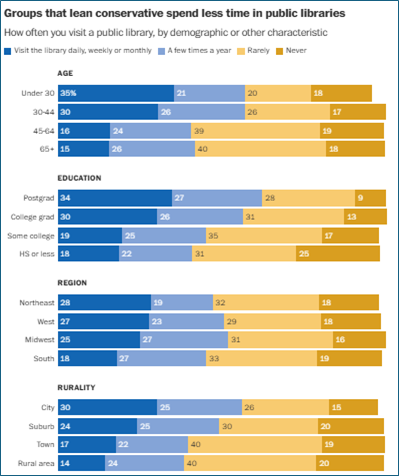
This chart tells us that heavy users of public libraries are young highly-educated individuals living in northeastern cities. I think this probably encapsulates a lot of information where the crosstabs would be more revealing than the gross results.
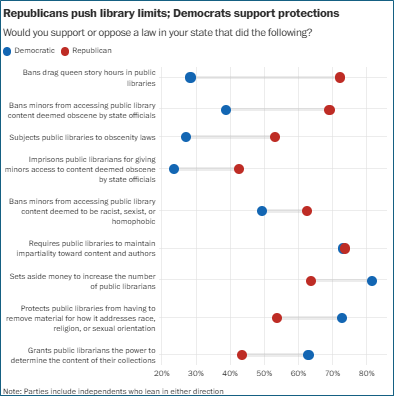
Although Republicans are, overall, less likely to patronize their public library, they are very interested in controlling what goes on there. They want to limit what individuals can do at the library, remove material they deem offensive, and cut their funding.
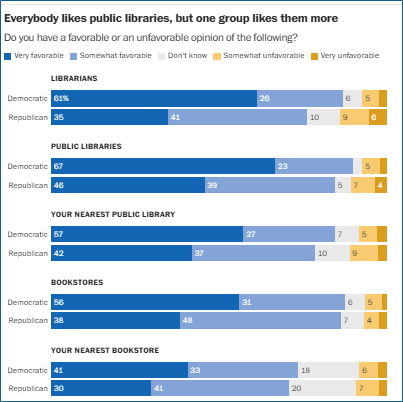
This chart just confirms the earlier conclusion: everyone has a generally favorable opinion about libraries, librarians, and bookstores, but Democrats just like them more.
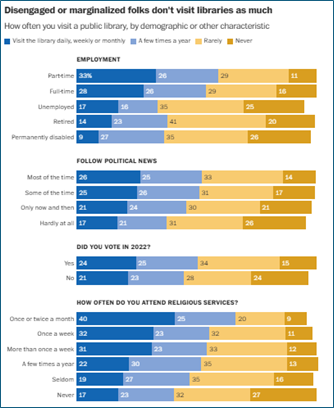
The only thing that surprised me about this chart was that retirees rank low in the rate at which they visit libraries. I live in a town with lots of retirees and it seems like they’re all at the library all the time. But it may be that I see them there because I’m there.
What do you all think about all of this?
All of this reminds me that I haven’t actually been to the library for a month or so. That’s unusual, and I need to get back there. I’m probably missing something.
Funny ... as a child I loved the library. I think it was college that ruined it for me - too much time spent studying there perhaps. BUT, I love their electronic books! An eye "issue" several years ago made reading on paper difficult, but reading on my Kindle is paradise, and I love the electronic library dearly. I can research, reserve and check out almost any book I want, then read and return it ... all from the comfort of my recliner. If your library has it, try it. If not, get a card at the Henrico County system and enjoy our books to your heart's content.
I'm feeling more and more that surveys doesn't give me much helpful information. Especially the political ones. The samples are so small and responses low so that weighting us used.
Wondering about your comment " Atheists and Agnostics fall (appropriately, I think) in the kind of wishy-washy middle." Maybe it's because I know so many and identify, but my experience is they are curious and big readers. It may be they purchase books rather than use the library.
Fashionable or not, I cancelled my subscription to WP in response to Jeff Bezos's cowardice. I do like they have written numerous articles supporting Harris and against P01135809. But he let himself and the paper be intimidated.