
Who Knew?

Like many of you, I learned last night that there is a court called the United States Court of International Trade. We learned about this court when we heard that it had called an “oopsie” on the tariff announcements of the current Republican president.
Paul Krugman's Substack this morning provides a good explanation of the tariff ruling, so I recommend you read it.

When I first heard about this ruling last night, I Googled around a bit to see what I could find out about this court. What follows is what I found out; there’s probably more to know, but this will work for today.
The United States has a Dual Court System
First, some basics. Our Federal system (separate powers for the states and the federal government) means that we have two court systems. In general, if you break a federal law, you are in federal court. If you break a state law, you are in state court. Article I, Section 8 of the Constitution lays out the areas in which the federal government has jurisdiction; the 10th Amendment says that any power not given to the federal government belongs to the state. Over the past couple of centuries, these sometimes overlapping jurisdictions have been sorted out by the courts. Because the Constitution doesn’t provide specific guidance for things the people who wrote it couldn’t have known about, this is an ongoing process.
The Federal System is Hierarchical
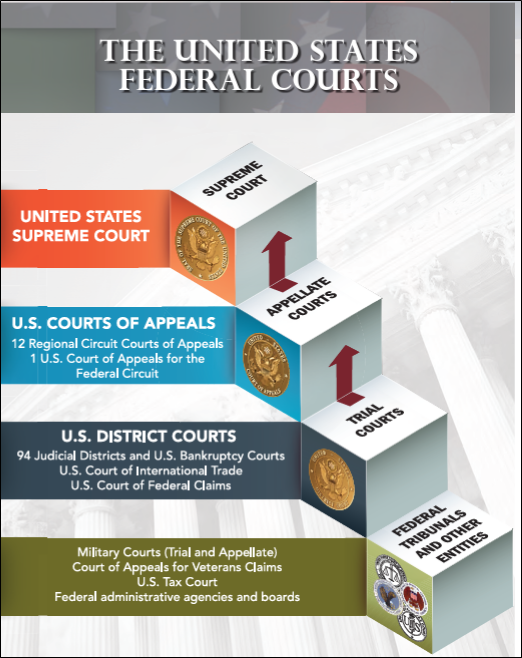
I found this graphic in a document I looked at this morning. Here’s the link to the document so you can read it for yourself. https://www.uscourts.gov/sites/default/files/understanding-federal-courts.pdf
For my purposes this morning, ignore the lowest step on this staircase. Look instead at the next step – the United States District Courts. These are the trial courts in the federal system – the courts where evidence is presented, witnesses testify, and either judges or juries adjudicate the guilt or innocence of the people before them. You’ll see the U.S. Court of International Trade as structurally on par with U.S. district courts, although it does not have a geographic district. It is located in New York City, but it hears cases from across the country and can sit anywhere in the country as needed. It has exclusive jurisdiction over civil actions arising out of United States customs and international trade laws, including the following:
Customs duties
Import/export regulations
Tariff classification
Trade embargoes
Anti-dumping and countervailing duties
Actions against the US government relating to trade agreements
The next step shows you the 13 Courts of Appeal – the 12 geographically-determined courts and the one U.S. Court of Appeals for the Federal Circuit. This latter court will hear the appeal of last night’s ruling from the current Republican administration.
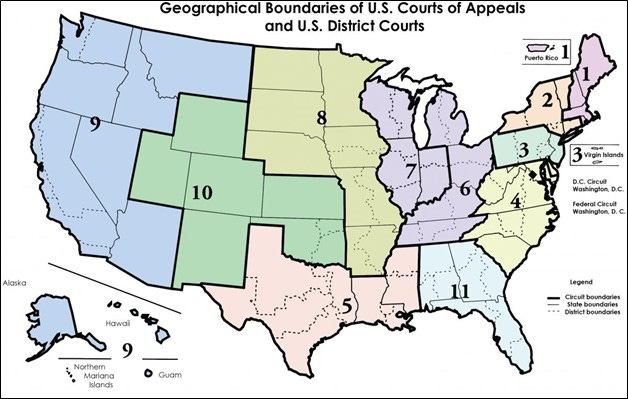
This map shows the 12 geographically based Circuit (appeals) courts. The 94 district (trial) courts are shown by the dotted lines within the states. Every state has at least one trial court (Utah, for example). Other states have multiple trial courts (based on population. California and Texas both have four federal district (trial) courts.
The U.S. Court of Appeals for the Federal Circuit meets in Washington, D.C., where it handles a variety of cases originally heard in lower specialized courts like the U.S. Court of International Trade.
What happens now
Yesterday’s decision was handed down by a three-judge panel taken from the nine judges that sit on the U.S. Court of International Trade. These judges include one chosen by President Reagan, one chosen by President Obama, and one chosen by the current Republican President during his first term.
The legal team for the current Republican administration obviously anticipated this action, as they filed a notice of appeal almost immediately after the ruling was issued. The appeal will be heard by the U.S. Court of Appeals for the Federal Circuit in Washington. This court has 12 active judges. Although they normally sit in panels of three, the court can also sit en banc (all 12 judges together) for important cases.
White House economic advisor Kevin Hassett has said that there are three trade deals “nearly done” and that he expects more despite the court ruling, which he dismissed as the work of “activist judges.” However, legal experts and analysts have expressed skepticism about the administration’s prospects on appeal. The court’s decision that the administration had manufactured the “unusual and extraordinary threat” required by the underlying statute. In addition, the court ruled that significant economic policy decisions require clear congressional authorization.
The court’s ruling gave the White House a 10-day deadline to complete the bureaucratic process of halting the tariffs. John Leonard, a former top official at the US Customs and Border Protection Agency, told reporters that there won’t be any changes at the border for now, and that tariffs will still have to be paid. If the ruling is upheld, businesses that have had to pay tariffs will receive refunds on the amounts paid, with interest. That sounds complicated.
Good one. I’ve wondered about these districts, so of course, I love the map.