
Weekend Update: Trump’s Performative Imperialism

The nations of the world periodically recognize that people across the globe are generally happier and more prosperous when they live in peace. That does not mean that wars are an anomaly – on the contrary, people generally believe that peace will be a good thing ONCE THEY ACHIEVE THAT ONE LITTLE GOAL that stands in their way.
The Pax Romanica (Roman Peace) refers to approximately 200 years during the height of the Roman Empire, from 27 BCE to 180 CE. Having achieved its desired territorial expansion, Rome spent these two centuries consolidating its control over the territories it had acquired, facilitating trade through the development of infrastructure like roads and aqueducts, and maintaining law and order under Roman Law.
We should note that this was also the era in which the Romans executed an upstart, brown-skinned religious zealot in Judea, one of the areas they had previously conquered and where they were now consolidating their power. Not so paxful.
The Pax Britannica (British Peace) refers to approximately 100 years, from 1815-1914, when the British were the world’s dominant global power. The Royal Navy ensured freedom of the seas – on British terms, of course – and helped maintain relative peace among the world’s major powers, stimulating trade and industrialization.
We should note that this was also the era in which anti-colonial conflicts occurred across the world – most specifically in Latin America. Not so paxful.
The Pax Americana (American Peace) refers to approximately 75 years, from 1945 to the present (kind of), when the United States emerged as the dominant global superpower after World War II an led the effort to establish international institutions like the United Nations, the International Monetary Fund, and the World Bank.
We should note that maintaining the Pax Americana led the United States to intervene in conflicts. The Cold War and various regional interventions (Korea, Vietnam, Iraq, Afghanistan) regularly interrupted this Pax. Not so paxful.
I’ll add to this something I’m calling the Pax ob absentiam discordiae religiosa (thanks, ChatGPT) after the European Wars of Religion, a period of 150 years or so where a series of conflicts, primarily driven by religious divisions between Catholics and Protestants, devastated European regimes and killed hundreds of thousands of people. These events were among the factors that created an Enlightenment urge to separate the church from government. Rather than draining their treasuries and killing off their people, European rulers began to realize that it didn’t make sense to go to war over issues that could not be settled this side of the grave.
All of this leads me to the soon-to-be-POTUS and his Performative Imperialism. I won’t go into the details here – they are nauseatingly available wherever you get your news.
Many people are warning against listening to his nonsense. It’s a distraction, they say. They implore us to watch what he does, not what he says. These are valid points. But they are not the only points worth making.
Since the end of the Second World War, the international community has rallied against invasions by one nation against another. But invasions occurred anyway, and it didn’t always work out well for the invading country. Here is a list of some of these invasions for you to think about:
1950s:
North Korean Invasion of South Korea
Chinese Invasion of Tibet
Soviet Invasion of Hungary
Israeli Invasion of Egypt (Suez Crisis)
1960s:
Indian Invasion of Goa
North Vietnamese Invasion of South Vietnam
Six-Day War (Israel/Egypt)
1970s
Pakistani Invasion of Bangladesh
Turkish Invasion of Cyprus
Vietnamese Invasion of Cambodia
Soviet Invasion of Afghanistan
1980s
Iraqi Invasion of Iran
Argentine Invasion of the Falkland Islands
U.S. Invasion of Grenada
U.S. Invasion of Panama
1990s
Iraqi Invasion of Kuwait
Rwandan Invasion of Congo
NATO bombing of Yugoslavia
2000s
US-led Invasion of Afghanistan
US-led Invasion of Iraq
Russian invasion of Georgia
2010s
Russian Annexation of Crimea
Saudi-led Intervention in Yemen
Turkish Invasions of Syria
Azerbaijan-Armenia Conflict
Russian Invasion of Ukraine.
The commonality among these events is that invasions and interventions don’t end conflict – they begin it. Some of these invasions (Iraq and Afghanistan, for example) led to years of warfare involving American troops and armaments. Defense budgets rose to support these conflicts.
MAGA voters believed Trump’s promises to end foreign wars. They must be a bit flummoxed by the current noise about starting new ways in places they really don’t care about, like Greenland and Panama.
The soon-to-be POTUS is threatening to invade or in some other fashion take control of Panama, Greenland, and Canada (as of this writing). This may be performative, but it is profoundly unsettling to the other nations of the world. The United States has the military and economic power to do what Trump is threatening, and the world doesn’t trust the upcoming administration to behave rationally.
The United States was expansionist from its earliest years, officially joined the empires of the world in the second half of the 19th century and continued its expansionist ways through the early years of the 20th century.
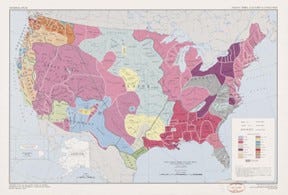
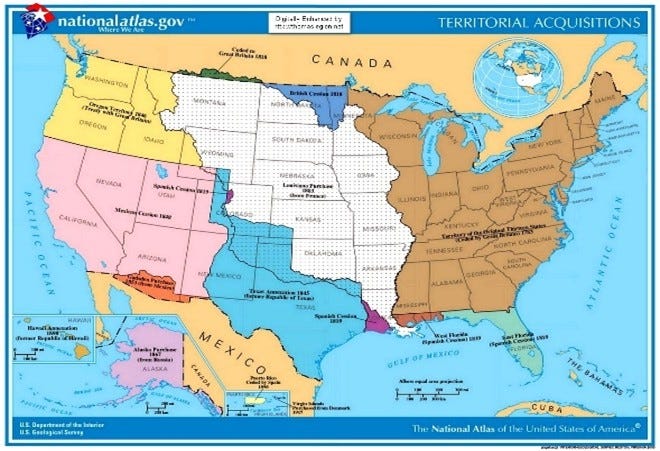
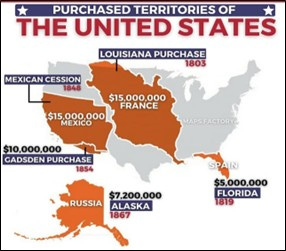
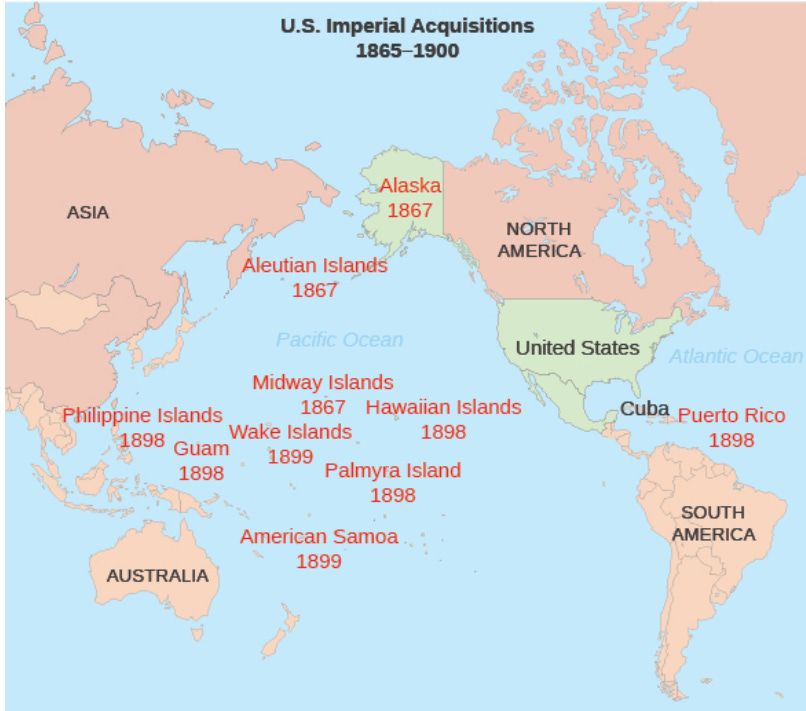
Trump worships President William McKinley, partly because of the unbridled and unregulated capitalism of the McKinley era but also because McKinley presided over the acquisition of America’s foreign empire. After McKinley’s death, William Howard Taft (Teddy Roosevelt’s Governor-General in the newly-acquired Philippines) famously referred to Filipinos as our “little Brown Brothers.” Trump would fit right in with this crew. In Trump’s mind, it has to be the greatest indignity that Roosevelt is on Mt. Rushmore and not McKinley. Trump’s bootlickers often post images of Mt. Rushmore with his head added.


This post is already too long, but I need to add one more point: Trump’s Performative Imperialism has real-world consequences. Several NATO nations have warned against any US aggression toward Greenland, promising to invoke Article 5 of the NATO charter to combat the United States. Panama has promised retaliation (probably in the form of denying the US access to the canal), and Canada has promised retaliatory tariffs.
And suppose he somehow “wins” – not by taking Canada or Panama, but perhaps by buying enough influence in Greenland to put the United States in charge. I want to remind you of the Pottery Barn Rule enunciated by Colin Powell in 2002. He was referring to the proposed US invasion of Iraq, saying:
"You are going to be the proud owner of 25 million people," he told the president. "You will own all their hopes, aspirations, and problems. You'll own it all." Privately, Powell and Deputy Secretary of State Richard Armitage called this the Pottery Barn rule: You break it, you own it.”
If the US under Trump “breaks” the current situation in Greenland, he owns it – all of it. The Russian and Chinese ships that will transit the Arctic more regularly as the polar ice cap melts? The United States will have to beef up its military presence in Greenland to deter any aggression from these powerful nations.
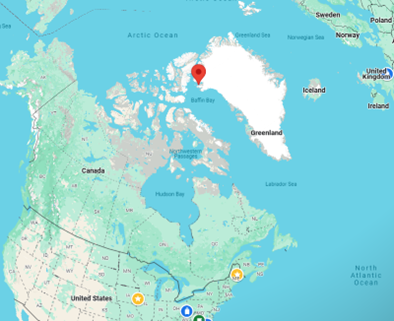
Since 1951, the United States has maintained a minimal air base at Thule. It is currently home to a Ballistic Missile Early Warning System operated by the U.S. Space Force. It also supports space operations by tracking satellites and space debris. The base includes runways capable of handling large aircraft, a port, and various support buildings. It operates year-round despite extreme weather conditions
About 800 US military personnel are stationed at the base, serving 24-month unaccompanied tours. The average winter temperature ranges from a high of -7 degrees to a low of -19 degrees. In the summer, the temperature rises to a balmy 46 degrees.
If the US somehow came to own Greenland, the American military presence there would have to expand. As climate change melts portions of the Arctic icecap, this waterway is expected to become a popular shipping lane, increasing its geopolitical significance. Any perceived threat to Greenland from Russia or China would be a threat to the United States and a spark for frequent hostilities — and perceived threats will become more common as shipping increases in the region. Think Fulda Gap with ice.
MAGA famously wants to pursue “America First,” which in their minds means isolationism. Acquiring Greenland would be the antithesis of this. DOGE also plans to cut government spending. These actions would increase it. It doesn’t make sense. But we should not expect Trump to make sense. We should accept, however, that he will be dangerous.
Despot. He's played Monopoly. Now he thinks it's time for Risk, the game of global domination. He is our country's ruination.
Great historical overview. Trump's longtime blackmailer & enabler Czar Putin is of course loving this tension - especially any talk of war among NATO members - regardless of what happens from here with Greenland.