
Weekend Update: History Doesn't Repeat Itself -- But It Often Rhymes
Mark Twain (probably)

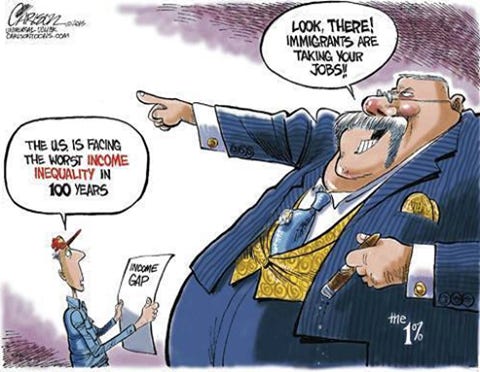
As we move into the {{shudder}} second Trump administration, it’s hard to ignore the similarities between today and the Gilded Age in America – the time between the end of the Civil War and 1900. America was experiencing the combined tension of recovering from the Civil War and embracing rapid technological change. Trump has embraced the ethic of the Gilded Age, with its monopolists, robber barons, and downtrodden labor force. He fancies himself the rightful heir to the earlier era’s Rockefeller, Vanderbilt, and Carnegie.
We should remember that the ‘Gilded Age’ moniker was not intended in a positive sense. It does not mean a ‘Golden Age;’ gilding is a thin veneer of gold leaf applied to an exterior to make something look more valuable than it really is.
Historians know that the excesses of the Gilded Age led to the rise of the progressive movement, which ultimately found its greatest expression in Roosevelt’s New Deal in the 1930s. That should give hope to all people (like me) who want to see the United States evolve into the fairer, kinder, and more inclusive society we know it can be. The thought that it could take 50 years, however, is daunting. The 77-year-old me won’t see this happen. So where are we, in comparison to the Gilded Age? Are things as bad now as they were then? What are the odds that I’ll see a turn for the better?
The Gilded Age (approximately 1870s-1900) and the first Trump Administration (2017-2021) exhibit some striking parallels, particularly in their economic policies, political dynamics, and social impacts. The second Trump Administration seems prepared to double down on the trends enabled the first time around.
Here are key areas of comparison:
Economic Policies and Wealth Disparities
Pro-Business Policies:
Gilded Age: The period was marked by laissez-faire economics, minimal government interference, and rapid industrialization. Policies favored large corporations and the wealthy, often at the expense of workers and smaller businesses.
First Trump Administration: Significant corporate tax cuts (e.g., the 2017 Tax Cuts and Jobs Act) aimed to stimulate economic growth but disproportionately benefited corporations and wealthy individuals.
Second Trump Administration: Plans to extend the 2017 Tax cuts and cut the corporate tax rate even further, from 21% to 15% for companies that manufacture products in the US. There are discussions about decreasing capital gains taxes
Wealth Inequality:
Gilded Age: The era saw the rise of "robber barons" like Rockefeller and Carnegie, who amassed vast fortunes, while many workers lived in poverty.
First Trump Administration: Wealth disparities widened, with the wealthiest Americans increasing their share of national wealth due to policies that favored capital gains, stock market growth, and deregulation.
Second Trump Administration: With the installation of his band of oligarchs in the cabinet (at least eight billionaires so far), the policies of the administration will bend even further in favor of the wealthy.
Populism and Political Rhetoric
Populist Appeal:
Gilded Age: Populist movements like those led by William Jennings Bryan arose, advocating for farmers and laborers against industrial elites.
First Trump Administration: Trump’s rhetoric appealed to disaffected working-class voters, positioning himself as an outsider challenging the “establishment” and “elites.”
Second Trump Administration: Trump and his allies (think Kash Patel) have an ‘enemies list’ of people they wish to prosecute in his second term in office.
Division and Partisanship:
Gilded Age: Politics were deeply divided, with intense partisanship and corrupt practices like patronage systems.
First Trump Administration: Polarization reached historic levels, with sharp divides between Democrats and Republicans. Accusations of corruption and cronyism paralleled the patronage and nepotism of the earlier era.
Second Trump Administration: The veneer of bipartisanship is gone entirely. Trump vows to ‘jail’ anyone who opposes him, including political adversaries and media outlets.
Labor and Workforce Dynamics
Labor Unrest:
Gilded Age: The period saw major labor strikes (e.g., the Pullman Strike, Haymarket Riot) as workers protested low wages, poor conditions, and lack of rights.
First Trump Administration: While labor unrest was less pronounced, issues like stagnant wages, gig economy exploitation, and debates over union power highlighted worker dissatisfaction.
Second Trump Administration: Trump’s plans to deport vast numbers of immigrants will cripple agriculture and industry.
Immigration and Labor Markets:
Gilded Age: Waves of immigration provided cheap labor but led to xenophobia and restrictive policies, such as the Chinese Exclusion Act.
First Trump Administration: Immigration became a focal point, with policies like the travel ban, family separation at the border, and reduced legal immigration pathways.
Second Trump Administration: The focus on mass deportations of immigrants (including people who may be here legally) will ramp up violence on the borders and generate labor shortages that will make it difficult to support the kind of capital investment Trump supports to renew American manufacturing.
Corruption and Ethics
Government and Corporate Ties:
Gilded Age: Close ties between politicians and industrialists led to widespread corruption (e.g., Credit Mobilier scandal, political machines).
First Trump Administration: Critics pointed to conflicts of interest, alleged misuse of public office for personal gain, and the revolving door between industry and government officials.
Second Trump Administration: The incoming administration seems to be paying little attention to conflicts of interest. Trump is selling branded merchandise (shoes, perfume, pieces of his clothing) while his family members are negotiating deals with foreign countries (Eric, Jared). He is literally asking people to send him money if they want his to support their preferred policies.
Regulatory Oversight:
Gilded Age: Regulatory agencies were either nonexistent or heavily influenced by industrialists.
First Trump Administration: Deregulation efforts, particularly in environmental protections and financial oversight, often benefited large corporations.
Second Trump Administration: The Department of Government Ethics (DOGE) is focused on eliminating wasteful spending in government. With no official existence other than a Twitter (X) feed, this non-Department non-Government entity will focus on cutting money where it will get the most attention rather than ferreting out and eliminating real fraud, waste, and abuse
Media and Public Opinion
Sensationalism and Propaganda:
Gilded Age: The rise of yellow journalism amplified sensationalist narratives, influencing public opinion.
First Trump Administration: Social media played a comparable role, amplifying divisive rhetoric and misinformation, often weaponized for political gain.
Second Trump Administration: A total rightwing media infrastructure creates its own reality, making reasoned decision-making virtually impossible. Right now, anyone who says anything negative about a potential Trump nominee or policy is threatened by the wealthiest man in the world, Elon Musk, with a funded primary challenger in the next election.
Distrust in Institutions:
Gilded Age: Public trust in government and business institutions eroded due to corruption and exploitation.
First Trump Administration: Distrust in media, government agencies, and elections became a central theme, with Trump frequently undermining institutional credibility.
Second Trump Administration: Lather, rinse, and repeat. No institution is safe against the fervor of Trump supporters. Public schools, the military, banks, the PTA – all are under attack if they express opinions he doesn’t like.
Cultural and Social Impacts
Nativism and Social Tensions:
Gilded Age: Anti-immigrant sentiment and social Darwinism fueled racial and ethnic tensions.
First Trump Administration: Nativist policies and rhetoric targeted immigrants and minorities, exacerbating social divisions.
Second Trump Administration: An expansion of nativism targeted immigrants and minorities – even those who are here legally and have been here for a long time. It is uncloaked and socially approved racism, pure and simple.
Rise of a "New Elite":
Gilded Age: Industrial magnates shaped society, culture, and philanthropy.
First Trump Administration: Wealthy business leaders and Silicon Valley elites gained increasing cultural and political influence, akin to the industrial titans of the past.
Second Trump Administration: Add a layer of South African tech bros – Musk, David Sacks (Paypal), and Peter Thiel (also Paypal and J.D. Vance mentor), who bring an apartheid sensibility and enormous wealth to Trumpism.
Overall Environment
International Context
Gilded Age: The United States was emerging from its isolationist past to become a major global actor — the most powerful global actor in the coming 20th century
First Trump Administration saw the shift toward American isolationism, with an emerging mentality against alliances, including NATO
Second Trump Administration will be staffed by people who are even more isolationist than the first time around,
Technological Innovation
The Gilded Age was a period of massive industrial growth that fundamentally changed the relationship among the primary factors of production – land, labor, and capital.
First Trump Administration saw shifts to a post-industrial, service-oriented economy which required adjustment to the Gilded Age models.
Second Trump Administration faced the emergence of AI Technology that will create problems no one understands yet and will require integrated and nimble reactions from national and global government and private businesses.
So the answer, my friends, is not positive. The problems America faces are bigger than the problems faced during the Gilded Age and will take a longer consolidated effort to solve, I fear. Things may turn around and start to improve, but I’m not likely to see it.
Or as a friend once said to me "Never give up on America." I haven't yet. That doesn't mean I'm not apprehensive about our future, though. We must continue to push back against those who do not serve their country, but themselves.
“It is during our darkest moments that we must focus to see the light.”
Aristotle