
We Can’t Be Distracted
Weedend Update

The National Divorce occupied our attention at the end of last week, and over the weekend we were all ensnared by the story about the National Guard in California, the threatened use of the Marine Corps to assist the National Guard, and the images of tanks entering Washington to be in place for the parade next Saturday – and, oh yeah, to be ready to go into action in case someone in the Oval Office wants to invoke the Insurrection Act or impose Martial Law (you know, since the tanks will already be in place. Be a shame not to use them.)
We can be forgiven for losing track of the One Big Beautiful Bill, the stench of which is still hovering over Congress. Today, I want to focus on only one part of it—the proposal to impose work requirements on able-bodied adult individuals between the ages of 19 and 64 who are recipients of Medicaid benefits.
A few definitions first:
Medicaid – offers free or low-cost medical care to individuals who fall below a certain income level.
Medicare – offers low-cost medical care to retired individuals (and people in a few other categories.
I used to give my students a somewhat impolitic mnemonic to remember how to distinguish between these programs:
Medicare ain’t got no hair.
Medicaid ain’t been paid.
You can thank me later.
At first glance, work requirements for adult able-bodied people wishing to access Medicaid sound reasonable. Why should taxpayers pay the medical bills for someone who isn’t doing anything to earn the money to pay their own bills?
But, as always, the devil is in the details. You’ve probably heard or read pieces of these details, but I’m going to summarize a few things here. Numerous studies have shown three things:
Most able-bodied adults on Medicaid either are in exempted categories or are already employed
Work requirements have not worked where they have been tried – either the costs of imposing the work requirements exceeded the savings achieved by eliminating people from the Medicaid rolls, or the people who were deemed employable (and therefore ineligible for Medicaid) were not able to find jobs that provided health insurance
People eligible for Medicaid lost their health insurance because of bureaucratic snafus.
You’ve seen the stats, but let me remind you. Some groups are already exempt – people over a certain age (like 60 or 65), pregnant women, full-time caregivers for children or disabled relatives, people with disabilities, those medically certified as unable to work. When you factor in these exempt categories, you find that around 60%-65% of non-exempt adult Medicaid recipients are already working. Another 25-30% are in school, caregiving full-time, experiencing health-related barriers to work, or actively looking for work. This leaves about 6-7% who are neither working nor formally exempt. This percentage is the primary target of work requirements policies.
Now let’s look at the realities of low-income employment.
Many jobs pay so little that workers in those positions still qualify for Medicaid. For example, in a state that expanded Medicaid under the Affordable Care Act (Obamacare), a single adult earning up to around $20,000 per year or a family of four earning up to $43,000 per year is still eligible for Medicaid.
People who work in unstable, low-wage, seasonal, or part-time jobs may not be able to find additional work (or have time to take additional jobs) to be able to pay for health insurance.
Many employers of low-income or part-time workers do not offer health insurance to their employees. A Kaiser Family Foundation found that in 2023 only 31% of low-income workers were offered health insurance by their employers and that less than 20% actually enrolled, due to high premiums, deductibles, or waiting periods up to a year before benefits kicked in. The same study showed that fewer than 25% of part-time workers have access to employer-sponsored coverage. In addition, employers with fewer than 50 full-time workers are not required to offer health insurance. When all the numbers are taken into account, roughly ¾ of low-income or part-time workers don’t have access to employer-offered health insurance.
Additional paperwork requirements will inevitably lead to eligible recipients losing their Medicaid coverage. The OBBB Act as currently worded requires states to verify compliance with work requirements monthly (by submitting work or training hours), and re-evaluate every six months (by completing a full re-determination of the recipient’s status (e.g., pregnant woman previously exempt is no longer pregnant).
At the same time that the paperwork requirement will increase if work requirements were imposed, the ability of HHS and state-level offices to deal with the paperwork had decreased. Roughly 10,000 HHS employees have been laid off – about 12% of the staff. DOGE has taken over internal systems essential to Medicaid operations. The Medicare-Medicaid Coordination Office (MMCO) has lost at least 1/3 of its staff – who handle complex dual-eligibility cases (like poor disabled old people). Reports from state-level surveys show that when grant and coordination staff are removed, processing slows, appointments are delayed, and backlogs form.
Like everything else, the disruptions to Medicaid coverage will hit hardest on the most vulnerable – those whose exemptions will make it most difficult for them to keep up with the paperwork required to maintain their eligibility status. The need to endure long wait times on the phone, make in-person visits to (often-shuttered) offices to resolve problems, cope with inferior cell-phone or wifi coverage, or navigate complex “for technical problems, press Number 1” options will mean that many eligible recipients (many with lower levels of education and less tech skill) will lose their coverage.
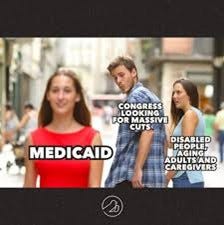
There is little evidence that work requirements do anything but kick eligible people off the Medicaid rolls while increasing costs. So why are these requirements in the bill? Because the current Republican party and its elected leaders, including the current Republican President, have never met a talking point they didn’t like. From Reagan’s 1980s welfare queen to today’s freeloader, the meme is the point.
Congress’s problem is that the current Republican administration is led by someone who doesn’t know how government works and doesn’t care to learn. He wants to curry favor with his wealthy donor base, and the way he wants to do this is by extending his 2017 tax cuts. This policy decreases government revenues and thus, under the terms of reconciliation (the process the GOP is using to shove this bill through Congress), the budget proposal has to be revenue-neutral. Just like gangster Willie Sutton said he robbed banks “because that’s where the money is,” the GOP robs social programs like Medicaid and SNAP because they make up a huge amount of government spending. There is no way to cut the budget to fill the projected deficit without cutting Medicaid.
“The fault, dear Brutus…..”