
War Powers

The United States Constitution (1787) is vague about a lot of things – it’s only about seven pages long so it can’t go into much detail – so it should not surprise us that it is also vague about what parts of the government have control over whether the United States goes to war and who controls the sequence of events during a war – including the treaty to end it.
Article I, Section 8 of the Constitution spells out the power of Congress (the bold-faced words relate to defense or war-making powers):
The Congress shall have Power To lay and collect Taxes, Duties, Imposts and Excises, to pay the Debts and provide for the common Defence and general Welfare of the United States; but all Duties, Imposts and Excises shall be uniform throughout the United States;
To borrow Money on the credit of the United States;
To regulate Commerce with foreign Nations, and among the several States, and with the Indian Tribes;
To establish an uniform Rule of Naturalization, and uniform Laws on the subject of Bankruptcies throughout the United States;
To coin Money, regulate the Value thereof, and of foreign Coin, and fix the Standard of Weights and Measures;
To provide for the Punishment of counterfeiting the Securities and current Coin of the United States;
To establish Post Offices and post Roads;
To promote the Progress of Science and useful Arts, by securing for limited Times to Authors and Inventors the exclusive Right to their respective Writings and Discoveries;
To constitute Tribunals inferior to the supreme Court;
To define and punish Piracies and Felonies committed on the high Seas, and Offences against the Law of Nations;
To declare War, grant Letters of Marque and Reprisal, and make Rules concerning Captures on Land and Water;
To raise and support Armies, but no Appropriation of Money to that Use shall be for a longer Term than two Years;
To provide and maintain a Navy;
To make Rules for the Government and Regulation of the land and naval Forces;
To provide for calling forth the Militia to execute the Laws of the Union, suppress Insurrections and repel Invasions;
To provide for organizing, arming, and disciplining, the Militia, and for governing such Part of them as may be employed in the Service of the United States, reserving to the States respectively, the Appointment of the Officers, and the Authority of training the Militia according to the discipline prescribed by Congress;
To exercise exclusive Legislation in all Cases whatsoever, over such District (not exceeding ten Miles square) as may, by Cession of particular States, and the Acceptance of Congress, become the Seat of the Government of the United States, and to exercise like Authority over all Places purchased by the Consent of the Legislature of the State in which the Same shall be, for the Erection of Forts, Magazines, Arsenals, dock-Yards, and other needful Buildings;—And
To make all Laws which shall be necessary and proper for carrying into Execution the foregoing Powers, and all other Powers vested by this Constitution in the Government of the United States, or in any Department or Officer thereof.
Article II, Section 2 spells out the power of the President
The President shall be Commander in Chief of the Army and Navy of the United States, and of the Militia of the several States, when called into the actual Service of the United States; he may require the Opinion, in writing, of the principal Officer in each of the executive Departments, upon any Subject relating to the Duties of their respective Offices, and he shall have Power to grant Reprieves and Pardons for Offences against the United States, except in Cases of Impeachment.
He shall have Power, by and with the Advice and Consent of the Senate, to make Treaties, provided two thirds of the Senators present concur; and he shall nominate, and by and with the Advice and Consent of the Senate, shall appoint Ambassadors, other public Ministers and Consuls, Judges of the supreme Court, and all other Officers of the United States, whose Appointments are not herein otherwise provided for, and which shall be established by Law: but the Congress may by Law vest the Appointment of such inferior Officers, as they think proper, in the President alone, in the Courts of Law, or in the Heads of Departments.
The President shall have Power to fill up all Vacancies that may happen during the Recess of the Senate, by granting Commissions which shall expire at the End of their next Session.
The Tenth Amendment muddies the waters a bit:
The powers not delegated to the United States by the Constitution, nor prohibited by it to the States, are reserved to the States respectively, or to the people.
This doesn’t seem too troublesome – until you compare it with the language of the last clause of Article I, Section 8. That clause basically says that Congress can extend its jurisdiction to pass laws that are ‘necessary and proper’ even if they aren’t specifically identified in the rest of Article I, Section 8. In other words, Congress may still be able to pass laws on a topic that is not specified in the constitutional language. But the Tenth Amendment says that if a power is not specifically granted to the federal government by the Constitution, that power belongs to the states. So Congress may not be able to pass laws on the topic. This is a fundamental source of tension in our constitutional structure. Since the 1920s or thereabouts, the Supreme Court has issued many opinions that have attempted to put meat on the bones of this structure and carve out distinctions that can guide lower courts' decisions.
A current popular theory poses the construct of a Unitary Executive Power – a Chief Executive who is above the law and who can operate the federal government at his will. Although some language in the Constitution gives credence to this reading of the document, history and precedent firmly embed the President in a system of checks and balances that make him just one player, although a player with potentially a great deal of power, in a system intended to control and focus the use of power
Probably the most important decision a leader of any nation makes is the decision to take his country to war. This is an expensive proposition, in terms of money, people, productive capacity, and morale. Although there are times when quick and decisive action is needed in response to fast-moving events, a leader who sets his nation on the path to war without seeking public support for the initiative finds himself isolated and powerless as his country reels in chaos, conflicting motivations, and mistrust.
In our constitutional structure, only Congress has the power to declare war, although the President has the power, under his “Commander in Chief” authority, to take emergency action to take command of the military in response to provocations or threats to national security. The United States has not declared war since World War II, because, absent an obvious threat or shared sense of national emergency, Congress is not eager to issue a war declaration.
In Korea, the United States joined in a UN-led conflict to wrest Korea from forces controlled by Russia. In this Cold War contest, the global superpowers – the US and USSR – fought a proxy war, supported by the UN on the side of the United States, to deny Russia hegemony over Korea and give it a launching pad to extend its control to the weak but recovering nation of Japan in the aftermath of its defeat in World War II. Although the results of this war were unsatisfactory to both sides, it ended with an armistice that is still in effect.
The situation was different in Vietnam. Without going into the deep history of how the US became involved in Southeast Asia in the first place, in the 1950s, by the middle of the 1960s, American troops were on the ground in support of a purportedly ‘free’ South Vietnam that was threatened by a Russia-backed North Vietnam. Depending on how you calculate the beginning and end dates of this war, the United States was involved in specific combat for eight years (1965-1973), although the full Vietnamese conflict (anti-colonial and civil war) lasted from 1945 to 1975.
The 1964 Gulf of Tonkin Resolution was the only Congressional action authorizing warfare against Vietnam. Subsequent Congressional approval for this war was embodied in the budgets that Congress passed, authorizing weapons and personnel expenditures necessary for the conduct of the war. By the end, the war was continued only in a ‘pour good money after bad’ set of policy decisions; the US had already devoted so much money and national prestige toward the conduct of this war that the notion of giving up was inconceivable.
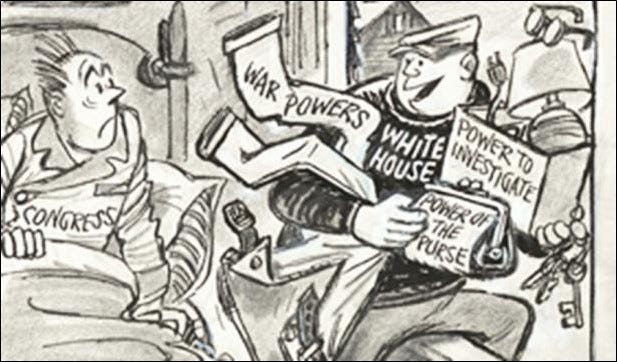
In the wake of the Vietnam War, Congress passed the War Powers Act to reassert its constitutional authority over war-making and prevent another prolonged and undeclared war. This act was passed by Congress over President Nixon’s veto in November 1973. In the House, the override vote was 284-135, and in the Senate, it was 75-18 – strongly bipartisan in both houses and a firm statement that Congress was reclaiming its war-making authority. Nixon argued that it was unconstitutional, but Congress disagreed. Congress won because it had the votes. The Supreme Court has never ruled directly on whether the War Powers Act is constitutional, consistently avoiding the issue by saying that the claimants do not have standing to bring the case or claiming that this is the kind of ‘political question’ that the Court has normally avoided.
The War Powers Act is fairly simple:
The President must notify Congress within 48 hours of introducing US forces into hostilities or situations where hostilities are imminent
If Congress does not authorize the action, the President must end military involvement within 60 days and use up to 30 additional days to safely withdraw troops.
US forces may remain engaged only if Congress declares war of Congress passes a specific authorization for use of military force (AUMF).
The War Powers Act has been activated several times since it was passed in 1973.
In Lebanon in 1983, Congress authorized deployment after reports under the Act
In Kosovo in 1999, Clinton continued operations despite having been denied formal authorization. This was controversial, as you probably imagine.
In Iraq and Afghanistan (2001, 2002), Congress passed AUMFs, which presidents later used broadly.
In Libya in 2011, Obama argued against the application of the War Powers Act because he said that air operations did not constitute hostilities.
In recent decades, Presidents often relied on old AUMFs rather than attempt to pass new ones. Although the 2002 Iraq AUMF was repealed in March 2023, the 2001 Afghanistan AUMF continues to function as a standing de facto war authorization that presidents have used to justify drone strikes, special operations, and counterterrorism missions across multiple countries. It is not an exaggeration to say that this AUMF has functioned as a de facto permanent war authorization.
Last week, the US Senate advanced a war powers resolution aimed at limiting the President’s ability to conduct further military action in Venezuela without Congress’s approval. The vote in the Senate was 52-47 – all Senate Democrats supported it, and five Republican senators broke with the White House to join them. This was a procedural vote – essentially, a preliminary step to bring this resolution to the floor for a final Senate vote. Of course, the House would then have to take up the bill, and given the current fecklessness of Speaker Johnson, he is likely to refuse to bring it to the floor. Then there would have to be a discharge petition to get the bill to the floor. Even assuming that this happens, and that the bill then passes the House, it would go to the President’s desk. He would then veto it. Would Congress be able to pass the bill over the President’s veto, as the 1973 Congress did to Nixon’s veto?
The most likely answer is “no.” Although cracks are appearing in the MAGA armor, the GOP, having painted itself into a corner by its inexplicable fealty to Trump, has no other base of legitimacy. Last week, they failed to override Trump’s veto of a piece of legislation related to water rights in Colorado, even though the House had approved this bill almost unanimously when it first passed through Congress.
So last week’s War Powers resolution will have no direct impact on Trump’s interventionist and illegal foreign policy adventures. But it sends a strong signal that even the GOP can sense the tide turning. After five Republican senators joined the Democrats in reprimanding Trump, he viciously turned on them (because that’s what he does), saying that they should never be reelected. This may come back to bite him in the ass – one of those Republican senators was Susan Collins of Maine, who is on the ballot this year. Her hold on this seat was already endangered – the Democrats have targeted it as a possible flip in November. Voters in Maine supported the Democratic ticket in 2024. This condemnation by Trump – and the likely resultant cowardice of the GOP establishment to risk his wrath by supporting her reelection – could result in the GOP losing a seat they could have won.
In another signal to the GOP, the House approved a 3-year extension of the ACA subsidies last week. Seventeen Republican members of the House supported this legislation – including my Congressman, Rob Wittman. I was surprised and intrigued by his ‘yes’ vote. He is fundamentally a backbencher – his 20 years in Congress have earned him some subcommittee chairmanships and some of the perks of seniority like having access to more desirable office space – but he is never among the gaggle of GOP leaders surrounding Mike Johnson or Gym Jordan. Just a couple of weeks ago, I told a friend that I would believe that Trump’s hold on the GOP was weakening if Wittman broke ranks with MAGA.
Well, bo and lehold – he quietly voted against the House GOP leadership on the ACA subsidies bill.
I’ve said it before and I say it again: the only way we get out of this is by the GOP turning on Trump, either openly or behind closed doors. There is no amount of stellar candidates running magnificent campaigns that can get around the GOP's lying and alternative facts approach to elections and governance. Checks and balances require all institutions to play their part. When the people who control the elements of power that are supposed to provide the counterbalance to avert a slide into tyranny refuse to do their job, the system fails. It really is as simple (and as complicated) as that.
I was having this conversation with a group of friends yesterday, and one of them asked, “Then why are we doing this?” — “this” being getting together to talk about the ongoing dumpster fire around us. This was in the context of yesterday's “Ice Out” demonstrations, including the one in Williamsburg. My response was that we were doing this to continue to let the GOP know that we are watching them and that they will pay electorally unless they wrest control of their party from the MAGA element that is destroying American democracy. The group was generally not satisfied with this argument, but that’s the way it goes.
You are ABSOLUTELY right. We have to keep fighting. We're all tired and frustrated by seemingly constant loss, but the fight has to continue. We cannot simply acquiesce to this authoritarian grab. That is NOT our country. We need to be sure it's still there for the children and grandchildren down the years.