
Trump's Economic Trilemma

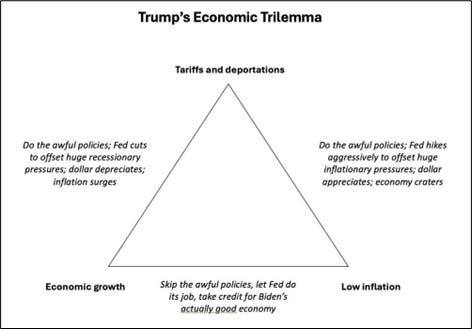
I love diagrams like this — elegant in its simplicity. I have constructed diagrams like this to explain the connections among related variables. As another example, here’s the chart I developed to explain why the American Civil War happened:
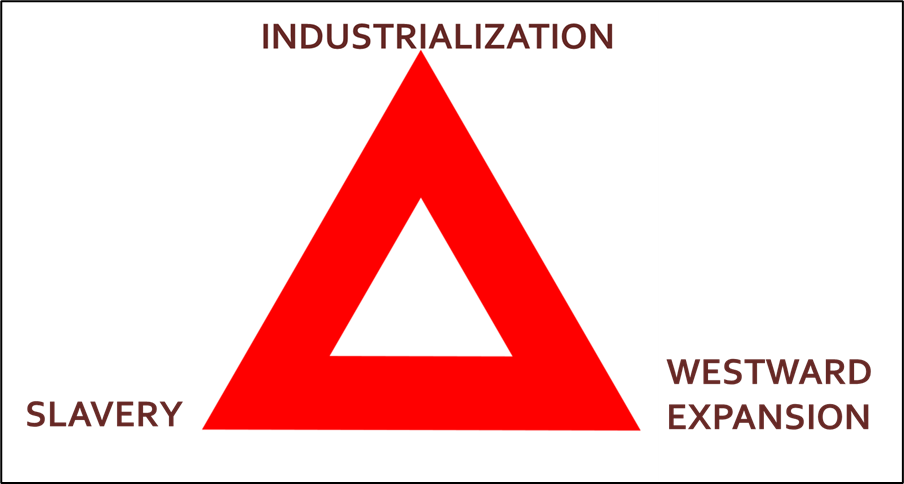
The point I was trying to make when I made this chart was that there were three major factors at work in the United States between 1800 and 1860: Industrialization, Slavery, and Westward Expansion. I hypothesized that the Civil War would not have happened if only two of these were present without the third.
Slavery and Industrialization: The North would have continued the development of a manufacturing and industrialized economy while the South would have continued to have an agricultural economy based on chattel slavery. Northern industrialists were becoming wealthy through the trade of goods – especially cotton – produced in the South. Abolitionists would have been unsuccessful in ending slavery, were it not for the fact that the settlement of the West made the United States constantly revisit the question of whether new territories and states would be based on free or enslaved labor. This constant picking at the scab kept tensions high, leading to the Civil War.
Slavery and Westward Expansion: If the entire nation had a slave-based economy, then westward expansion would have simply moved slavery westward. It is hard to imagine, however, how a non-industrialized South would have actually accomplished expansion without the steamboats, railroads, and telegraph developed in the industrializing North.
Industrialization and Westward Expansion: This is the simplest of all; without slavery, there would have been no conflict as the nation moved west.
Now let’s look at the chart at the beginning of this essay. Here it is again so you don’t have to scroll back. Geek along with me.
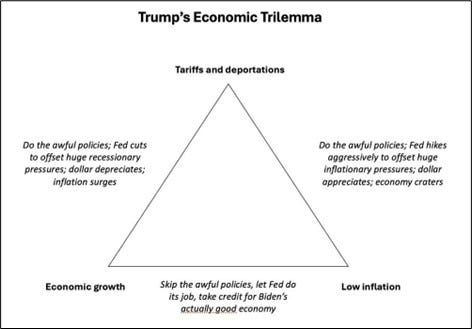
I looked around a bit to find what the creator of this chart, Mark Copelovitch meant by it. This was part of a larger analysis he and a colleague, David A. Singer, wrote in 2020 called The Trilemma and Trade Policy: The Monetary and Financial Roots of WTO [World Trade Organization]. He built on his analysis in 2020 to explain the dilemma faced by the United States if Trump carries out the policies he campaigned on – raising tariffs and conducting mass deportations. In an article in the Milwaukee Journal Sentinel from October 31, 2024, he wrote that if Trump followed through with his economic promises, the result would be disastrous in both the short- and long-term.
Here’s a simplified explanation of this chart in case you don’t want to read the article. I think I’m interpreting it accurately. Let me know (kindly, please) if you think I got it wrong.
If Trump raises tariffs and conducts mass deportations, the Federal Reserve could decide to cut interest rates to offset recessionary pressures. The dollar would depreciate, which is another way of saying prices of imports will go up, allowing domestic producers to increase their prices to just a tad below the price of the competing imports. Another word for that is ‘inflation.’
Alternatively, the Fed could decide to raise interest rates to offset inflationary pressures. The dollar would appreciate, increasing its value abroad. People would buy more goods made in other countries (because that’s what happens with the value of the dollar increases — the cost of imports goes down) and the domestic economy would crater.
But if neither of these policies were enacted, the Fed could just simply keep doing its job, tinkering with interest rates at the margins (which is mainly what the Fed does to stabilize the economy, and Trump could take credit for the Biden economy, which left the United States with better levels of economic growth and inflation than most of the rest of the world.
Tell your friends.
Yeah, I get that. Good one. *sigh* We'll see what the "brain distrust" informs us of its plans.
It’s hard to imagine how really tough the next 4 years will be for our country. What is almost incomprehensible to me is how our country will handle the inevitable consequences. I just hope there will be enough of us left to pick up the pieces.