
Timeline Cleanse

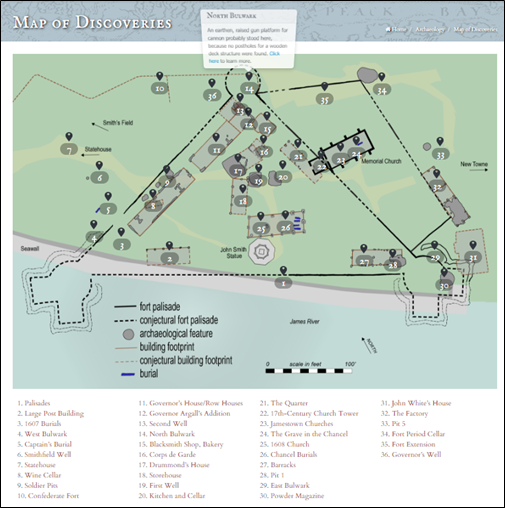
The past week (Month? Year? Decade?) has been a totally predictable sh*tshow, both in the United States and abroad. I’ll write about that later this week. Today I’m writing about events that happened 400 years ago just down the road from me, in Jamestown, Virginia. I’m doing this because I received an email update from the Jamestown Rediscovery project this morning.
A quick recap: Jamestown is the site of the first permanent English settlement in North America. Despite what our Pilgrim brethren to the north say, this colony was not a failure – although it did struggle for more than a decade before it found its feet. Here’s a recap of the disasters that befell these colonists during the settlement’s first decades:
Winter of 1609-1610 – aka The Starving Time. It’s not good when a period of time is capital-letter identified as The Starving Time. After this winter, the settlers decided to abandon the colony, and were actually on the ships, heading back to England, when they encountered a resupply ship and decided to return to the colony.
1622 – Members of the local Powhatan tribe (under the leadership of their paramount chief Opecancanough (pronounced “Opie Can Canoe”) launched a coordinated attack on both sides of the James River from near its mouth (near today’s Norfolk, VA) west to the area of Richmond. More than 1/3 of the settlers were killed in this attack.
1644 – The aging Opecancanough led a second attack, this time killing fewer settlers.
1676 – Nathaniel Bacon led a gang of rebels against the government at Jamestown, burning the town before Bacon died from dysentery and the rebellion collapsed. Bacon had come to the colony as an indentured servant. When he had worked out his indenture and expected to receive the land he had been promised, he found that most local land had been bought up by the wealthy immigrants who had come before him. His land was near the falls of the James River, where Richmond sits today. The Native Americans who lived there were not happy to see the settlers encroaching on their land. Bacon asked Governor Berkeley for armed protection against the natives, and Berkeley refused. Bacon then gathered a group of similarly-situated men and attacked the Jamestown settlement. The attack fizzled after Bacon’s death.
Historic Jamestowne (note the final ‘e’) is a joint state/national park service site on Jamestown Island. Archaeological work has been part of the effort at this site for 150 years, and the discoveries of the Jamestown Rediscovery-University of Virginia Field School continue to enlighten us about life in this colony. I visited this site recently when some family members came to town, so I’m more aware now of what’s going on there than I was before.
Why am I writing about this today? Our current sh*tshow seems to be a particularly disastrous sh*tshow, but world-altering sh*tshows are commonplace across history. The people who lived in Jamestown in the early 17th century suffered in ways that we find difficult to comprehend. Death rates were high, life expectancies were low, and the future seemed bleak. Understanding this puts our current bleak situation into perspective, I think. I’m not saying there’s nothing to worry about, but I am saying that all is not lost.
First, the newsletter points out that this summer’s excavations were concentrated in front of the Archaearium (Jamestowne’s archaeology museum – I didn’t know there was a specific name for this type of museum. It seems like it has too many vowels, just sayin’.)
Here’s what the team (including students working a summer internship at the site) uncovered.
A building foundation similar to one found inside the fort itself. The archaealogists hope that this foundation dates to the same time period.
A variety of 17th-century artifacts, including shards of identifiable pottery and glassware.
More than a half-dozen bruials
A piece of slate with writing on it
A fragment of a 17th century grenade that may have been used during Nathaniel Bacon’s failed attempt to overthrow the government of Sir William Berkeley
Field School students also spent a week working with Dr. David Leslie, principal investigator at TerraSearch Geophysical & Heritage Consultants, on a GPR (ground penetrating radar) study of the shoreline of the James River and a vibracore (sediment sampling) study of various locations in the Pitch & Tar Swamp that lies in the middle of Jamestown Island.
We all know that historians are fixated on using primary sources to document the past. When we think about primary sources, we usually think about documents of some kind. But in a time and place like Jamestown in the early 17th century, documents tell us about only a small group of people – those who were literate and in positions of power. However, the shards and fragments uncovered by archaealogists are also primary sources – and like the documentary sources, require study and analysis by trained experts to reveal the stories they tell.
The Jamestowne Rediscovery project has a YouTube channel; here’s the latest video to let you know what they’ve been doing this summer.