
The Endarkenment

Last year a friend and I collaborated to teach an Osher course called Historians Talk About History. She recently retired from a 30-year career as a college history professor; I retired from teaching history at the high school level and have pursued genealogy and broader history research in retirement. The course focused on what history is (and isn’t), what historians do (and don’t do), and what the purpose of history education is in a democratic society. We put this course together because we agreed that there were a lot of misconceptions out there about these topics, and we wanted to share some of our insights with Osher members (who are a very well-educated and outspoken group of individuals who don’t suffer fools gladly). The course was well-received, generating extensive waitlists both semesters we taught it.
This fall, I’m scheduled to teach a course on the impact of the 18th-century Enlightenment on Williamsburg. I’ve been thinking about this class for a long time. As the final project for my master’s degree in history in 1997, I completed a summer internship at Colonial Williamsburg, during which I focused on analyzing the importance of this philosophical movement on the town we were planning to relocate to at the end of that summer. At the end of the internship, I wrote a piece on the topic for The Interpreter, the in-house journal for Colonial Williamsburg employees.
Last week, Lawrence O’Donnell interviewed David W. Blight, a Yale historian and current president of the Organization of American Historians, who recently co-authored a piece in The New Republic entitled “Trump May Wish to Abolish the Past. We Historians Will Not.” Blight talked about a New Republic project he organized – a package called “Trump Against History” that gathers pieces by 11 historians to examine how the current Republican administration is attacking the integrity of historical scholarship and institutions like the Smithsonian. You can read about it here.
Blight made the point that the current administration is systematically dismantling the Enlightenment principles on which the United States was founded – ironically, at the same historical moment when the nation is celebrating the 250th anniversary of that founding moment. That movement was characterized by an emphasis on political virtues like rationality, science, equality, individual liberty, tolerance of religious diversity, freedom of speech, and progress.
I want to look at this prospect for a moment. How are the current Republican president and his administration contributing to the “endarkenment” of America?
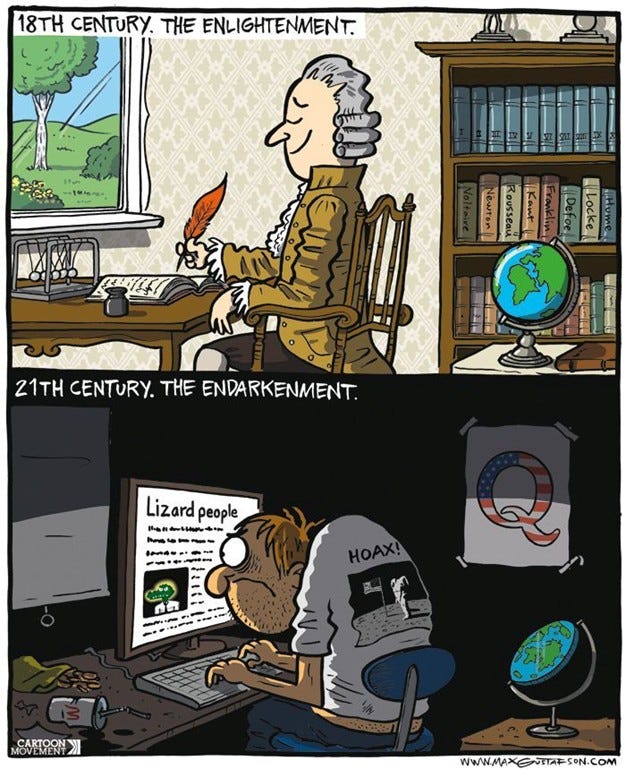
Rationality and science come together to provide the underpinning for expertise – a respect for combining education and experience to make good policy decisions. The current Republican administration is full of people who are completely unqualified for the jobs they hold. I won’t take the time to go down the list – it is sufficient to say that it is hard to find political appointees under this administration who would even be on the list of candidates in other administrations. The only criterion for serving in this administration is loyalty to the President and a willingness to abandon all principles and ethics to achieve the GOP’s political goals.
I want to talk for a minute about religious freedom, as embodied in the First Amendment but as originally embraced by Deism, the religious (or non-religious?) philosophy embraced to varying degrees by some of the founders – most famously, Franklin and Jefferson, although neither of them espoused the philosophy in any coherent fashion. The best-known Deist image of a god is a clockmaker – an entity that created the universe and set it in motion, and then backed away to let it work. Jefferson famously created The Life and Morals of Jesus of Nazareth (what’s known as the Jefferson Bible) by literally taking scissors to a Bible and cutting out everything that defied reason. In Jefferson’s version of the Bible, there is no parting of the Red Sea, Noah’s Ark, immaculate conception or virgin birth, no turning water into wine, no resurrection – all of which defied reason and thus fell into the category of superstition. But Jefferson did not deny the utility of the Bible, which he believed remained an important text of moral philosophy.
Jefferson encouraged James Madison to pressure the State of Virginia to adopt a Statute for Religious Freedom (which it did in 1786) because of their shared belief that government should not have the power to dictate an individual’s beliefs. Madison was clear on his perspective — he thought that both the church and the government suffered when they were too closely linked, because distaste for any particular government action would bleed over into rejection of the church. All they had to do was look to European history over the previous centuries to see the impact of this, as nations constantly sacrificed their treasuries — and their sons — over disagreements that could not be resolved this side of the grave.
Jefferson didn’t take the lead on moving this through the Virginia state legislature because he was in Paris (with Sally Hemings) at the time.
I never said these guys were consistent.
This became the root of the First Amendment, passed by Congress in 1789 and ratified in 1791. The current Endarkenment view that “the United States is a Christian nation” and that we need to post the Ten Commandments in schools and courthouses, impose Christian religious teachings in the schools, and encourage Christian proselytizing in government agencies – well, let’s just say that the rumble you hear near Jefferson’s Monticello and Madison’s Montpelier is the sound of these men turning over in their graves.
Jefferson’s ideal of equality as stated in the Declaration of Independence is also under attack by this administration. Rather than believing that “all men are created equal,” this administration operates under the twisted belief that the pursuit of equality is in fact discriminatory, as they attack any efforts that pursue the totally invented principle of DEI (Diversity, equity, and inclusion) that does not privilege white native-born men in all arenas of political, social, economic, and individual existence.
The current Republican president’s disdain for facts and reality barely needs explication: from the sharpie on the hurricane map to the “if we don’t test we won’t have COVID” to the recent firing of the head of the Bureau of Labor Statistics and the subsequent embrace of made-up numbers, he bends reality to fit his political worldview. Not unlike the Puritans who hanged old women because someone in the community got sick.
As is frequently the case when I think I’ve come up with what I think is a new idea or approach, I almost immediately discovered that major cultural institutions are ahead of me. In 2015, the New Republic (again – I need to start reading this magazine more diligently) published an article called The Culture of Criticism: What do we owe the Enlightenment? This is interesting, mainly it was published before the current Republican president began stomping all over the Enlightenment worldview. Here’s a link to the article.
I also found that even my title for this essay – The Endarkenment – of which I was kind of proud – was not original either. Cartoonist Chris Madden reflected on this term in a 2020 political cartoon. You can see what he had to say here.
There is no better indicator of the current Republican president’s rejection of the Enlightenment than his recent description of the Declaration of Independence. (This is a direct quote, so help me Goddess):
“Well, it means exactly what it says. It’s a declaration. A declaration of unity and love and respect, and it means a lot. And it’s something very special to our country.”
Not quite, Sport.
Thomas Jefferson, the primary author of the document, was steeped in Enlightenment thought, and the document reflects this:
Natural Rights: Jefferson’s “life, liberty, and the pursuit of happiness” is adapted from John Locke,
Government by Consent of the Governed: This emphasis on the Social Contract is straight out of Rousseau
Reason over Tradition: Jefferson’s list of grievances (yes, it’s an indictment, despite pushback from Representative Nancy Mace (R-SC), best known for her Capitol potty patrol activities) says that the power of kings is not absolute
Equality of Individuals: This is also from Locke and Rousseau, and the Declaration says these rights are both self-evident and inherent in every individual by virtue of their being human – not derived from government.
In his most famous speech – at Gettysburg in 1863 – President Abraham Lincoln referenced the Enlightenment ideals of the country’s founders throughout his short address:
“a new nation, conceived in liberty, and dedicated to the proposition that all men are created equal”
“that this nation, under God, shall have a new birth of freedom – and that government of the people, by the people, for the people, shall not perish from the earth.”
It’s a far cry from “grab ‘em by the p***y,” gotta say.
Before I end this, I need to acknowledge that the enlightened figures among America’s founders – Jefferson, Madison, and George Wythe, for example – espoused a goal that they did not accomplish in their personal lives. They all were slaveholders, for example, a clear exception to their stated belief in equality. The fact that they recognized this contradiction – in 1785, Jefferson wrote about slavery and its moral consequences for the United States, saying that "Indeed I tremble for my country when I reflect that God is just: that his justice cannot sleep forever.” – is not an adequate justification for their willingness to continue to profit from the institution.
Yes, very good summation of where we are and where we are heading.
In retrospect probably from a more distant future then we can now achieve, suspect this MAGAGA madness will look more like an archetypical wave from the collective unconscious than a current trend that yields to logical understanding.
Potential examples could be the European dark ages after the collapse of Rome or the Greek dark ages after the Bronze Age collapse.
Hopefully this one won’t last as long
Great piece.