
The Culpeper Resolves

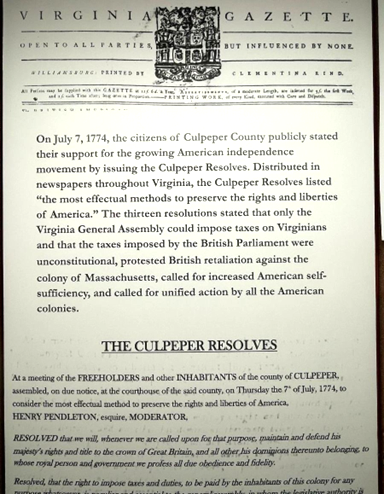
As I have written about over the past couple of months, the Boston Tea Party and the ensuing ‘Coercive’ Acts passed by the British parliament enflamed opinion throughout the American colonies. I have written about the reaction in Rhode Island (twice!), Maryland, Virginia, Pennsylvania (twice!), Quebec, and New York. Today I’m focusing on Virginia again – specifically, Culpeper, which lies in the central part of the state. On July 7, 1774, a committee of Culpeper County freeholders drafted the “Culpeper Resolves,” which, like the many other similar resolutions passed in county meetings throughout the colonies, summarized the feelings of Culpeper citizens.
As I was researching to find out a bit more about these resolves, I came across a program being offered by the Museum of Culpeper History (partnered with the American Battlefield Trust) about this event. It is scheduled for the evening of July 9 – tonight! – and the featured speaker is Jim Bish, a former teacher colleague from Woodbridge High School. In retirement, Jim has pursued his passion for history. I won’t be able to attend this event tonight, but it would have been fun to drop in on Jim.
Last Sunday, the Culpeper Minute Men Chapters of the Sons of the American and the Daughters of the American Revolution hosted the dedication of a historical marker to commemorate the 1774 resolves. I couldn’t go to this either. Culpeper is about 2 ½ hours from my house, and I didn’t have time for the trip. However, here’s the text of the marker:
“This is the site of the first (1750-1808) and second (1809-1870) courthouses of Culpeper County, thought to be laid out by Culpeper County’s first surveyor, George Washington in 1749. At the first courthouse, two important events occurred. On October 31, 1765, a protest of the Stamp Act by the Culpeper Court Justices, challenged English actions. The most important protest on July 7, 1774 produced the Culpeper Resolves. A committee of Culpeper County freeholders drafted the Culpeper Resolves in response to Parliament’s recently passed Coercive Acts and Governor Dunmore’s closure of Virginia’s House of Burgesses. The Culpeper Resolves repudiated the actions of Parliament and Dunmore and pledged “at all times, at the risk of our lives and fortunes, oppose any Act imposing such taxes of duties, unless we are legally represented.” Culpeper was one of Virginia’s earliest counties to publish resolves in 1774.”
The Culpeper Star-Exponent newspaper ran an article about these Resolves earlier this year. The resolves were a series of 13 resolutions made by 16 members of the Culpeper community, outlining their grievances with the British Parliament and signaling their solidarity with other American colonies. Culper County was among the first 10 counties in Virginia to issue such resolutions. Henry Field and Henry Pendleton, who represented Culpeper in the Virginia House of Burgesses, participated in creating and publicizing the Resolves. As with the other colonies, these Resolves performed a kind of dance, where the authors expressed loyalty to the king but concern about Parliament.
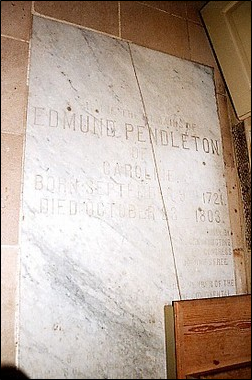
I was stymied at first because much of the information about the events of this week was behind a paywall. However, my subscription to Newspapers.com gave me access to stories from a couple of months ago – including an article written by Jim. I suspect it contains much of the information he’ll present in his talk on Tuesday night. Jim provides some general background information and then focuses for a bit on men from Culpeper who were involved in creating these resolves. He notes that Henry Pendleton, one of the freeholders of Culpeper who formulated the resolves, was the nephew of Edmund Pendleton, a prominent Virginian. Edmund Pendleton had served in the House of Burgesses, was a delegate to the First Continental Congress, and was selected to be the first speaker of Virginia’s new House of Delegates, which replaced the House of Burgesses in 1777. Edmund married twice but had no surviving children, leaving only nieces and nephews as his heirs. I am descended from Richard Gaines, another of Edmund’s nephews. Edmund’s sister, Isabella, was my 7th great-grandmother, making Edmund my 7th great-granduncle. Edmund is buried beneath the floor of Bruton Parish Church in Williamsburg. When I go for walks downtown I often drop by to visit Uncle Ed. Here’s his grave marker.
I have other ancestors who lived in Culpeper, but I haven’t been able to find a list of men who signed these Resolves. I’ll keep looking.
Culpeper is certainly a charming little town with an interesting history. Thanks for sharing the details.