The Credibility Gap Redux
Weekend Roundup

From Ernie Pyle (World War II) through David Halberstam (Vietnam) to Richard Engel (Iraq, Syria, Libya, Afghanistan), journalists embedded with military units have helped the American people understand what their military is doing in their name. All three men told the story of their war from the perspectives of the troops on the ground and local people, highlighting the disconnect between battlefield realities and official reports. Since the Iraq War (beginning in 2003), a formal embedding process has allowed reporters to accompany military units, witness operations firsthand, and transmit near-real-time accounts.
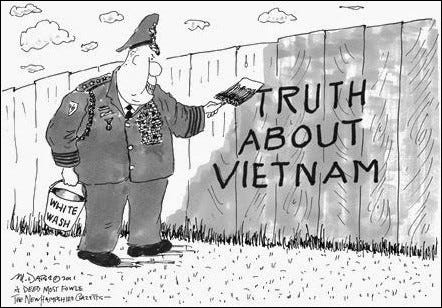
The Vietnam War taught Americans many things about their political system – perhaps most significantly, the problem of the accretion of too much power in the hands of the president. Putting aside for a moment that the country seems to have forgotten this lesson, another important lesson was that the government sometimes lies to cover up a truth they’re unwilling to face. In Vietnam, the truth was that the war was not going anywhere near as well as the government was telling us. Remember body counts? It took Walter Cronkite going to Vietnam and reporting on the facts on the ground to awaken the American public to this reality; Halberstam’s reporting provided the details that underpinned Cronkite’s conclusion.
We are not hearing any first-hand reports about what’s going on with the current war (or whatever it is) against Iran, and that’s a problem. Lucian Truscott wrote a Substack post about this in early April, and the situation has only worsened since then. I’m going to talk about a few of his main points, but here’s a link to his article if you want to read it in its entirety.
A federal judge ruled that Hegseth’s denial of press credentials to those who weren’t sufficiently loyal to Trump was unconstitutional. Hegseth responded by banishing reporters from the Pentagon altogether unless they were accompanied by a military escort.
Trump has always been hostile to unfriendly press; this has only become more extreme during his second term, as he belittles and insults them – particularly if they’re black and/or female.
The briefings by the Trump administration about the war are laughable, driven by his late-night social media posts that feature AI-created memes of himself in preposterous costumes or saying ridiculous things in ALL CAPS.
The White House tightly controls information about the war, including updated lists of casualty figures. All available information suggests that the White House claims of 15 deaths and 365 wounded are almost certainly an undercount.
The number of airstrikes claimed by Trump and Hegseth is suspect as well – they are sometimes mutually contradictory, and none of them are backed up by reliable data
We don’t have any reliable reporters in the theater of operations from which missiles are launched, and aircraft are sent on bombing missions. The only people who have been credentialed by the Pentagon are right-wing podcasters and other irresponsible folks. No one on the ground in-theater has any reason to trust them enough to tell them what’s going on. Hegseth’s self-congratulatory briefings shed little light on what’s actually happening.
Trump’s statements don’t help. Over the course of a single day, the administration made the following statements:
Trump: “I think the war is very complete, pretty much.”
DOD: “We have only just begun to fight.”
Hegseth: “This is only the beginning
Trump: “We’ve already won in many ways, but we haven’t won enough.”
Trump: “We’ll not relent until the enemy is totally and decisively defeated.”
Trump: “We could call it a tremendous success right now, or we could go further, and we’re going to go further.”
Trump (Iran has been destroyed):
“They have nothing left.”
“There’s nothing left in a military sense.”
“They have no radar, they have no telecommunications.”
Trump (Iran has been degraded)
“Most of Iran’s naval power has been sunk.”
“Missile capacity was down to about 10%.”
“Drones were probably down to 25%.
Trump (about Iran’s leadership):
“Everything they have is gone, including their leadership.”
“They have no leadership.”
But minutes later:
“two levels of leadership are gone.”
This was after Iran had already installed a new supreme leader. Later in his remarks, he acknowledged this new leader, saying he represented “more of the same problem.”
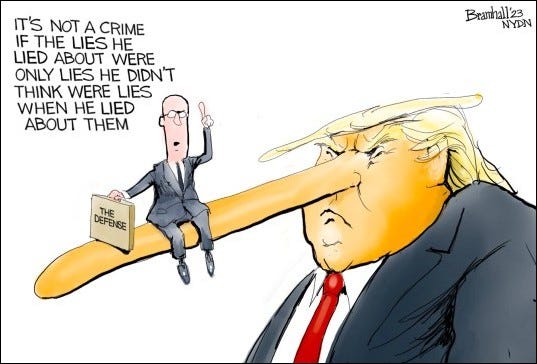
Truscott concludes his article by saying that modern warfare, with restricted press access, creates an environment in which democratic publics must rely heavily on official narratives without independent verification – and these official narratives are at best unreliable and at worst intentionally misleading.
We’ve seen this movie before.