
The Arts
"And medicine, law, business, engineering, these are noble pursuits and necessary to sustain life. But poetry, beauty, romance, love, these are what we stay alive for."

Drawing. Painting. Sculpture. Photography. Architecture. Design. Videography.
Theater. Dance. Music. Circus acts. Puppetry. Mime.
Film. Television. Radio. Podcasting
Fiction. Poetry. Drama. Storytelling. Creative nonfiction.
Culinary arts. Fashion design. Home decorating. Landscape gardening.
And more.
These are The Arts. It is difficult to be traditionally successful in The Arts because, although we all enjoy them to varying degrees, we don’t consider them necessities, so we don’t want to pay for them.
Consider Maslow’s Hierarchy of Needs.
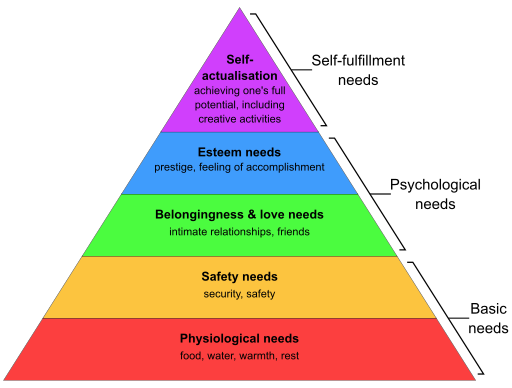
We’re probably all familiar with this pyramid or some variant of it. It lays out something we know to be true – people need to stay alive before they can worry about anything else. But in another sense, this hierarchy assumes that we have to ignore the higher-order needs until the lower-order needs are taken care of.
Although estimates vary, here’s how long people can generally live when these basic needs unmet:
Without warmth (subfreezing): no more than 45 minutes before core temps fall to ~70°F, leading to organ failure as muscles (including the heart) are unable to contract
Without cooling (high external temperatures): Minutes in a closed hot car; 1-2 days in dry desert heat before sweating decreases blood volume, which speeds up the heart rate. Major organs fail because of reduced blood flow
Without water: 3-5 days before your kidneys and circulation fail
Without food: 30-40 days before your organs fail
Without sleep: 3-5 days before severe cognitive and physical impairment; death results when hallucinations and impaired judgment make you do stupid things.
But the other levels in this pyramid are not as predictable or reliable as guides for human behavior.
For example, “safety” is a need that we address through judgment every day. We take risks. Now, some of us are tolerant of higher risks than others. Some thrill-seekers are downright stupid in their quest for that squirt of adrenaline that makes them feel alive. But we are all risk-takers to some degree.
We drive at high speeds on interstate highways, relying on our car and the vehicles around us, along with our judgment and that of the people in those other vehicles, to get to our destination safely.
We lock the doors of our houses in full recognition that anyone who really wanted to could get into our house and do bad things.
We stuff ourselves into flying metal canisters, so eager to spend Christmas with our families or see the Leaning Tower of Pisa that we trust “waves hands in air” all of this to get us there safely.
The next level – belongingness and love – is even squishier. I saw a sign at the recent No Kings rally that makes the point.
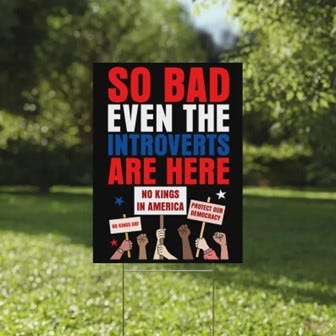
My family contains a combination of introverts and extroverts. I bet yours does too. We all recognize that being alone is not the same thing as being lonely. People adjust to all levels of belongingness and love. Those of us who have experienced a life characterized by these feelings can’t imagine life without them. But other people manage quite well as solitary figures in a world that doesn’t understand them.
In addition, people vary in the ways they experience this kind of connectness. The idea of “love languages” is having a moment.
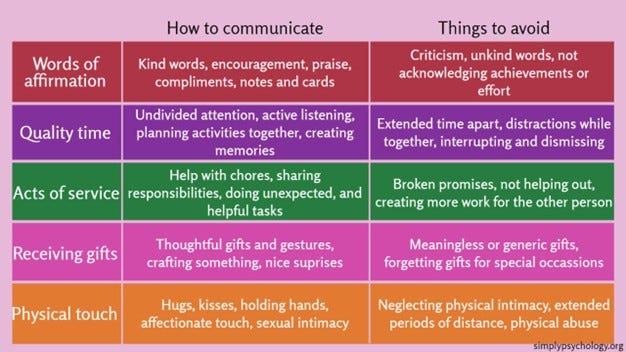
I have realized that I am a “words of affirmation” person. It feels a bit shallow, but it’s what I need to feel appreciated. Now, if it’s accompanied by physical affection, gifts, helping out with things I’m doing, or planning a vacation with me, so much the better. I think this also means that people feel loved and emotionally connected in different ways.
When you get to the top of the pyramid – where you are dealing with the things you, in the most literal sense, CAN LIVE WITHOUT - you encounter the greatest misunderstandings.
This leads me to another related point – learning styles.
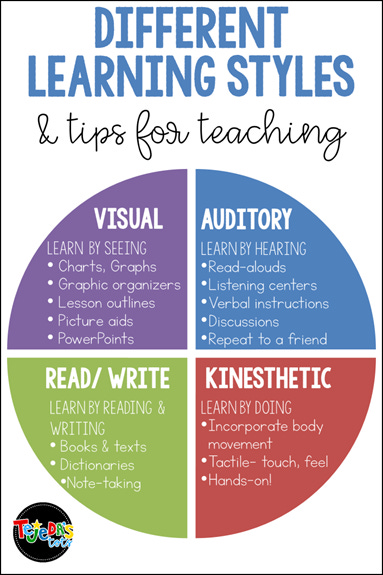
It’s not hard to figure out what this means. What’s your preferred way to learn about something? I’m more of a Read/Write type of learner (go figure!), which is why I began to write this newsletter in the first place. Writing about things helps me understand them. Other people would rather see a documentary or hear a lecture, while still others want to be involved in creating things that illustrate a concept.
Education has traditionally rewarded people who learn the way I do while leaving other people in the dust. I had one student who couldn’t write an essay to save her life. She asked me if she could submit a drawing in place of her next essay. I said sure, why not? I’d like to be able to report that her drawing was breathtaking and deeply meaningful, but it wasn’t. However, what she turned in made sense and at least had some meaning — which could not be said about any essay she wrote that year. I think it’s important for people to learn to write essays, but her drawing made me realize that she actually had learned something in my class.
When I was teaching, I experimented with something I called “Doodle Notes.” I told my students that for some period of time (I think it was 15 minutes) any notes they took on the day’s lecture had to be in the form of doodles — shapes or figures, not words. One thing that happened is that they all began to take notes — something exceedingly rare, even in an AP class with the school’s best students. After 15 minutes, I told them to form into small groups (2-3 kids) and compare doodle notes. After this exercise, I asked a member of each group to tell the rest of us what they admired about the doodle notes of someone else in the group.
Learning broke out in this moment, I gotta say, as the kids realized that the point of taking notes was to record information in a way that would help them recall it at a later point. This should not have been a breakthrough moment for college-bound seniors, but it was.
All this gets me to my point for today. I knew you were wondering.
When societies and their accompanying institutions come under financial stress, the things broadly categorized as The Arts are the first to be slashed from the budgets. We decrease or abolish school programs in The Arts while holding onto funding for academic subjects like Math, English, History, and the Sciences.
Government spending for the Arts is always held up to closer scrutiny than infrastructure or development projects. The Arts are seen as an add-on to the things that are really important.
If it weren’t for the Arts, no one would know what a Great Gatsby party at Mar-A-Lago would mean. Just sayin’.
Rather than being an add-on – at the totally non-essential top of Maslow’s hierarchy – I suggest that The Arts are fundamental to what it means to be human. We bathe, put on clothing, and engage in basic grooming because we care about what we look like to other people. We buy furniture that matches and put pictures on our walls because we like to be surrounded by things that look nice. We decorate our houses for the holidays because we like the way it looks.
Music is a frequent accompaniment to daily activities. Mood music and elevator music provide a soothing (although sometimes annoying) backdrop to our routine errands. We watch television and movies because we like to stretch our brains by imagining ourselves in situations we are unlikely to experience in real life. We read for the same reason – we like the feeling of engaging our brains. We go leaf-peeping in the fall or stop to gaze at a sunset because we enjoy the show the earth puts on for us. Newborn babies and houseplants respond to music.
If we come across a random hopscotch board on a sidewalk, we hop in the right places. If someone kicks a ball in our direction, we are likely to (try to) kick it back. We sing along with songs on the radio, and when Sweet Caroline plays, we sing along with the “Ba, ba, ba” followed by “So good! So good! So good!” Some of you sang this in your heads (or out loud) just now. Communities host Messiah sing-alongs in December, passing out scores to people who want to be part of a choir, even for just an hour or so. An organization called Choir, Choir, Choir takes advantage of this need to connect through the arts. Here’s what they did at Lincoln Center with Kermit and a choir of 2,000 singers.
I mean, who doesn’t want to be part of this?
And just because I love this rendition, here’s something to make you optimistic in the face of many bad things. (You can learn more about this group here .)
Yes, I live for poetry, beauty, romance and love. Thanks for an awesome essay!
I have always believed that the arts should be the center of any curriculum, with math, English, social studies, etc branching off of them.