
Suffolk Resolves

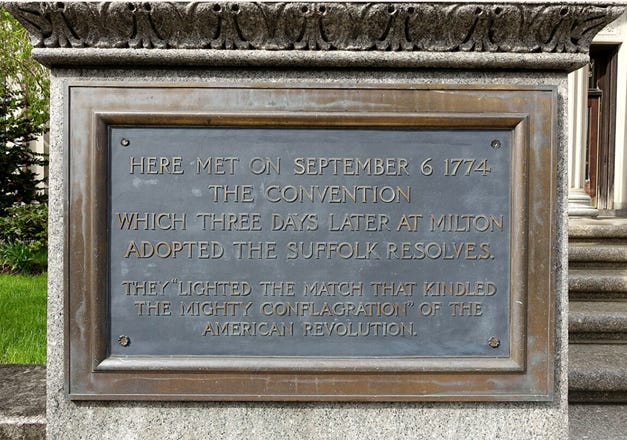
Since May of this year, my Tuesday essays have focused on events from 250 years ago – 1774, two years before the signing of the Declaration of Independence in July of 1776. After the Boston Tea Party on December 16, 1773, Parliament passed the Coercive (or Intolerable) Acts to punish the colonies for the behavior of Bostonians on that day. Although all of the colonies felt the effects of these acts, Massachusetts was more directly affected, as the acts closed the port of Boston and suspended local government in the colony.
I found this story interesting because it was moving along a different track from most of the other events I’ve written about in this series. The various ‘resolves’ passed in other colonies were part of a process leading to the First Continental Congress, which was convened on September 5, 1774. The Suffolk Resolves were different; they represented a parallel effort by people in Massachusetts to respond to the threat to the political liberty presented by the Massachusetts Government Act, which basically converted the Massachusetts Council (an elected body with the governor’s approval) into a body of crown appointees. The Act gave the new royal governor tha ability to choose judges and county sheriffs without the Council’s approval, and further gave the County sheriff’s the power to appoint jurors. To cap it off, the Government Act restricts town meetings to once a year, with any additional meetings requiring the governor’s approval.
In August of 1774, the Committees of Correspondence from Suffolk, Middlesex, Essex, and Worcester counties met in Boston to oppose the act, urging all Massachusetts counties to close their courts rather than submit to the oppressive measure. By the first week of October, seven of the nine contiguous counties in Massachusetts had closed their courts. As each county in turn closed its court, it issued a set of resolves to explain its actions. The Suffolk Resolves serve an an exemplar of these efforts for two reasons: it was better crafted than most, and it was formerly endorsed by the Continental Congress. It was also significant that Boston is in Suffolk County, so actions taken there almost automatically get more attention than other places.
When the Suffolk County Committees of Correspondence met on September 6, Joseph Warren introduced the first draft of the Suffolk. The Resolves were debated and approved three days later, on September 9. The Suffolk Resolves denounced the Coercive Acts and specifically resolved the following:
boycott British imports, curtail exports, and refuse to use British products;
pay "no obedience" to the Massachusetts Government Act or the Boston Port Bill;
demand resignations from those appointed to positions under the Massachusetts Government Act;
refuse payment of taxes until the Massachusetts Government Act was repealed;
support a colonial government in Massachusetts free of royal authority until the Intolerable Acts were repealed;
urge the colonies to raise militia of their own people.
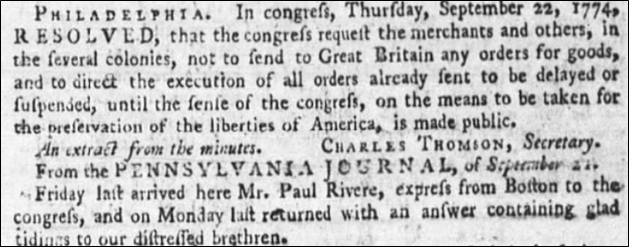
Paul Revere (!) delivered a copy of the Suffolk Resolves to the First Continental Congress meeting in Philadelphia, where it was endorsed on September 17 as a show of colonial solidarity. John Adams wrote in his diary "This was one of the happiest days of my life. In Congress we had generous, noble sentiments, and manly eloquence. This day convinced me that America will support Massachusetts or perish with her.”
When the Continental Congress endorsed the Suffolk Resolves, its statement was interpreted to represent all of the rebellious colonies. This paved the way for the creation of the Continental Association, a general nonimportation agreement adopted by the First Continental Congress in October.
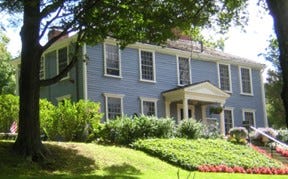
The Suffolk Resolves House (where the resolves were signed) was originally owned by Daniel Vose. It had fallen into disrepair until it was moved in 1950, restored to its original colonial appearance, and now serves as the headquarters of the Milton Historical Society. It was added to the National Register of Historic Places in 1973 and is open to the public.
If you want to know more, here’s a link to a 20-minute podcast about The Suffolk Resolves. https://blog.amrevpodcast.com/2018/06/episode-047-suffolk-resolves.html
People in Williamsburg learned about these events in the September 29, 1774, issue of the Virginia Gazette, where this block appears on Page 3 as part of a longer story.
Fascinating story. Recounts some of what I read in new book about Sam Adams