
Staggering Your Breathing

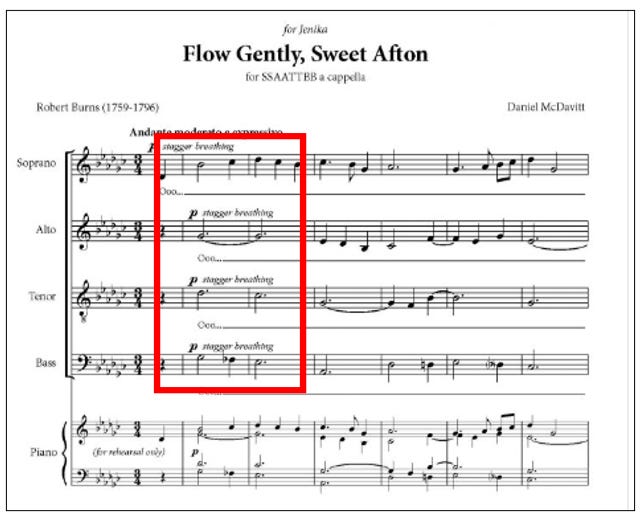
I’ve done a fair amount of choral singing in my adult life. I sang with a community chorus in Charlottesville in 1971, and in the 1990s I began to sing with my local Methodist Church choir. When we moved to Williamsburg, I continued singing with the Williamsburg United Methodist Church choir, and I sang with the Williamsburg Choral Guild for a few years in the early 2000s. I continued singing with my church choir until the Methodist Church got stupid in 2018 (when they decided God didn’t love LGBTQ+ individuals) and we stopped going to church and I stopped singing in the choir.
I miss choral singing. I love to sing different vocal parts on the occasions when I’m in church these days (a few times a year, tbh). I’m enjoying watching my grandchildren develop their talents. My 17-year-old grandson is a talented musician who sings bass in a youth choir in Columbus, Georgia. When we were visiting them over Labor Day weekend, I spent some time with him, watching videos of his choral performances and talking about the music they were singing. I had sung some of the music, so it was fun to do a musical geek-out with him.
This leads me to my topic for today: staggering your breathing while you’re singing in a choir.
Musicians who play wind instruments also need to stagger their breathing, but I don’t play a wind instrument so I’m not using that as an example.
Composers often write music that requires singers to hold a note longer than they can sing without taking a breath. What’s important to the music is that the sound continues as long as the composer intended, but it’s not necessary for every individual singer to sustain the note until they faint – or ‘fall out,’ since I’ve just spent some time in Georgia. What singers do, instead, is talk to the people around them – the people singing the same vocal part – and agree on who is going to breathe at what point in the music. I sang a lot of alto; in rehearsal, the altos would agree that we would stagger our breathing so that the sound continued even if one or two of us at a time stopped to take a breath. We all had notation we used on our musical scores to indicate when to breathe; mine was to write “breathe” at the appropriate point. We would catch a breath surreptitiously; when we rejoined the altos after taking a breath, we eased back into the music (no glottal stops) so that the sound was continuous and no one in the audience would realize that we were all catching our breath as needed.
Thank you, Karen. But why are you writing about this today?
I’m glad you asked. Political activism often requires individuals to “hold the note” – stay involved – when they really need to take a breath. If you are part of a group that has enough altos (to continue my example), you can take a breath – drop out for a bit – with confidence that the rest of the altos will hold the note until you can seamlessly merge back in.
I’m thinking of this today because we are in another election cycle in what has seemed to become a continuous cycle of outrage and resistance. For me, my serious activism began after the 2016 presidential election. Here’s what has happened, and here’s how I’m currently “taking a breath.”
Along with half a million of my closest friends, I attended the Women’s March in DC on January 21, 2017, to express my opposition to #P01135809.
When I got back to Williamsburg, I came across an Indivisible Group that had formed after the Women’s March. I joined the Williamsburg Indivisible Group (WIG) in the spring of 2017.
For the next several years, we worked to “defeat #P01135809 and defeat the #P01135809 agenda” by helping out in campaigns, educating ourselves on issues, donating to progressive causes, and participating in local demonstrations and marches about issues we cared about. We phone-banked, wrote postcards for candidates, did voter registration, and manned the Democratic Party tent outside of polling locations for primary and general elections as they occurred.
This meant a lot of electioneering. In Virginia, we have elections of some kind every year. The national elections are in even-numbered years, while state elections are in odd-numbered years. There was always an election to work toward.
One result of this work was that the people involved got to know one another, and they found slots where they could pursue their interests. Some WIG members became less active in WIG while they increased their participation in the League of Women Voters. Some of them ran for office. Others became active in the local Democratic Party organization and spent less time on WIG events. Our original leader moved away, and my Friend and I took over the leadership of WIG.
This all happened between 2017 and 2023. We (it was a big WE) defeated #P01135809 in 2020. But the work wasn’t over. We had not defeated the #P01135809 agenda. There was more work to be done. But Friend and I needed to take a breath so we didn’t fall off the risers.
So we disbanded WIG. That wasn’t easy. We felt we were letting people down. But our active numbers had shrunk to a dozen or so members, and we were spending way too much time figuring out how to get people to attend meetings and not enough time actually doing the work we had come together to accomplish. The WIG seedlings had spread throughout the community, and we decided WIG had served its purpose.
We took a breath but then we rejoined the sound. Not as part of WIG any longer, but still part of the choir. Friend became very active in the League of Women Voters; I became an Election Officer and began writing a blog (this one) that focuses heavily on state, national, and international politics. I have over 100 subscribers (okay, so I’m not Heather Cox Richardson), which means I’m communicating with several dozen people every week about things I care about. I have readers in Massachusetts, Florida, and Arizona. Friend is joining in the Election officer work this fall.
And guess what? The sound has continued. Friend and I participated in a pro-Harris march in Williamsburg two weeks ago, where we joined 250 members of our community in expressing our continued concern about democratic norms and institutions. A lot of WIG members were there; WIG went away, but the responsibility and activism didn’t. The WIG members who had stepped away from WIG to catch a breath, for whatever reason, were still in the fight. And other people joined the choir, keeping the sound going while we were taking a breath.
No one person has to do it all. I’m a fairly healthy 77-year-old woman who doesn’t plan to knock on doors or write postcards any longer. But I can still do my part. I’ve taken my breath, the sound continues, and I’m still in the fight.
You go girl! As Joyce Vance says “We’re in this together”!
Thank you, Karen!