
So What’s Bugging You?

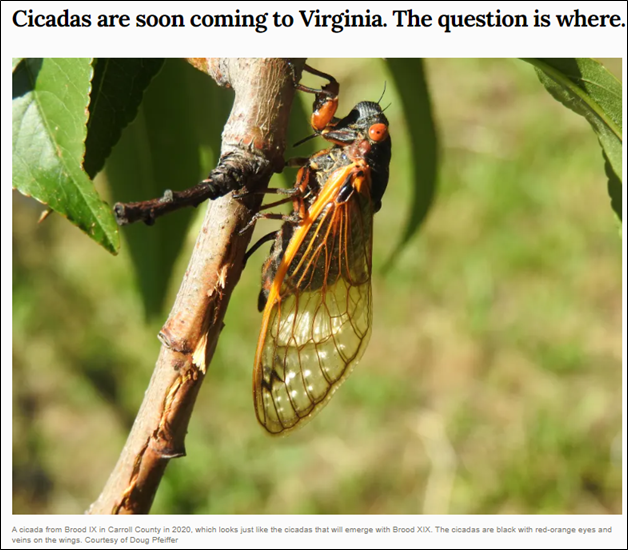
Some are calling it ‘Cicada-Palooza;’ others prefer ‘Cicada-Gedden.’ But whatever you call it, the cicadas are coming.
The article in the Virginia Gazette begins with this question: What’s crunchy when stepped on, loud as a chainsaw, and capable of living years underground? You know the answer.
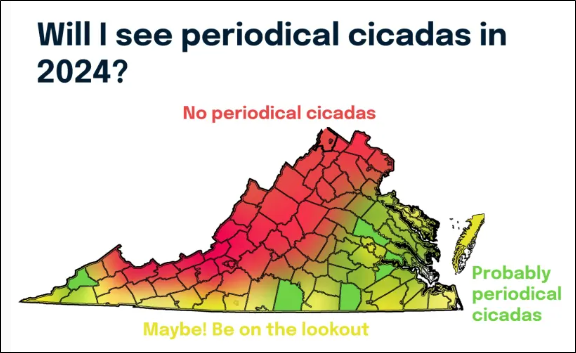
I learned this morning that there are two broad categories of cicadas: annual and periodical. According to the handy “Will you have periodical cicadas” map accompanying the article, I live somewhere between “probably” and “maybe.”
Annual cicadas are around every year, as the name indicates. This year, the cicada excitement is based on the convergence of two broods of periodical cicadas – Brood XIX, a 13-year brood found primarily in the south, and Brook XIII, a 17-year brood localized to Illinois. The two haven’t been seen together since the 1800s.
Brood XIX (the Great Southern Brood) is expected to emerge in 14 states, including North Carolina, South Carolina, Georgia, and Tennessee. Virginians are encouraged to be on the lookout for the “chorusing creatures” and submit any photos of the periodical cicadas to their local extension officer. Brood XIII will not appear much outside of Illinois, so the chances are slim that any location will experience the double excitement of competing cicada choruses.
How will you know a periodical cicada when you see one? Periodical cicadas are black with red-orange eyes and veins on the wings, while annual cicadas are brown with green markings. Annual cicadas are also a little bigger than the periodicals.
An entomologist interviewed for the story notes that these are not simply fascinating creatures – they are a good source of protein. He said he ate some on tacos at a Northern Virginia restaurant years ago.
On a dare, my son ate a cicada sometime in the 1980s. The internet tells me that Brood XIX was out in 1985, which fits — he was eight years old at that time. He was a suggestible lad.
I can confirm that cicadas are noisy. According to one source, the noise – the mating call of the male cicadas – can approach the decibel level of a lawn mower or passing jet. One comment noted that it’s like going to a rock concert. The good news is that cicadas are not creatures of the night; they call only when the sun is out. If you’re being kept awake by nighttime screeches, it’s most likely from katydids. Adult periodical cicadas live only three to four weeks, so the annoying noise is self-limiting.
The article goes on to differentiate cicadas from similar critters like katydids and locusts, in case that differentiation matters to you.
If you want to join the fun, the article points to two websites: a University of Connecticut scientific explainer and Cicada Mania, which can best be described as a cicada fans page.
The UConn site provides some baseline scientific information about cicadas in general, as well as a link to more specific information about this year’s periodical cicadas. One interesting thing I found on this site – rough estimates suggest that the population density of cicadas can exceed a million critters per acre.
The Cicada Mania site is more fun, providing a spreadsheet of the life cycles of the two periodical cicada broods along with cicada swag – t-shirts, mugs, and cicada throw blankets.
NOTE: When I moved my mouse over the link to the swag, the cursor turned into a little cicada. Cute.
It’s time for me to bug out.
I like your “sound of summer” phrase, Anne. That’s exactly right. It reminds me of the years I spent trying to catch lightening bugs. Another “sound” of summer. I still like them, too. But Karen, in general, I really don’t like bugs, especially the cicadas. 😎
Yep. Saw a big one on the road this morning on a walk. He acted like he didn't know which way to go. He seemed confused. They don't bother me. It's the sound of summer.