
Sanctuary
Sunday Sermonette

The word “sanctuary” goes back more than 2,500 years. The first Biblical mention of the idea of Sanctuary appears in the Torah, where “cities of refuge” appear as places to go to escape immediate retaliation for a purported illegal act. The theological principle was clear: justice must be tempered by mercy when a life is at stake. These were places where a person who had unintentionally killed someone could flee while some variant of due process was observed and blood vengeance was suspended.
This carried directly into Christian practice. By late antiquity, Churches were understood as places where coercion stopped. Soldiers and magistrates were expected to lower weapons at the threshold, and clergy acted as negotiators between the state and the accused. Sanctuary did not mean innocence – it meant time, protection from immediate harm, and a chance for negotiations, repentance, or mercy
By the Middle Ages, sanctuary had become formalized into law in much of Europe. Anyone reaching a church could claim sanctuary and potentially be protected for up to 40 days. Crucially, this concept was accepted by both the Church and the Crown: the legal government acknowledged the limits on its power when sacred space intervened.
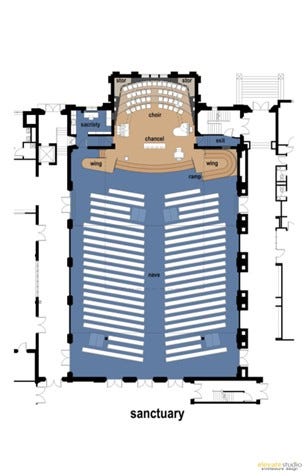
Today, the word “sanctuary” officially refers to the part of a church where the altar is located and where the worship leaders do their thing. Unofficially, the word usually encompasses the altar and nave of a church — not only the (usually) raised altar, but the seating and aisles as well.
Importantly, the protection provided by sanctuary was never based on a claim that law doesn’t matter or that accountability would be avoided forever. It was, instead, a declaration that law without mercy becomes tyranny. It proposed that God’s law was higher than man’s law, and that human dignity overrode state authority.
We’re most likely to hear about sanctuary today in the context of “sanctuary cities.” It’s useful to explore what this means.
The first important point is that sanctuary cities are not grounded in the theological concept of a sacred space as a sanctuary. Rather, these cities have defined themselves as spaces where the original purpose of sanctuary – time, due process, and mercy – can be practiced when the threat is from the federal government.
Sanctuary cities claim the power to do several things to mirror the older sanctuary principle by which local authority refuses to be the instrument of immediate harm from someone outside of the community:
Refuse to use local police and other resources to assist federal immigration enforcement
Limited information-sharing beyond what is actually required by law
Prioritize community trust over immigration policing.
When we hear people talk about sanctuary cities, we are seldom given a clear explanation of the legal framework that allows or prohibits a city from acting as a sanctuary. This power depends on how the state constitution describes the relationship between the powers of the state and the powers of counties and cities. There are generally two major categories of this relationship: Home Rule and Dillon Rule states. As this map shows, there are several variations within these categories. I’ll define each of these categories, then let you think about the states that allow some overlap between them.
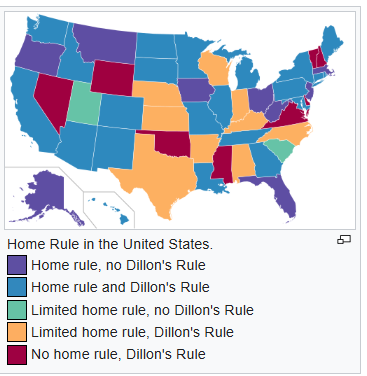
Home-rule states allow cities and counties to act unless state law specifically forbids it. This is similar to the relationship between the federal government and state governments as laid out in the United States Constitution. Article I of that document spells out the power of the federal government, and the 10th Amendment says that any power not specifically delegated to the federal government belongs to the state. It’s a bit more complicated than this, but this is the basic scheme.
These states allow their localities broad latitude in the governing choices they make. Minnesota is a home-rule state; this means that cities, for example, may govern local matters without specific legislative permission. Courts in Minnesota presume that local authority exists unless the state has clearly preempted it. Although Minneapolis can claim authority in the area of immigration enforcement cooperation (for one example), this can be overridden by specific state action if the state legislature wishes to take over this issue. California (also a home-rule state) has stronger protections for local authority than Minnesota does; this means that a sanctuary city declaration in California has greater legal authority.
A smaller number of states are Dillon Rule rather than home-rule states.
This rule is named for John Forrest Dillon, a 19th-century jurist who articulated the rule while serving on the Iowa Supreme Court and later as a federal judge. You’ll note on the map that Iowa, where the Dillon Rule was initiated, is not a Dillon Rule state. This change happened in the middle of the 20th century, when Iowa amended its state constitution to reject the Dillon Rule and grant municipal home rule.
Under the Dillon Rule, a local government exercises only those powers expressly granted by the state constitution or legislature, powers necessarily or fairly implied from these grants, and powers essential to the local government’s declared purpose. Most significantly, in a Dillon Rule state, any reasonable doubt about the allocation of power is resolved in favor of the state and against the locality.
My state, Virginia, is a Dillon Rule state. This means that cities and counties do not have the power to declare themselves sanctuaries, as that power rests with the state legislature, and the Virginia legislature has not delegated it to the localities. The eight deepest blue/purple states are at the opposite end of this continuum – localities in these states have the freedom to declare themselves sanctuaries unless the state legislature has specifically forbidden them from doing so. For all the states between these extremes – the blue, green, and peach states – you would have to look at specific decisions by the state legislatures to determine whether localities have the power to decide whether to align their local law enforcement and other resources with the federal activities, including ICE, within their jurisdiction.
I have heard gun-toting people in Virginia claim that they want their counties to be sanctuary areas — but for guns, not immigration enforcement. In their minds, this would allow them to impose different gun laws (looser) than the laws imposed by the state legislature (more restrictive). This is not a thing in a Dillon Rule state.
After I finished writing this on Saturday, January 17, I saw that Virginia’s new governor, Abigail Spanberger, had ordered an end to Virginia's participation in the 287g program, which is a federal-local enforcement partnership run by ICE. Under this program, implemented by the former governor Glenn Youngkin, local law enforcement were trained and deputized to act as ICE agents. They had the power to question, detail, and begin removal proceedings for people suspected of immigration violations during routine policing. Governor Spanberger terminated that cooperation. This does not mean that she turned Virginia into a “sanctuary state.” Cities and counties are not barred from all contact with ICE, and state law is not preventing ICE from enforcing federal immigration law on its own. However, what it means is that local police are no longer immigration agents, and immigration enforcement responsibility is returned exclusively to the federal government. Local law enforcement will return to its traditional focus on local crimes, not civil immigration status.
Virginians probably won’t see any immediate change. However, Virginia state police will stop acting as ICE enforcement partners and return to state/local policing duties. Some localities may find that immigrant communities will be more cooperative with local law enforcement as they realize that a routine police interaction will not automatically trigger a federal immigration action. Immigrants or other people who feel threatened by heightened immigration enforcement (brown or black people, or people who speak a different language or whose English is accented) will be more willing to come forward as witnesses or other roles that connect them with the courts. These people may be more willing to report a crime or interact with police.
Thanks for clarifying the Dillon Rule. Was familiar with the name, but not the content. Very helpful.