
Rhode Island issues first call for “Intercolonial Congress” on May 17, 1774

In June of 1774, the General Assembly of the colony of Rhode Island and Providence Plantation adopted a resolution calling for an inter-colonial congress that would give continuing attention to “proper means for the preservation of the rights and liberties of the colonies.” This was a response to a plea from the freemen of Providence to take action against the British. This resolution built on a decade of growing tension between Britain and her colonies in North America, as I’ll lay out below.
The British victory in the Seven Years War (we call it the French and Indian War) in 1763 created an Imperial Crisis that eventually ended British control over their North American colonies. As a result of this war, France was forced to cede to Britain all of the land bounded by the Ohio River, Mississippi River, and Great Lakes. Britain was broke, however; the costs of decades of war with France (beginning long before the Seven Years War) had virtually bankrupted the country. To maintain and govern its new lands, and to protect the Americans who wanted to settle there, Britain decided (quite logically, IMHO) that the Americans should be forced to pony up to help pay for their own governing and defense. Not surprisingly, Americans disagreed.
1765 – passage of the Stamp Act, leading to organized colonial resistance. The Stamp Act was withdrawn.
1767 – passage of the Townshend Act (an extension of the Navigation Acts) that imposed duties on specific goods that Americans imported from Britain. A boycott of British goods and a campaign of harassment against British customs officials led Britain to send troops to occupy Boston.
1770 – simmering tensions between these troops and Boston residents boiled over into open confrontation one afternoon; three men died and two were mortally wounded
1773 – in an event that became known as the Boston Tea Party, a group of Americans disguised themselves as Mohawks, boarded three ships in Boston Harbor, and dumped 92,000 pounds of British tea into Boston Harbor. Since 1770, the British had withdrawn their forces from Boston and repealed much of the onerous Townshend legislation, but they left in place the tax on tea and enacted a new law in 1773 that would give even more financial benefit to the British East India Company over traders from other countries.
1774 – The British Parliament passed a series of laws, called the Coercive Acts, which closed Boston Harbor and abolished local government in Massachusetts. The Quartering Act, one element of the Coercive Acts, allowed British military officials to demand accommodations for their troops in town.
1774 – Several colonies – including Rhode Island – established a third system of Committees of Correspondence in reaction to the Coercive Acts. This system was built on earlier systems of Committees of Correspondence that had been active throughout the 1760s and early 1770s.
Now I want to drill down and look at what was happening specifically in Rhode Island over this period.
The 1767 Townshend Acts had a direct effect on Rhode Island. The Act established American Commissioners of Customs to reside in Boston to stiffen enforcement of the acts of trade. This meant that Rhode Island violators of the customs laws could henceforth expect their cases to be carried before the Boston court rather than the friendly Rhode Island admiralty court. Rhode Island made a formal protest in a petition to the King and then voted approval of the Massachusetts House of Representatives Circular Letter condemning the taxes.
In June 1772, the HMS Gaspee, a Royal Navy customs schooner that enforced the Navigation Acts around Newport, Rhode Island, ran aground in shallow water while chasing an American packet boat, the Hannah. The British Navy and the officials of the colony of Rhode Island had a long history of mutual distrust, with Lieutenant William Duddingston, the commander of the Gaspee, falling under particular scrutiny.
The crew of the Gaspee was unable to free the ship once it had run aground, so Duddingston had to wait for high tide to set the vessel afloat. Before that could happen, a band of Providence men rowed out to the ship, boarded it, wounded Duddingston, forced the crew off the ship, and then burned it to the waterline.
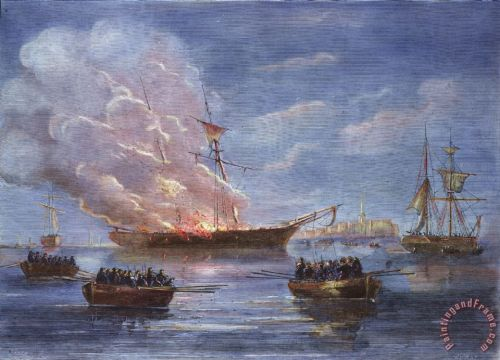
Although previous similar incidents had gone unpunished by British authorities, this time the Admiralty chose not to ignore the destruction of one of its military vessels. The British wanted to extradite suspected participants to London, where they would be tried for treason. Colonists were alarmed by the prospect of Americans being sent to England for trial, and a committee of correspondence was formed. (This was one of the earlier systems I mentioned before). In Virginia, the House of Burgesses formed a similar inter-colonial committee of correspondence to consult with similar committees throughout the Thirteen Colonies.
Ultimately, even though the identities of the perpetrators were widely known, the investigation was ultimately fruitless and no arrest was ever made.
Rhode Islanders are quick to claim that this event was more significant than the more highly publicized Boston Tea Party: Rhode Island Senator Sheldon Whitehouse noted in a recent interview with the Washington Post that “Nobody knows that well before anybody pushed a tea bag off a civilian ship in the Boston Harbor, Rhode Islanders blew up a military vessel.” The Washington Post article notes that Whitehouse made this comment while sitting in his office – in front of a painting that depicts the burning of the Gaspee.
Whitehouse continued to reflect on the vagaries of historiography:
“They got drunk, painted themselves like Indians and pushed tea bags into the Boston Harbor, which we in Rhode Island think is pretty weak tea compared to blowing up the goddamn boat and shooting its captain. But you know, all those Massachusetts people went on to become president and run Harvard … so they told their story, and their story, and their story.”
Here's a free link to the Post article if you want to read more.
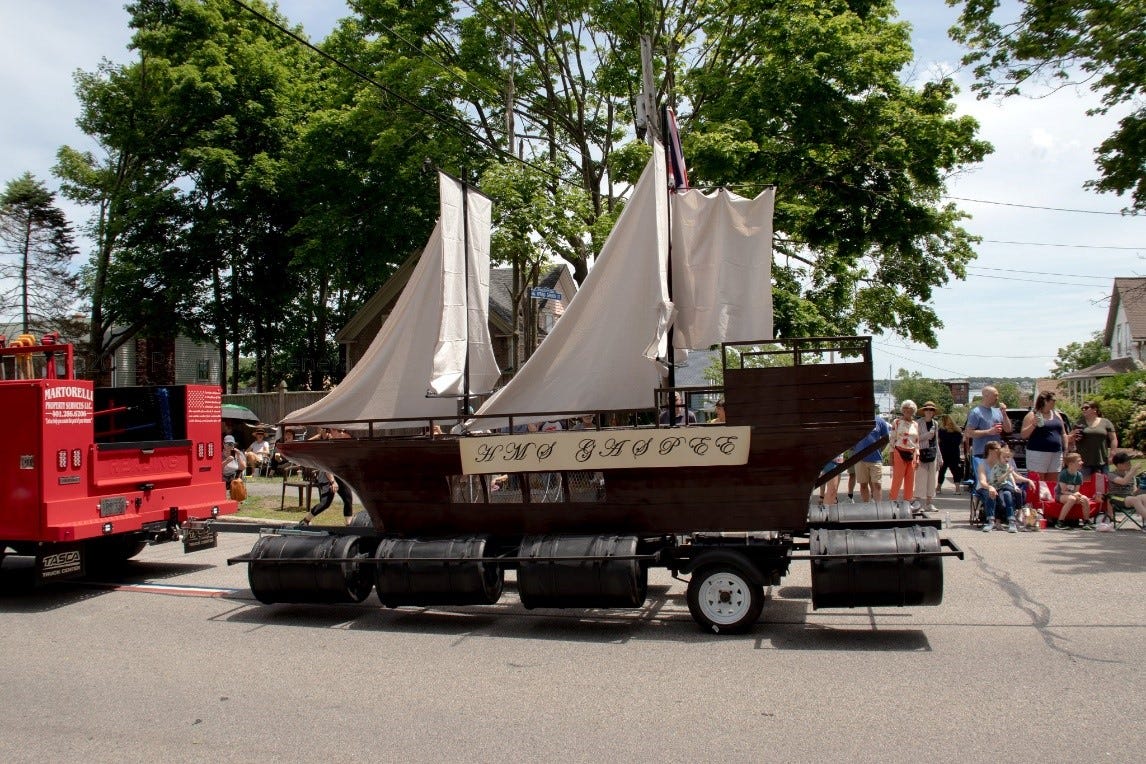
Communities in Rhode Island celebrate Gaspee Day; here’s a picture of a float in the Warwick, RI, 2022 celebration of this holiday. This year, the parade is on Saturday, June 8, at 10:00. It’s less than two hours from Weymouth, MA, for anyone interested in going to the parade. Take pictures.
The 1773 passage of the Tea Act led to the Boston Tea Party, as I described earlier, but also to similar protests in other communities. In December, 1773, three hundred families in Newport, Rhode Island, pledged not to drink tea, and many towns in Rhode Island adopted resolutions and established Committees of Correspondence against the Tea Act.
After Parliament adopted the Coercive Acts in 1774, the freemen of Providence reacted quickly, urging that all trade with England be immediately stopped. In addition, on May 17 of that year, they proposed a general congress of all the colonies to consider further “opposition to the Unrighteous Impositions.” When the General Assembly met in June, it quickly adopted the idea of an inter-colonial congress and selected Stephen Hopkins and Samuel Ward to represent Rhode Island.
Happy “Rhode Island Calls for Intercolonial Congress” Day to all who celebrate.
Pretty amazing, and all of this accomplished without any of the technology we have today. There’s more than one or two lessons here. Good for Rhode Island!!