Respite
250 Years Ago

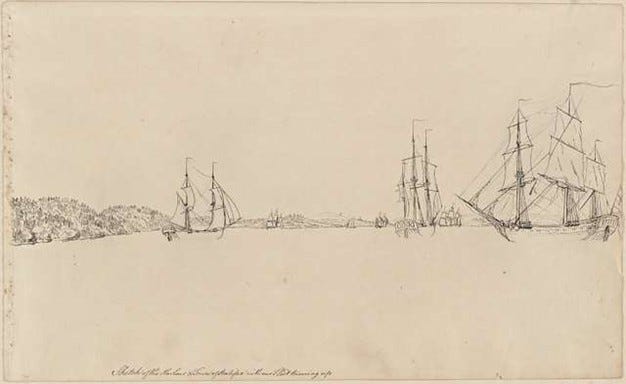
After the British evacuated Boston last week after a months-long siege by Washington’s Army on Dorchester Heights, this week was marked by a sort of breathing spell. The British army under William Howe headed toward Halifax, Nova Scotia, to regroup, although they had to remain at sea longer than expected due to bad weather and poorly provisioned ships. The Continental Army made no effort to chase down and challenge the Royal Navy – mainly because there was no American fleet to do this.
In Boston, some of the Continental forces focused on occupying Boston, restoring civil order, securing abandoned supplies and fortifications, and repairing buildings damaged during the siege. Washington didn’t let his guard down, fearing that the evacuation could be a feint or a diversion while the British army might land nearby, for example, in Rhode Island.
Boston showed clear signs of strain after the siege. In addition to buildings that had been torn down by the British for firewood or defensive works, others were damaged by artillery fire during the bombardments earlier in the month. The economy of the city was in crisis – trade had nearly collapsed during the siege, and shops and warehouses were empty. In addition, the harbor had been clogged with military shipping rather than commerce.
People moved around during this period. Loyalists who had departed with the British fleet left property behind. Many patriot families that had fled early in the conflict returned to reclaim their homes and property. The Massachusetts provincial government, which had been abolished in 1774 by the Coercive Acts, began to function openly again. Courts and town meetings restarted, and authorities began addressing the problems of confiscated Loyalist property, rebuilding damaged infrastructure, and restoring the food supply system. Businesses that had been shuttered during the siege took steps to reopen.
Despite these problems, the people of Boston celebrated by ringing church bells and preaching sermons of Thanksgiving. In subsequent weeks, militia parades and patriotic demonstrations occurred throughout the city.
This article appeared in Williamsburg’s Virginia Gazette on April 6, 1776 – three weeks after the evacuation of Boston and two weeks after it first appeared in the Pennsylvania Gazette.
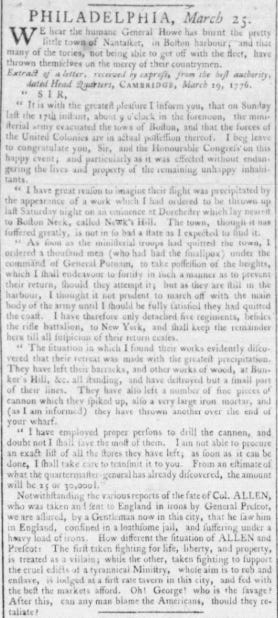
A little digging revealed that this was actually a dispatch written by George Washington to John Hancock, the President of the Continental Congress. Written on March 19, that dispatch is virtually identical to this letter as it appeared in the Philadelphia newspaper and in the Gazette.
Here’s the full transcribed text of the Gazette article:
PHILADELPHIA, March 25.
WE hear the humane General Howe has burnt the pretty little town of Nantasket, in Boston harbour, and that many of the tories, not being able to get off with the fleet, have thrown themselves on the mercy of their countrymen.
Extract of a letter, recently by express, from the head-quarters, dated Head Quarters, CAMBRIDGE, March 19, 1776.
SIR,
“It is with the greatest pleasure I inform you, that on Sunday last the 17th instant, about 9 o’clock in the forenoon, the ministerial army evacuated the town of Boston, and that the forces of the United Colonies are in actual possession thereof. I beg leave to congratulate you, Sir, and the Honourable Congress on this happy event, and particularly as it was effected without endangering the lives and property of the remaining unhappy inhabitants.
“I have great reason to imagine their flight was precipitated by the appearance of a work which I had ordered to be thrown up last Saturday night on an eminence at Dorchester which lay nearest to Boston Neck, called Nook’s Hill. The town, though it has suffered greatly, is not so bad a state as I expected to find it.
“As soon as the ministerial troops had quitted the town, I ordered a thousand men (who had had the smallpox) under the command of General Putnam, to take possession of the heights, which I shall endeavour to fortify in such a manner as to prevent their return, should they attempt it; but as they are still in the harbour, I thought it not prudent to march off with the main body of the army until I should be fully satisfied they had quitted the coast. I have therefore only detached some regiments, besides the rifle battalion, to New York, and shall keep the remainder here till all suspicion of their return ceases.
“The situation in which I found their works evidently discovered that their retreat was made with the greatest precipitation. They have left their barracks, and other works of wood, at Bunker’s Hill, &c. all standing, and have destroyed but a small part of their lines. They have also left a number of fine pieces of cannon which they spiked up, also a very large iron mortar, and (as I am informed) they have thrown another over the end of your wharf.
“I have employed proper persons to drill the cannon, and doubt not I shall give the most of them. I am not able to procure an exact list of all the stores they have left; as soon as it can be done, I shall take care to transmit it to you. From an estimate of what the quartermaster general has already discovered, the amount will be £35,000.
“Notwithstanding the various reports of the fate of Col. ALLEN, who was taken and sent to England in irons by General Prescott, we are assured, by a Gentleman now in this city, that he saw him in England, confined in a loathsome jail, and suffering under a heavy load of irons. How different the situation of ALLEN and Prescott! The first taken fighting for life, liberty, and property, is treated as a villain; while the other, taken fighting to support the cruel edicts of a tyrannical Ministry, whose aim is to rend and enslave, is lodged at a first rate tavern in this city, and fed with the best the markets afford. Oh! George! who is the savage? After this, can any man blame the Americans, should they retaliate?”
The editor of the Virginia Gazette added the final paragraph to the article as originally published in the Philadelphia newspaper Poulson’s American Daily Advertiser, Monday, March 25, 1776.
I wanted to figure this out. Why is this article referencing Ethan Allen and Richard Prescott – without identifying them to its readers or explaining their significance?
Ethan Allen helped capture Fort Ticonderoga in May 1775; he later joined an ill-coordinated attempt to seize Montreal and was captured by the British. He was imprisoned on a British ship for a while before being taken to Britain, where he was held in deplorable conditions.
Richard Prescott was a British general who was captured after the Battle of Bunker Hill and was imprisoned near Philadelphia, where he was treated with relative civility.
Newspaper readers in Williamsburg were expected to understand these references and recognize their propaganda value – the Americans were portrayed as kind and civilized, while the British were portrayed as brutes.
Meanwhile, Washington and his officers were planning what to do next. It made strategic sense for Britain to target the Hudson River corridor next, so Washington issued orders preparing regiments to march south toward New York. This marked the opening moves of what would become the campaign of 1776 – a campaign that would include the battles of Long Island (August 27), Kip’s Bay (September 15), Harlem Heights (September 16), White Plains (October 28), Fort Washington (November 16), and Fort Lee (November 20).
NOTE: I’ve been writing these ‘250 Years Ago’ essays since the spring of 2024, and there have been several weeks where I’ve really had to search for things to write about. As I look ahead to the rest of 2026 and beyond, I think I’ll have plenty of content.