
Reading
Weekend Update

I wrote last week about reading Jeffrey Rosen’s book The Pursuit of Happiness. I’m still reading it – I’m about 2/3 of the way through it – and I’m beginning to understand what he means when he says someone like Jefferson or Franklin “was reading” something – it meant that they read the book, then read it again, and returned to it at various times throughout their lives. They engaged in deep reading rather than extensive reading; there were fewer books in the 18th century, so educated readers reread the same books repeatedly. Their goal was not simple to acquire information, but to internalize style, moral lessons, and principles of reasoning.
Education in the 18th century was steeped in rhetoric – among those who were formally educated as well as those who were self-taught. They read, memorized, imitated, and recited classical literature. Readers often kept what were called “commonplace books” where they would copy out passages they wanted to remember and return to them later as they composed letters, speeches, or longer essays. When I was doing my graduate program in history, I remember reading Jefferson’s commonplace book.
The Enlightenment was a verb, not a noun; it involved action. Philosophical reading meant wrestling with a text, not just consuming it. Books like Locke’s Essay Concerning Human Understanding or Montesquieu’s Spirit of Laws were not books you raced through; rather, you might spend years dipping into the texts, discussing or writing about them, and regularly rereading them as your life situation changed.
Educated people in this time saw reading as an act of cultivation or exercise – much as we see physical exercise today – and a process that required repetition and discipline.
In 1819, for example, Jefferson wrote to Adams: “I am again devouring Tacitus, and I have more leisure to do it with care and with reflection than I had in my younger days.” What he did with speed as a younger man he was now doing with thought as an older man.
Adams agreed with this approach, saying at one point that Cicero’s writings were his “constant companion” and that rereading them was essential because “every man ought to read Cicero, and read him over and over again.” Adams was also known for the marginal notes he wrote in his books – sometimes writing new marginal notes responding to his earlier notes. He was in conversation with his books – and with himself.
If you’re like me, you probably have a stack of books (either literally or metaphorically) that you plan to read. Rereading something I’ve already read won’t do a thing to pare down that stack. But maybe revisiting old friends has some merit.
Public libraries and school summer reading programs always focus on how many books a kid reads over the summer – awarding badges or various trophies for the kids who amass the longest summer reading list. What about the kid who reads one book deeply – or several times? That’s more like what the Founding Fathers did.
When I was doing a genealogy research project a few years ago, I was trying to understand my father’s family in western Illinois in the second half of the 19th century. As I was poking around, I found a source that identified Illinois as The Prairie State. I’m an East Coast gal, and I had never thought much about the meaning of the word “prairie.” If I thought about it at all, I probably combined it with the Great Plains or thought about Little House on the Prairie.
Once I figured out that the Little House books were focused on roughly the same time and place as the family I was researching, I decided to reread the series. It had been easily 65+ years since I read them the first time. I found them full of all sorts of insights into the lives my ancestors had lived in Illinois; I was no longer that 10-year-old who had read them so long ago, and the story was much more complex and interesting than I had remembered.
I’m thinking about books that I should reread. I have reread some British murder mysteries a number of times – Gaudy Night by Dorothy Sayers probably most prominently, but all of Sayers and Agatha Christie are worth a revisit. I don’t know about academic books – there are probably some I could reread, but none draw me.
We gave three Kurt Vonnegut novels to our grandson for his 18th birthday, and I skimmed a couple of them before we sent them on. I vividly recall reading them when they first came out. I think I need to read them again.
I browsed the Internet and found some books that people say are worth rereading – Beloved, The Catcher in the Rye, 1984, Dune, Invisible Man, and The Lord of the Rings.
The only book that people are apparently willing to read and reread ad infinitum is the Bible. People read this book their entire life and still talk regularly about how they get more out of it every time they read it.
The only book that comes anywhere close is Goodnight Moon.
What books do you think you need to revisit?
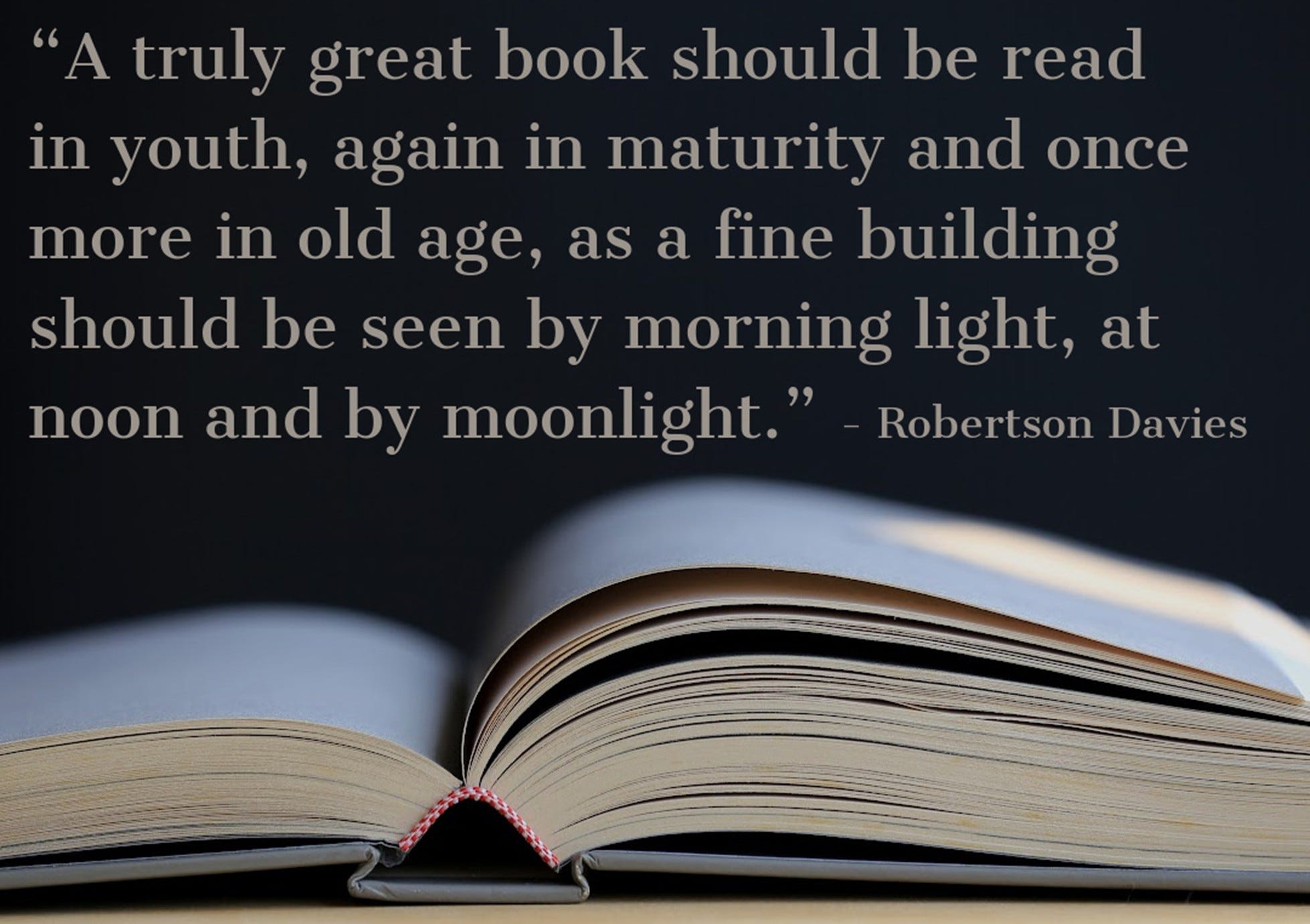
love the Davies quotation!
To Kill A Mockingbird
Timeline