
President Carter
sui generis

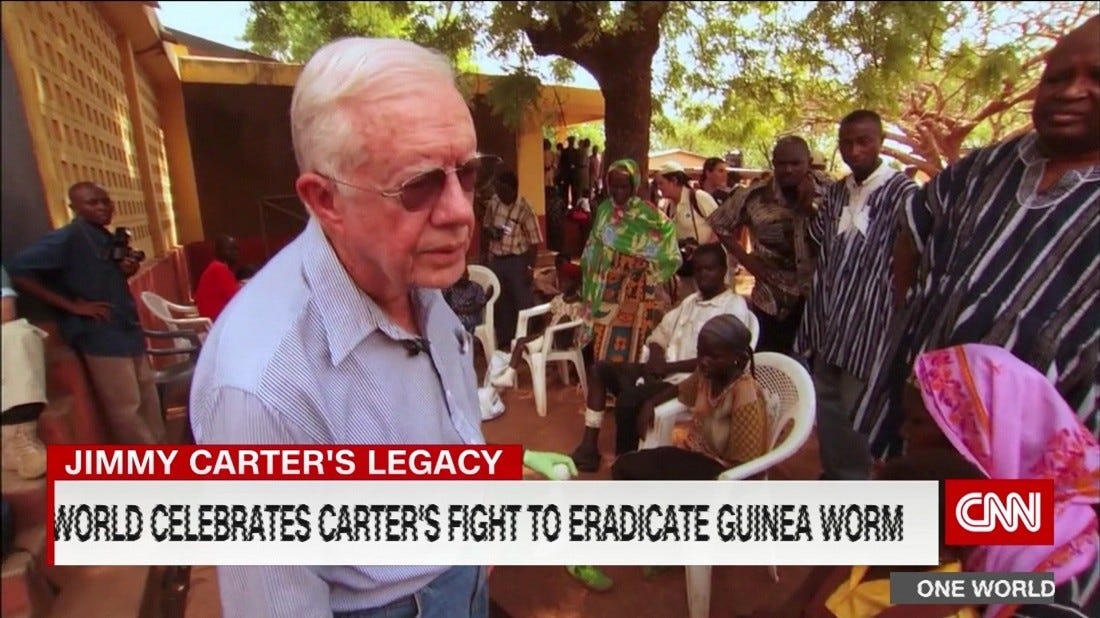
The worldwide period of mourning for President Jimmy Carter is ending, but I want to add one more acknowledgment to the career of this extraordinary man. Although people have spent a great deal of time and energy recounting various elements of his story over the past couple of years, no one (that I’ve seen) has told the story the way I want to tell it.
Carter’s presidency came in the wake of one of the most turbulent eras in modern political history. The United States had been shaken to its core by the growing civil rights movement and by the twin debacles of Vietnam and Watergate. I used to tell my high school government students that it was impossible to understand modern American government without knowing a lot about these events. Since their history classes never got to the post-WWII era, they didn’t know much about these events.
For two years, my first government unit of the year focused on these events (this was in the pre-SOL days when teachers could be more creative). Then I moved on to the elements of a government class – the constitution, governing institutions, political parties, and so forth – which all made more sense when students understood their what had led to their current environment.
When I taught about the presidency, I used President Carter’s victory in 1976 to illustrate these changes. What was significant about Carter? He was a former state governor, a graduate of the Naval Academy, a Southerner, and an Evangelical Christian. These characteristics made him a strong Democratic candidate in 1976 – but once that term ended, he was no longer the candidate the party wanted.
Former State Governor
It’s hard to remember when Americans generally held the federal government in high esteem. Before 1976, most people who became president had experience in national politics. That was the expectation – before someone was elected to lead the federal government, it seemed like a good idea to have some Washington experience. The seemingly heavy hand of Washington in implementing Civil Rights laws, the military disaster in Vietnam, and the corruption and criminality of the Nixon Administration led Americans to lose confidence in their national government.
Carter’s victory was at least in part because of his outsider status. But his outsider status also hampered his ability to work with Congress, and some of his worst mistakes were the result of his naivete and arrogance. Now, we don’t generally accuse Carter of arrogance – but the people who knew him and worked with him often noted his intransigence when people tried to explain that something he wanted to do just didn’t work.
It’s not hard to see the impact of this – since Nixon, Americans have elected only two presidents – Bush I and Biden – whose experience was primarily in Washington. Carter, Reagan, Clinton, and Bush II were all state governors with no Washington experience. Obama had served in the Illinois state legislature before serving in the US Senate for less than one term. Trump – well, ’nuff said. It is not hard to conclude that at least some of the dysfunction in American government is the result of constantly electing people who don’t understand how the government works.
Naval Academy Graduate
A Democratic president, Lyndon Johnson, was Commander in Chief leading the escalation of the Vietnam War. The leading voices in the antiwar movement, however, were also Democrats. The party somehow became identified with an unpopular war and an unpopular antiwar movement.
That takes talent.
After the antiwar movement splintered the Democratic party in 1972 (George McGovern was best known for his antiwar positions, and he was shellacked by Nixon in that year’s election), the Democrats had to find some way to gain back the “patriot” identity. Who better to do that than a Naval Academy graduate?
Southerner
The New Deal Coalition that underpinned the Democratic Party since the 1930s had been an uncomfortable amalgam of northeastern liberal intellectuals, pragmatic working-class voters, immigrants, religious minorities (primarily Catholics and Jews), and southerners who could not bring themselves to vote for the ‘Party of Lincoln,’ whom they blamed for everything bad that happened in the South after 1860.
The Civil Rights movement split the Democrats – in 1948 with the Dixiecrat walkout from the Democratic National Convention and in 1968 and 1972 with the segregationist candidacy of George Wallace. The Democrats had passed the Voting Rights Act of 1964 and the Civil Rights Act of 1965, further alienating Southern voters. Richard Nixon promulgated his “Southern strategy” to entice Southern voters to vote for Republicans. It eventually worked (all we have to do is look at election maps to see how successful this was), but the nomination of a Southerner in 1976 staved off the total electoral realignment for another election cycle.
Evangelical Christian
The Democratic Party had also become identified with the “sex, drugs, and rock and roll” culture of the 1960s. In 1972, the Democratic Convention featured delegates wearing tie-dyed shirts and sandals, sporting long hair (both men and women) and chanting antiwar and pro-equality slogans. This was scary to the “silent majority” of Americans, and this fear was transferred to the Democratic Party in general.
In addition, the Nixon scandals had revealed the corrupt underbelly of American politics. People lied, cheated, and stole to gain and maintain power. We heard the voice of the President – Nixon – cursing as he conspired to achieve nefarious goals. This was also scary to Americans – but they were not wary just of Republicans, but of politicians in general.
But then Carter emerged – a man who made no secret of the important role of his Christian faith in his life. He made regular references to the power of prayer, the need for personal and public morality, and to the small Baptist Church where he attended and taught Sunday School for decades.
In the 1980s, journalist Hedrick Smith wrote a book called The Power Game, which I asked my students to read for their summer reading before their senior year in high school. Some of them read it (I choose to believe this despite all evidence to the contrary). There was also a four-episode documentary based on this book, and I used this documentary in class for many years.
I looked for this documentary on YouTube as I was writing this essay, but it doesn’t seem to be available.
One episode I remember talked about how the Democrats managed to win the presidency in 1976. The analysis went something like this:
By the 1970s, the Democrats had lost the states-rights voters, the pro-military voters, the southern voters, and the ‘moral majority’ voters.
But what if they nominated – oh, I don’t know – a southern state governor with a military background who was also an Evangelical Christian? Maybe then they could win a presidential election.
And it worked. For one election cycle. But Jimmy Carter was sui generis, as the Democrats discovered in 1980.
In the later 1980s and 1990s, other Democrats from the South – most notably Bill Clinton and Al Gore – formed the Democratic Leadership Council (DLC) to move the party away from the leftward turn it had taken since the 1960s. Known derisively as the “Southern White Boys’ Club,” its goal was to win back white middle-class voters – to the probable detriment of the party’s minority voters. Clinton’s victories in 1992 and 1996 showed that this movement had some legs, but subsequent events led to the group’s eventual dissolution within a few years.
We all know a bit about Carter’s post-presidency – which encompasses most of my adult life. I’m a slacker by comparison. But we should not dismiss his presidency. He was a transitional president, the person who was in a position to help the nation recover from the turmoil of the previous decade. He was not successful. But he did leave us with a model of how to live a good life. That’s not too shabby.
President Carter has been honored this week and is on his way to be buried next to his beloved Rosalyn in Plains, Georgia.
The next President of the United States is as different from President Carter as it is possible to be.
While I was driving around on Tuesday of this week, I happened to hear a bit of the music that accompanied the process of President Carter’s casket to the Capitol rotunda, where he would lie in state before a funeral service at the Washington National Cathedral on Thursday and then his burial in Plains, Georgia, on Friday. The bit I heard included the “Ruffles and Flourishes” that preceded the first measures of “Hail to the Chief,” the music that has announced the arrival of a President of the United States since the middle of the 19th century. This was followed by a musical rendition of the hymn Just As I Am. Here’s the Navy band’s rendition of this hymn.
America is capable of so much goodness. I fear that we have lost the capacity for goodness and greatness.
I know this hymn.
When my mother died in 2012, I had the privilege of being alone with her. She was not awake and it was clear that her death was imminent. I sat beside her bed and sang hymns to her as she died. One of the hymns we both knew was Just As I Am, so when I heard this on Tuesday I was reminded of my mother’s death and I teared up. Here are the lyrics:
Just as I am, without one plea,
But that Thy blood was shed for me,
And that Thou bid’st me come to Thee,
O Lamb of God, I come! I come!

Just as I am, and waiting not
To rid my soul of one dark blot;
To Thee whose blood can cleanse each spot,
O Lamb of God, I come, I come!

Just as I am, though tossed about
With many a conflict, many a doubt;
Fightings within, and fears without,
O Lamb of God, I come, I come!

Just as I am, poor, wretched, blind;
Sight, riches, healing of the mind;
Yes, all I need, in Thee to find,
O Lamb of God, I come, I come!

Just as I am, Thou wilt receive,
Wilt welcome, pardon, cleanse, relieve;
Because Thy promise I believe,
O Lamb of God, I come, I come!

Just as I am, Thy love unknown
Has broken every barrier down;
Now, to be Thine, yea, Thine alone,
O Lamb of God, I come, I come!
I am sure that President Carter designed this set of memorial events, including the music to accompany every part of it. He is announcing to his God that he is on his way.
Fair winds and following seas, Jimmy. I’ll miss you.
Beautifully written. Great perspective. Thank you
I was listening along with you as I drove to another funeral a couple of counties away, and like you, was struck by the choice of that hymn, altho I also knew that Jimmy Carter (remember the kerfluffle when he refused to sign documents as James Earl?) had planned every minute of the service and obviously chose every piece of music. Was also struck by the Ruffles and Flourishes which he hated and which were not usually played during his time in office.
When I think of Carter, tho, I think of standing in Lafayette Park on the afternoon of Sept 17, 1978. A Jewish girlfriend and I had left work to join the crowd to listen to the signing of the Camp David Accords. We truly believed/hoped that the world would be a better place thanks to Carter's getting these two old foes together.
That accomplishment and Habitat for Humanity alone would make a wonderful legacy for Jimmy and Roselyn Carter, but there was so much more.