
Opportunity Costs

Economists use the term “opportunity cost” to refer to what the rest of us mean by “instead.” The concept is simple: when you choose to do one thing, you are sacrificing any benefit you might accrue from doing one of your other options. Because they are economists, they have a formula for calculating opportunity costs:
Opportunity Cost = RMPIC – RICP
Where
RMPIC = Return on most profitable investment choice
RICP = Return on investment choice chosen to pursue
This formula creates a real number when used to compare financial investment strategies. It is possible to calculate how much you’ll earn from one investment vs. how much you’ll earn from alternatives.
When we used “opportunity costs” to refer to non-financial investments – investments of time or energy, for example – it’s tougher to quantify.
Robert Frost wrote about this in one of the poems we were all required to read in high school English class:
The Road Not Taken
Two roads diverged in a yellow wood,
And sorry I could not travel both
And be one traveler, long I stood
And looked down one as far as I could
To where it bent in the undergrowth;

Then took the other, as just as fair,
And having perhaps the better claim,
Because it was grassy and wanted wear;
Though as for that the passing there
Had worn them really about the same,

And both that morning equally lay
In leaves no step had trodden black.
Oh, I kept the first for another day!
Yet knowing how way leads on to way,
I doubted if I should ever come back.

I shall be telling this with a sigh
Somewhere ages and ages hence:
Two roads diverged in a wood, and I—
I took the one less traveled by,
And that has made all the difference.
I want to spend some time today reflecting on the opportunity costs associated with the current Republican president. I’ve made a list of “insteads” — the things the government could — and should — be doing instead of the nonsense emanating from the White House.
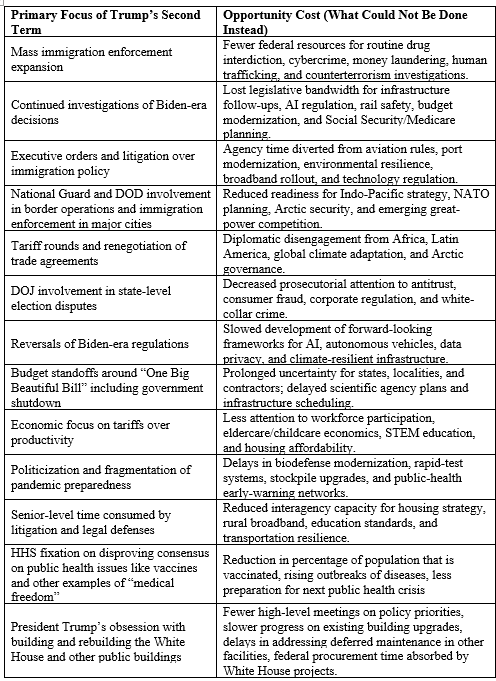
You can probably think of more items for this list.
The problem is that the federal government is huge and complex, and what it does is largely invisible until it stops working. Keeping it working takes investments of time and resources. This administration is focused only on the visible parts of government — the parts that swagger — and doesn’t care (or know) about the elements behind the scenes.
This makes me think of a book I read recently (or more accurately, listened to recently): Who Is Government? The Untold Story of Public Service by Michael Lewis. Here’s what Amazon says about this book:
The government is a vast, complex system that Americans pay for, rebel against, rely upon, dismiss, and celebrate. It’s also our shared resource for addressing the biggest problems of society. And it’s made up of people, mostly unrecognized and uncelebrated, doing work that can be deeply consequential and beneficial to everyone.
Michael Lewis invited his favorite writers, including Casey Cep, Dave Eggers, John Lanchester, Geraldine Brooks, Sarah Vowell, and W. Kamau Bell, to join him in finding people doing interesting jobs in government and writing about them. The stories they found are unexpected, riveting, and inspiring, including a former coal miner devoted to making mine roofs less likely to collapse, saving thousands of lives; an IRS agent straight out of a crime thriller; and the manager who made the National Cemetery Administration the best-run organization, public or private, in the entire country. Each essay shines a spotlight on the essential behind-the-scenes work of exemplary federal employees.
Whether they’re digitizing archives, chasing down cybercriminals, or discovering new planets, these public servants are committed to their work and universally reluctant to take credit. Expanding on the Washington Post series, the vivid profiles in Who Is Government? blow up the stereotype of the irrelevant bureaucrat. They show how the essential business of government makes our lives possible, and how much it matters.
I am certain that no one in the current administration has read this book or even knows about it. They don’t understand the government they are sworn to manage. They think that governing is a matter of making policy pronouncements and then watching them somehow magically become law and then operate without any additional effort.
When you watch or read about the latest nonsense coming from the governing party in this country — the GOP — think about what they could be doing “instead.”
Time spent on owning the libs is time lost on crafting solutions. This is a high opportunity cost indeed.
Pitiful. Looking at the chart, we see that the opportunity cost is too high on any topic. Too high by my standards but perhaps not to others. We only have one vote to change the equation. I'm optimistic that it can done. It must be done to save our democracy and the lives of millions. There is no decency in this administration or the Republican Congress.