
One Big Beautiful – Mess

In what has become a staple of budgeting under the current Republican president, the United States Senate had everyone on tenterhooks this past weekend as they tried to find their balls voted on the One Big Beautiful Bill Act (I swear that’s its name). The Republican leadership dumped the text of the bill on the Senators late Friday night and approved it Saturday night.
But let’s hold off on the applause, shall we? What they’re proclaiming as a monumental step in the budget process is one that should go by virtually unnoticed. This is simply one step in a budget process that has regularly been fumbled over the past 25 years.
Economist Paul Krugman regularly notes that the United States is an insurance company with an army — that’s what its budget priorities indicate. In his book Who Is Government? Michael Lewis says that the main function of government is to count things and then suggest policy changes based on what the government has counted. Policy changes are enabled by Congress. I used to stress to my high school government students that budgeting is Congress's most important job. It’s not the job that usually makes the most news or has the best soundbites — we can leave that to the performative nonsense of Nancy Mace or Marjorie Taylor Greene. But behind the scenes, developing and passing a federal budget is the most important thing Congress does. It creates government programs and then funds them. Nothing else really matters.
I have written about this before, but many of you were not yet subscribers to this Substack when I wrote this in 2022. https://kamcpherson.substack.com/p/a-broken-process.
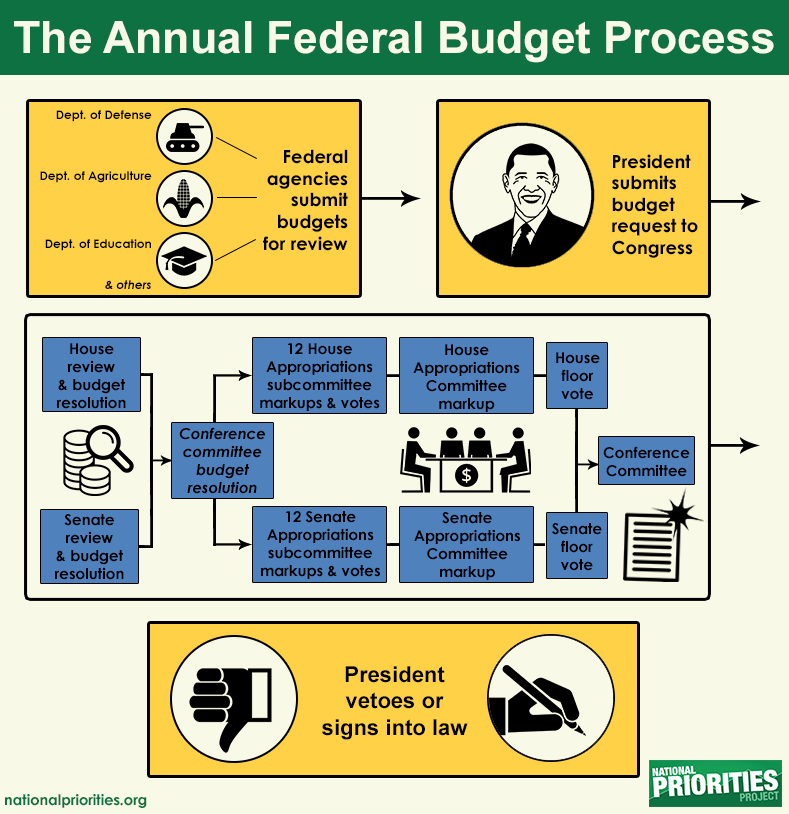
Now that you’ve had a chance to read a bit of the history of this process, here’s where we are now.
Congress is currently working on a budget for the 2026 fiscal year, which begins on October 1, 2025. According to the rules (rules, schmules), the federal budget is supposed to be firmly in place by that date so that the government can continue operating.
The first step in the budgeting process is for the House and Senate to agree on a budget resolution, which sets overall spending and revenue levels. This resolution, which was passed by both houses in April, enables reconciliation and guides the upcoming appropriations process.
HR 1, the OBBB Act passed by the House and now by the Senate, contains this language:
“It is known as a reconciliation bill and includes legislation submitted by 11 House committees pursuant to provisions in the FY2025 congressional budget resolution (H Con Res 14) that directed the committees to submit legislation… to increase or decrease the deficit and increase the statutory debt limit by specified amounts.”
Reconciliation (the process by which Congress “reconciles” actual laws with the fiscal plan or budget resolution it has adopted) is an intermediary step in the budget process. This step enables an expedited process in the Senate – a vote that needs only a simple majority to pass, rather than the normal 3/5 majority. In exchange for this expedited process, the rules of the Senate closely define what can go into a reconciliation bill. These rules are referred to as the “Byrd Rule” (named after Senator Robert Byrd of West Virginia) and essentially exclude any provisions of the reconciliation bill that are not budget-related. These rules are enforced by the Senate Parliamentarian, who decides what stays in the bill and what has to be excluded.
The current Senate Parliamentarian is Elizabeth MacDonough, who was appointed by then-Senate Majority Leader Harry Reid (D-Nevada) and has been reappointed by both Republican and Democratic majorities since then. The impartiality and independence of this role are evidenced by the fact that she is only the sixth person to hold this position since it was created in 1935. Recently, she ruled that multiple GOP provisions violated the Byrd Rule, blocking measures such a Medicaid cuts for non-citizens, SNAP adjustments, CFPB defunding, and changes to judicial oversight. These decisions pissed off some Senate Republicans, who even called for her removal. But the Senate leadership seems to respect her judgment – at least so far – and there is little indication that she would be removed in a partisan battle.
Although in recent years Congress has used Reconciliation as a way to pass partisan legislation that would not achieve the normal 60-vote threshold, it was never considered an essential part of the budget process. Instead, Congress traditionally focused on the appropriations process – the mechanism to create actual funding for the federal government. In theory, 12 appropriations bills, which cover discretionary spending like defense, education, and agriculture, are produced by the 12 subcommittees of the Appropriations Committees in the House and Seante in time for them to be passed by the full membership of each body by October 1 (the beginning of the government fiscal year.)
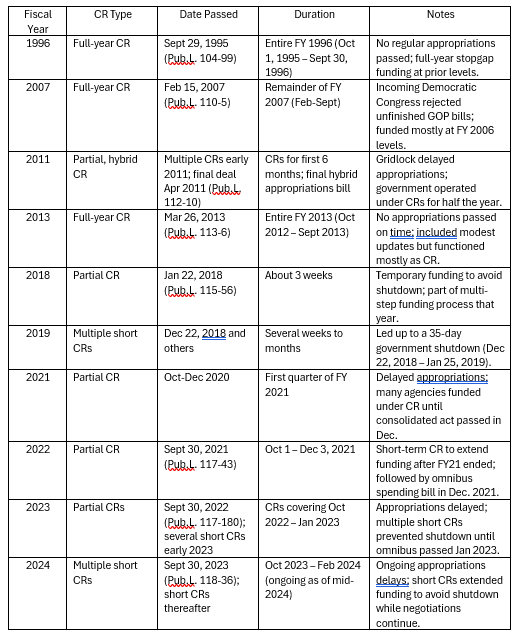
In recent years, Congress has not met these deadlines, leading them to be packaged into one large omnibus spending bill or several small minibus bills. When it has proved impossible for Congress to pass these bills by the deadlines, Congress votes on a Continuing Resolution (CR), which temporarily extends funding at current appropriated levels.
I asked ChatGPT to give me a visual representation of how CRs have been used in recent decades.
As of this morning (Monday, June 30, 2025), the Senate took a breather from its weekend marathon session. The Democrats in the Senate has done what it can to delay a vote on this bill, requiring the entire bill to be read aloud (it took 15 hours to read all 900+ pages) and speaking against the bill for the allotted 10 hours. After those speeches, the Senate adjourned in the wee hours this morning, planning on convening this morning to vote on amendments in a very thoughtful process called a “vote-a-rama.”
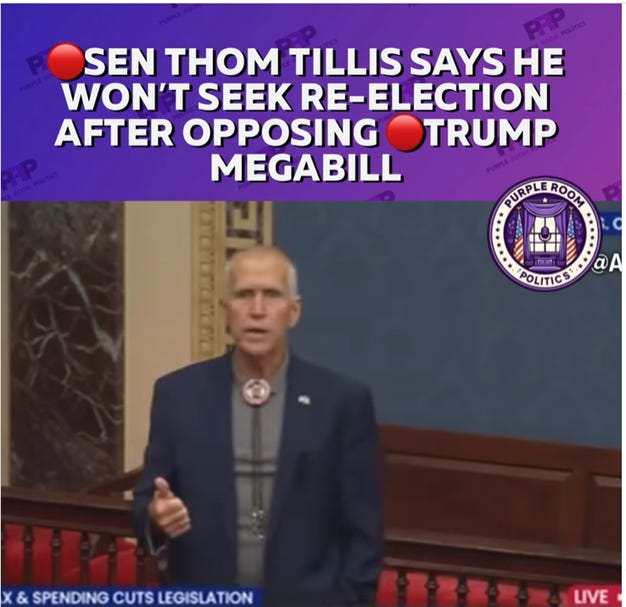
On one important political note, Senator Thom Tillis (R-NC) spoke out scathingly about this bill. Why is this notable? He was one of only two GOP Senators to vote against the bill as it squeaked through the Senate, but after that vote, the current Republican President publicly threatened to primary him in the run-up to the 2026 midterm elections. Tillis then announced that he was not going to run for reelection, and was the only member of the GOP to publicly denounce this bill. The Republic will be saved from the current Republican president only if other GOP Senators (it only takes a couple) follow his lead. There are at least a dozen Senators over the age of 65: Lisa Murkowski (68) and Susan Collins (72), who have been occasional holdouts from GOP support for the MAGA agenda, could take the Tillis route — speak out against the bill, and, when threatened with a primary, tell the current Republican president to take a hike.
Thanks for the detailed explanation of what’s what….. I’m going to take a deep breath and a long walk…..