
Okay, So Maybe History DOES Repeat Itself

This will be a short note this morning, because I have a lot to do today.
Yesterday, I taught the third session of a class for the lifelong learning program at Christopher Newport University in Newport News, about 30 minutes from my house in Williamsburg. I developed the course, Why the Civil War Happened and What We Can Learn From It, for the Osher Program at William and Mary and first taught it in 2018. I’ve taught it a few times since then.
The thesis is simple. Violence erupts in a society as a result of the failure of the political institutions that are supposed to help the country adapt to change. In the decades before the Civil War, the collective forces of territorial expansion, industrialization, and slavery challenged the political institutions – which held, more or less, until they all fell apart in rapid succession between 1850 and 1860. During this decade, the institutions that had previously powered through these challenges – the Presidency, the Courts, the Congress, the political party system, and state governments – proved incapable of handling the spiraling rate of change. When the political institutions of a society prove unable to solve growing problem, the stage is set for subnational or international violence.
In addition to the obvious connection to what’s happening around us today – that’s the “What We Can Learn From It” part – one event, the 1824 election, provides an example that is almost too on-point.
Here’s what happened in 1824:
The Revolutionary generation was gone – James Monroe, whose presidency ended in early 1825 after two terms in office, was the last president who had personal experience during the upheaval of the Revolutionary Era.
John Quincy Adams had served as Secretary of State during the entire Monroe administration. Up to that point in American history, the position of Secretary of State had been the jumping off point to become President. Jefferson, Madison, and Monroe had all served in this position, so John Quincy Adams was the logical candidate for this office as the 1824 presidential election approached.
There were four candidates in the general election – Andrew Jackson, JQA, William Crawford, and Henry Clay. Here are the results of the election

Yes, they were all members of the same political party, although they represented different alliances within the party. Jackson represented a new Jacksonian alliance, Adams was considered an Adams/Clay Republican (best described as an anti-Jacksonian alliance), Crawford represented the dying group of Republicans in the 1790s mold, and Henry Clay was also part of the Anti-Jacksonian group.
Although Jackson won the popular vote and the electoral vote, he did not have the majority of the electoral vote as required by the Constitution. This meant that the House of Representatives would decide the election in a process laid out by the 12th Amendment. Under this amendment, the names of the top three candidates were to be sent to the House for consideration. This meant Jackson, Adams, and Crawford would be under consideration for the presidency. Crawford, who had suffered a stroke in 1823, was not given serious consideration due to his health. The real race was between Jackson and Adams.
Because Clay had come in fourth in the race, his name was not considered by the House. Clay, however, despised Jackson and worked to defeat him in the House. Part of the reason he hated Jackson was that both Jackson and Clay represented “the west” at the time – Clay was from Kentucky and Jackson was from Tennessee – and they both wanted to be the “man of the west” in national politics. Jackson had military experience, however, and this proved hard for Clay to counter.
But Clay, nonetheless, had significant sway in the House. When he had been elected to the House as a War Hawk in 1811, he had immediately been named Speaker of the House, being the first of only two newly elected members elected speaker throughout the history of Congress (the other was William Pennington in 1860). Clay exerted his leverage on behalf of Adams when the House carried out its responsibility for electing the President in 1824, with the result that Adams defeated Jackson to become the nation’s sixth President.
After Adams assumed office, he named Clay his Secretary of State – a position which, as I mentioned above, was seen as a springboard to the Presidency.
Jackson was predictably outraged, and his supporters called the Adams/Clay cooperation a “corrupt bargain.” They claimed that Adams and Clay struck a deal – that in exchange for throwing his considerable power in the House behind Adams, Clay was given the position that would set him up to be President after Adams.
Jackson’s supporters claimed that the 1824 election was stolen from its real winner – Jackson – and they vowed to take the Presidency back in the next presidential election in 1828. Jackson and his supporters began to run against Adams virtually the day after the election was decided, making it difficult for Adams to accomplish the things he wanted to do while President, because everything he did was challenged by the increasingly vocal and powerful Jacksonian wing of the party. Adams’ political opponents, powered by the Jackson coalition, picked up seats in the 1826 midterm elections, and powerful voices – including John C. Calhoun and Martin van Buren – vowed their support in the upcoming presidential election.
Sure enough, Jackson had so weakened the Adams presidency that he was able to defeat Adams in 1828. Moreover, the 1828 election completed the era of party transition that had begun at the end of the War of 1812. The old Democratic-Republican party, divided into warring factions in 1824, had given way to a new party, the Democrats, whose new party credo echoed Jacksonian populism. The smaller group that remained loyal to Adams became identified as the National Republican Party, which would become the Whig Party by the early 1830s.
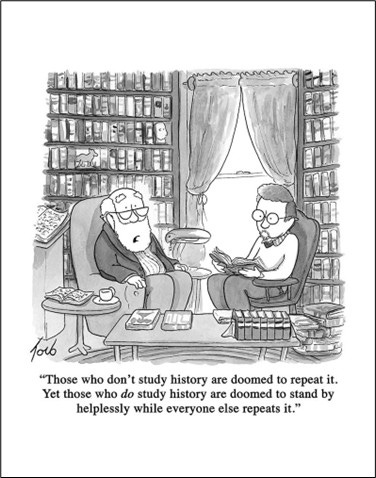
This all happened almost exactly 200 years ago. A presidential candidate claims an election was stolen. His supporters almost immediately begin the next presidential campaign and work for the next four years to undermine the elected president. They succeed in putting their preferred candidate in office at the next presidential election.
Who’s ever heard of such a thing!
I always thought Jackson was the country's worst president and used him as an example when discussing with my children why the presidency could survive the worst of despots and still rebound. Surviving both Jackson and Nixon led me to my conclusion. Wow was I wrong! I had similar thoughts about the supreme court. Wrong again!
Your history discussions are fun to read.
If you are an American I would feel a deep sadness in that. If you are not then here are a few reasons below why America fought Nazi Germany during WWII and I volunteered to serve my country.
Nazi Germany declared war against the United States after Japan declared war and attacked Pearl Harbor.
Nazi Germany destroyed U.S. freighter ships sent to our closest ally England to help provide much needed food and medical supplies after they had already declared war on England the year prior, and America had not attacked any Nazi Germans.
Nazi Germany invaded Poland, Czechoslovakia, Holland, Austria, stealing their national wealth and property, killing their men, women, and children, using many survivors as slave labor, and implementing the mass destruction of Jews.
My Grandfather volunteered to fight against Nazi Germany and became a Sergeant and squad leader. Some of his squad were caught in a barbed wire obstacle while under enemy fire; he attempted to free his squad members and was shot and captured by a Nazi SS platoon, and placed inside Bergen Belsen Prisoner of War camp. Adjacent was a Jewish Concentration Camp. He kept a diary during 7 months of capture under penalty of death if caught, and escaped during a bombing raid. He later became a Doctor and had six children. Reading his diary had a profound affect on me.
I volunteered to serve in the Army in honor of my grandfather and became a Sergeant in an Airborne Infantry regiment, was a squad leader, and fought against an Iraqi Army that invaded a peaceful Kuwait, killing unarmed men, women, and children; they threatened to fight and invade Saudi Arabia, firing ballistic missiles into their country as well as Israel, killing innocent men, women, and children, and threatening global stability. Iraq attacked Americans that were stationed in Saudi Arabia and Israel.