
Names Matter

NOTE: I know this is Christmas Day, and I thought about writing a Christmas-themed post for today. But I was drawn to this story and wanted to share it with you.
Over the past week, president-elect Donal Trump has indicated that he wants to revert to the old names for mountains and military bases. Because woke or something. He mentioned changing the name of Denali (the highest mountain in North America) back to Mt. McKinley and the name of the North Carolina military base Fort Liberty back to Fort Bragg.
As a reminder, Bragg was an unpopular and ruthless Confederate commander who was the target of an attempted fragging during the American Civil War. Bragg’s biographers often refer to his racism; one noted that Bragg opposed drafting enslaved people into the Confederate army because he didn’t believe they could be made into reliable soldiers.
I was reminded of this earlier this week when the spring catalog for the Osher Program at William and Mary was published online. Included in the regular administrative information and class schedule was the announcement that the program had moved to Boswell Hall on the William and Mary Campus. I like that the program will be on campus instead of in a shopping center – although parking will be challenging.
These two bits of information are brought together by the fact that Boswell Hall was named Morton Hall until 2021. Who were Morton and Boswell and why was the name changed?
When Morton Hall was constructed in 1972 (after I graduated from college), it was named after Richard Lee Morton, a faculty member at the college for almost 40 years and the history department chair. Morton was Associate Professor of History and Political Science from 1919 to 1922, Professor of History and Political Science from 1922 to 1959, and Chancellor Professor of History, Emeritus, from 1959 to 1968. It seemed reasonable to name the building after him, as this was to be the site of the college history department. But as time went on, this name became problematic; Norton and written several books with racist and white supremacist themes, including his 1919 tome The Negro in Virginia Politics, 1865-1902.
William & Mary was one of many communities and universities across the country that reacted to the George Floyd murder by removing Confederacy-related names from streets and buildings and taking down statues and memorials to the losing side in the American Civil War. Morton Hall was one of the buildings whose name was changed.
But who was Boswell? Interestingly (to me at least), I knew the Boswell whose name this building now bears. John E. Boswell (or Jeb, as he was known) graduated from William & Mary with me in 1969 (meaning that he and I both overlapped with Morton, who retired from the college at the end of our junior year). Jeb and I were in the college honors program the first year it existed – our freshman year. We were in English class together and in an Honors colloquium. I can’t claim that I knew him well – he was an unusual sort of guy and hard to know. I found out later that his outlier status was due in part to the fact that he was both gay and deeply closeted, at a time when such things were not spoken of.
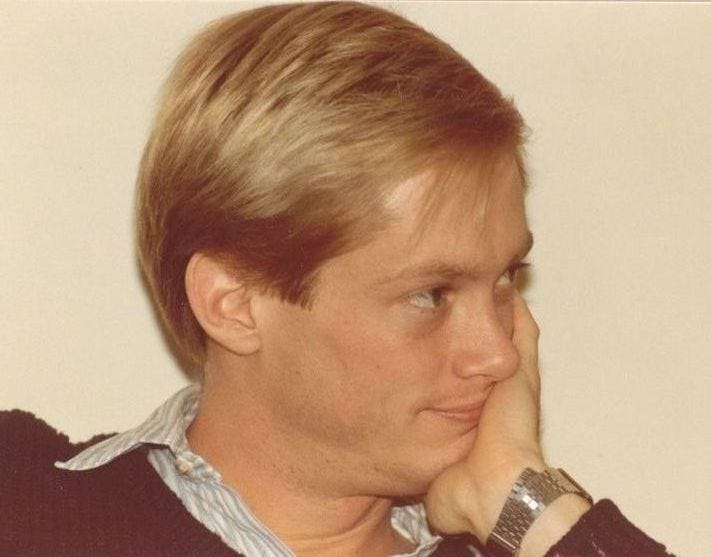
Jeb went on to a stellar academic career after earning a doctorate from Harvard. He was a professor at Yale whose scholarship in medieval history reshaped the field by uncovering LGBTQ+ people and traditions from that time. He also founded the Lesbian and Gay Studies Center at Yale in 1987. His obituary (he died of complications from AIDS in 1994 at the age of 47) notes that he was “brave and pioneering. And very brilliant.” Can confirm. Also that he was controversial.
Bob Maccubbin was the professor of the English class where I first met Jeb. Mr. Maccubbin (we called our professors “Mr.” and it was hard for me to call him Bob when I ran into him again after we moved to Williamsburg) and I became reacquainted in the Osher program – he took classes from me and I took classes from him. He told me once that Jeb was the most brilliant person he ever met.
According to his obituary, Jeb read or spoke 17 languages, including Church Slavonic, Old Icelandic, and some classical Armenian, Syrian, and Person. He joined the Yale faculty in 1975, became a full professor in 1982, and served as chairman of the history department in 1990.
William and Mary did not just name a building after him and then forget him. Since 1997, the college has hosted an annual endowed Boswell Lecture on topics related to his research during Homecoming each year. In October of 2024, the title of the Boswell lecture was “Our (Gay) Corner of Paradise: John Boswell’s Aelred of Rievaulx and Queer Worldmaking.” I don’t know what most of these words mean, but I learned about Jeb’s importance to his field by reading what the presenter (James Staples, who graduated from the College in 2010 and is a Visiting Assistant Professor of English at Trinity College, Hartford, wrote about him in the blurb announcing his topic:
I must make an embarrassing confession: I believe in John Boswell’s medieval gay subculture. Part of me will always believe in it, despite scholarship’s dismissal of it as anachronistic or essentialist. As a queer child in an evangelical household, I needed Boswell’s gay subculture to imagine the possibility of my own future. Following theories of minoritarian melancholia (whereby one ambivalently holds onto a reality that society rejects) I recognize my scholarship—devoted to queer futurity—as a negotiation of my ambivalent feelings around childhood shame, the ecstasy I discovered in Boswell’s text, and my present embarrassment at such ecstasy. My scholarship thus seeks to perform a reality in which Boswell’s gay subculture could exist, contributing to the invention of a more expansive future.
Boswell himself made a similar life-changing discovery: Reading Douglass Roby’s accounts of the twelfth-century Cistercian abbot, Aelred of Rievaulx, Boswell found not only a historical tolerance of homosexuality but also proof of its dignity. The backlash he received from stating that Aelred was unquestionably gay crushed Boswell. Yet by melancholically holding onto Aelred’s gay identity, Boswell forever altered reality: Beyond the effects in Aelred studies (almost every study now addresses the saint’s sexuality), Boswell’s Aelred challenged and inspired other queer trailblazers, from Michel Foucault to Derek Jarman, to reevaluate their relationship to the past and present to imagine different futures.
I haven’t been in Boswell Hall since it was renamed a few years ago. I’ll be there early in January, and I am moved by the prospect.
The local William and Mary alumni club has helped me make another connection to Jeb. Jeb’s distant cousin, James Boswell, graduated from the college in 1986 and is an adjunct professor at the Mason School of Business at the college. I first met him at an Alumni Club gathering and we have talked about Jeb a couple of times. In a recent issue of the William and Mary Alumni magazine, I found a story about James; in it, he talked about his cousin Jeb.
“Jeb was not ‘out’ to anybody and was terrified that people were going to find out he was gay, but he still said the best time of his life was at W&M,” Boswell says.
The younger Boswell recalls taking history classes as a student in what is now Boswell Hall and at times hesitating to tell professors that he was related to John E. Boswell for fear of not living up to such a “brilliant scholar, researcher and writer.”
At the Boswell Hall dedication ceremony in 2021, Boswell said, “As I speak with you today with my husband, Chris, looking on, I am able to be my authentic self. Had it not been for the brilliance of John Boswell, I doubt that would be possible. So today, I don’t feel that I’m in John Boswell’s shadow. Today, I feel that I’m in John Boswell’s light.”
I love knowing that a building on my campus is named after someone I know. I love that my college decided that the legacy of Jeb Boswell should be recognized and honored. I think it’s great to rename buildings after people whose stories are accessible to people who currently walk the campus. Many campus buildings are named after people who provided the funds to build them or for people who died centuries ago (I’m looking at you, Washington Hall and Jefferson Hall).
It's easy to quote Thomas Jefferson about – well, almost anything. The boy wrote a lot. But at one point he said that “every constitution then, and every law, naturally expires at the end of 19 years. If it be enforced longer, it is an act of force, and not of right.” I don’t agree with him that we need to sunset every constitution and every law after 19 years, but I do think it’s a good thing to rename buildings regularly.
The names would then reflect the prevailing rather than the historical ethic. And we wouldn’t get hung up on the names of things. Lee Highway in Northern Virginia would have been renamed 150 years ago. Jefferson Davis Highway in Alexandria would have been a historical relic by the same time. John Tyler Highway near me would no longer be named for slaveholders. It could be named for, oh, I don’t know, Will Molineux. Will was the editor of the Virginia Gazette from the 1960s until a decade ago, and his imprint on Williamsburg was significant. He continues to have an impact; he teaches Osher classes on the history of our community – not the long-ago history, but the history from 1850 through the 1950s or thereabouts. We should name a road for him. To heck with John Tyler.
FOOTNOTE: Research is amazing. In clicking around to get information for this post, I found a 2-hour documentary about John Boswell, done in 2022. I haven’t watched the whole thing but here it is in case you’re interested.
Thanks you so much for this post. I am grateful to you for expanding my knowledge in so many ways. Whether it is history, economics, popular culture, Williamsburg, William and Mary...I always learn something that expands me as a person. Thanks you for your substack posts. All the best to you in the new year.
What a sad and wonderful post. Very touching. I could go on, but won’t. Instead I’ll just wish all of us a warm, peaceful, and joyful holiday.