
‘Might Makes Right’ is Wrong

In my first graduate school class on international relations, the professor began by discussing the difference between influence and power. He walked over to a desk where a slender young woman was seated, picked up the desk (and her), and moved her a couple of feet. This made her (and the rest of us) uncomfortable, but he apologized and then made his point – that he could do this because he was big enough to do it and because she was unlikely to smack him because he was the professor. He simply said, “This is power.” We all nodded wisely as he walked to the front of the classroom, casually saying over his shoulder, “You can put your desk back in the right place now,” as he walked away. When she complied, he turned to face the class while announcing dramatically, “And that is influence.” Point taken.
There’s also a distinction between power and authority. Power means the ability to physically force people to do what you want; authority means that some recognized governing body has given you that power. I may have the power to throw you to the ground and disarm you (I don’t, but stick with me here), but I don’t have the authority to do so, and doing so will subject me to criminal charges. The President has the authority to do many things, but not everything. If he assumes authority he doesn’t have and then orders you to implement his decisions, you are right to disobey him (even though he is the President), because he acted beyond his authority. The authority to do some things doesn’t mean the authority to do anything he wants.
There are three ways to get people to do what you want. You can use brute force – metaphorically picking up their desk (with them in it), telling them to do what you want them to do or face unacceptable consequences, or convince them that they want to move their desk and let them do it for you.
Democracies don’t use option one – brute force – unless there are no other options. Leaders prefer to persuade their followers to choose a particular course because the followers see its value. If they can’t accomplish this, then threatening consequences is the next best option. Anyone who has raised children understands this. “Because I said so” is the last gasp of an exhausted parent who has tired of constantly being asked “why?” by their toddler (or teenager). The best approach is to model the proper behavior and then to encourage the child to follow your lead through endless reminders. If that doesn’t work, parents threaten consequences (and follow through). Parents should not threaten to ‘turn this car around and go home’ unless they intend to do just that if the inappropriate behavior doesn’t stop. Only in extremis do good parents physically manhandle a child to get them to do what the parents want. It’s okay to grab your child and throw him to the side of the road if you’re saving him from an oncoming car; it’s not okay to grab your child and throw him to the side of the road if he sassed you.
Bullies don’t know this. They think that being able to do something gives them the right to do it. We’ve seen this in the Trump administration – both domestically and internationally over the past year. He sends people in masks and tactical gear into the streets of our major cities and gives them the authority to rough people up as they seize them and ‘disappear’ them. Through his cosplaying Secretary of Defense, he touts the military's lethality without specifying the purpose of its lethal actions. He claims that the laws of war are for sissies. None of this makes Americans safer or more secure. Might not only does not ‘make right ’; it usually makes the achievement of ‘right’ less likely.
For each of the elements I’m presenting in this essay, there are obvious connections to what the Trump administration is doing at home and abroad. I won’t spell out these connections here, but you know what they are.
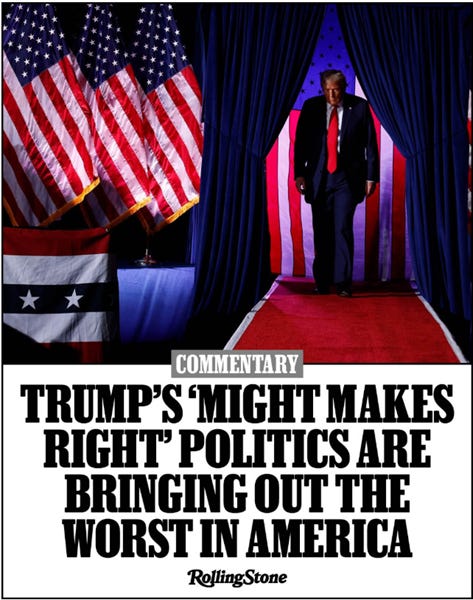
‘Might makes right’ undermines the rule of law. A healthy democracy depends on lawfulness, not raw power. When leaders treat power as justification for action, institutions become tools of personal will rather than protectors of citizens’ rights. Domestically, this means weaponizing agencies, ignoring legal limits, and rewarding loyalty over merit – behaviors that corrode the constitutional framework. Internationally, ignoring treaties, alliances, or norms signals to other nations that commitments are meaningless. That makes the world less predictable and thus less stable.
People in the cities may decide to take the law into their own hands if they don’t trust the intentions of the law enforcement folks who have been dropped into their midst. The leaders of some of the cities that have come under attack have indicated that their local police have the authority to resist unidentified armed individuals on their streets. These leaders are correct. One person lost her life a couple of weeks ago because of this, which doesn’t justify the murder but does explain it a bit.
Power without legal constraint becomes arbitrary rule. Suppose a society decides that any individual – President or otherwise – has unlimited power. In that case, the death spiral is inevitable, as subsequent leaders cannot survive long under the same anarchic ethos that allowed them to rise in the first place.
This approach also weakens the nation’s strategic position by treating diplomacy as weakness and coercion as strength. In reality, coercion invites counter-coercion. Bullying allies drives them toward other powers. Abandoning predictable norms (NATO commitments, trade agreements, human rights positions) makes the U.S. unreliable – not feared, just distrusted. Strong countries win not because they intimidate others, but because they build coalitions, legitimacy, and shared purpose. That’s how the U.S. contributed to winning WWII and the Cold War, and built 75 years of relative global stability.
Fear-based power is brittle. Trust-based power is durable. If your child obeys you just because you’re bigger than him, his teen years will not go well for you.
‘Might Makes Right’ also confuses force with effectiveness, assuming that the ability to impose your power automatically produces the right or best outcome. History shows the opposite; Vietnam, Iraq, and Afghanistan proved that military strength cannot solve political or social problems. Domestic crackdowns cannot solve systemic problems like immigration, economic inequality, racism, or other social divisions. My own pet peeve in this regard is the insistence by some people that people should be forced to say the Pledge of Allegiance, or that flag-burning should be outlawed. My response is that if the country is doing the right things, many people will say the Pledge without threats of consequences, and most people will refrain from burning the flag. Force can silence dissent, but it cannot solve underlying problems.
This approach also rewards impulse over judgment. Leaders who believe they have the right to do whatever they want will ignore expertise, bypass deliberation, punish disagreement, and act on grievance or other emotions rather than on reason. This leads to erratic, counterproductive policy – especially in an administration that frames disagreement as disloyalty. Impulsive leadership is dangerous leadership – and no more so than in a crisis.
‘Might Makes Right’ also erodes domestic social cohesion. When power becomes the metric for judging a policy's correctness, politics devolves into domination rather than representation. In this situation, minorities become targets, opponents become enemies, disagreement becomes disloyalty, and citizens become subjects rather than participants. Democracies need shared belonging, not ongoing retributive internal conquest.
This approach also mimics authoritarian models that, historically, have always failed. By appearing to mirror regimes like Putin’s Russia, Xi’s China, or Orban’s Hungary – or 20th-century regimes led by Hitler, Mao, or Stalin – authoritarian governments may look powerful. However, they crush innovation, breed corruption, weaken economic competitiveness, hollow out institutions, and ultimately collapse under their own rigidity. This may take a long time, but even while they are functioning, their subjects suffer rather than flourish. Authoritarians concentrate power but destroy national vitality.
A government that prioritizes ‘might’ has to be on a constant search for threats over which it can assert dominance. This approach turns foreign adversaries into tools for domestic politics, and domestic opponents become scapegoats used to rally a base. Institutions like the DOJ, DHS, ICE, and the military become instruments of punishment against invented enemies rather than guardians of the nation. A society cannot thrive when its government is perpetually at war with its own people.
Most fundamentally, ‘might makes right’ violates America’s founding philosophy. The United States is explicitly built on the reverse of this approach, as the nation has always assumed that ‘right makes might’ – the American is great because it is good, not because it can force others into submission. Our founding documents affirm that legitimate authority (meaning the legitimate use of power) flows from justice, consent, and respect for rights, not brute force. The Declaration of Independence argues that governments derive ‘their just powers from the consent of the governed.’ The Constitution is replete with checks and balances that both share and limit power, making the execution of raw power difficult (although, as we have seen, not impossible). American strength has historically come from shared principles, not domination – although the Native Americans and enslaved individuals would like to join the chat.
President Trump has lived his entire life as a bully, threatening and dominating people through his venality and amorality. He stands for nothing and has shown a lifelong willingness to do ‘the wrong thing’ if it suits his purposes and if he can get away with it. To him, laws are challenges to be overcome rather than guardrails to be observed.
I’m reminded of a statement always attributed to Mahatma Gandhi (although the internet tells me this morning that he almost certainly didn’t say these precise words):
An eye for an eye makes the whole world blind.
Power-based justice is always self-destructive because it assumes that the person with the most power gets to decide what is true, lawful, and justified. If everyone uses power to punish, dominate, or retaliate, everyone ends up harmed. Power becomes the only currency, and the result is escalating political and social – if not literal – damage. Retaliation perpetuates conflict rather than resolving it. Force invites more force, leading to cycles of vengeance rather than solutions. Domestically, this leads to escalating political reprisals, attacks on institutions, and the conversion of opponents into enemies. Internally, this means endless spirals of military confrontation, breakdowns in diplomacy, and destabilized (and thus ineffective and untrustworthy) alliances.
Justice rooted in power corrupts communities and nations, leading society to lose its moral vision. Law becomes a tool for power, not fairness, and each use of force justifies the next until no one is safe. It highlights the loss of empathy or a sense of shared humanity. ‘Might makes right’ treats people as obstacles or enemies, whereas the Gandhi-attributed statement reminds us that without restraint, empathy, and shared norms, we destroy the fabric of coexistence.
Gandhi argues for moral authority over raw strength. A society is strongest not when it inflicts the most damage (both domestically and internationally) but when it builds the strongest trust, institutions, alliances, and moral legitimacy.
The current Republican administration doesn’t understand this.
My friend and fellow Substacker Harry Chancey wrote an excellent piece yesterday that shows how far Trump has taken us in this direction. You can read it here.

Great piece. I respond to the bait rage I hear on the news. My response is deep breaths to calm myself and then try to consider what I'm really hearing. Your piece makes response to this bait clear. It's not just bait; it's really happening in real time. Keep pushing.
I appreciate the post, though I do have one point of contention: I’ve always viewed “might makes right” in a descriptive lens, where power dictates legality and enforcement but is separate from true morality. Am I wrong in this regard?