
Making American Irrelevant Again
Nature abhors a vacuum. When the US leaves, China waltzes in. And Xi doesn't have to worry about elections or public opinion polls.

I’ve been struggling to pull all of this together, but here’s what I’m thinking about today.
It’s all about the exercise of power – both hard and soft – in the global community. A recent article in Foreign Policy made me think about this: Trump’s Volatility is Pushing Asia Toward Beijing.
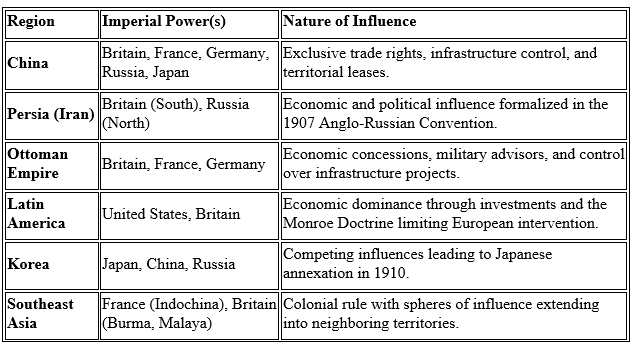
During the Age of Imperialism (late 19th century), the powerful nations of the world claimed exclusive rights or privileges – usually economic or political – to a region or territory without directly governing the area as a colony.
Examples from this period include the following territories:
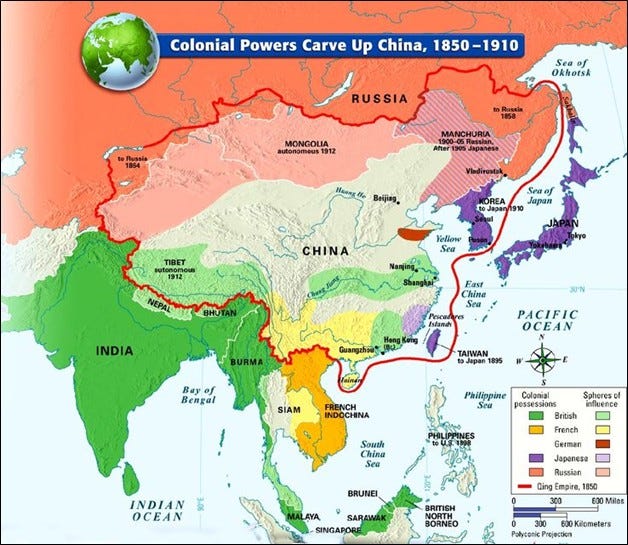
China is the most obvious example. Here’s a map of China showing how it was carved up into spheres of influence at the end of the 19th century.
The 50-year Cold War (between the end of World War II and the mid-1990s) featured a similar carving-up of the world into spheres of influence. Here’s what the global alliances looked like in 1980.
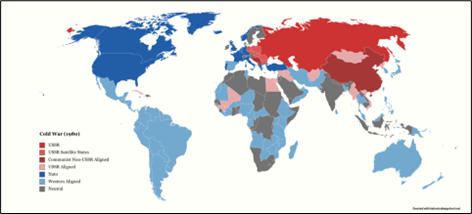
We all recall the proxy wars that were fought when one global superpower interfered with a country considered to be in the sphere of influence of the other superpower: Korea and Vietnam are the most obvious examples, but there were other conflicts over this issue: the Cuban Missile Crisis, the Soviet-Afghan war, and civil wars in Angola, Greece, Guatemala, and Nicaragua, to name a few.
Currently, China poses the biggest challenge to the global power and influence of the United States. In the course of looking into this over the past couple of days, I came across the Global Influence Index, which specifically focuses on the comparative influence of China and the United States in 191 countries of the world. Here’s a link to the website if you want to take a look – it’s pretty interesting. There’s loads of information on this site, including country-by-country analyses of how the United States and China are faring in the competition for power and influence.
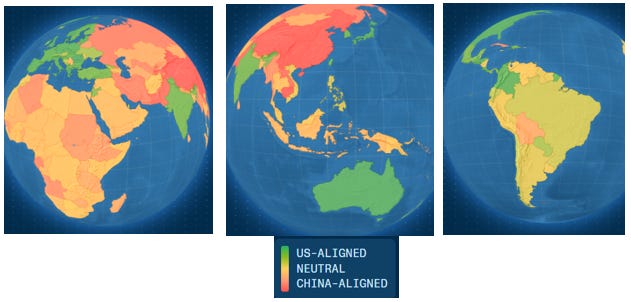
My point in this essay is that the second Trump administration's policies have, in several key ways, weakened the global position of the United States relative to China. While the long-term effects are still playing out, several specific actions and trends from Trump's return to office in 2025 have contributed to a relative loss of U.S. influence:
Withdrawal from Alliances and Global Institutions
Trump has continued his earlier pattern of disengaging from multilateral institutions like NATO, the World Health Organization, and the United Nations, while cutting funding or pulling out of agreements (e.g., the Paris Climate Accords, again). This vacuum has allowed China to expand its soft power and leadership role in these institutions, often presenting itself as a more stable and cooperative partner, especially in Africa, Latin America, and parts of Asia.
Trade Policy and Economic Decoupling
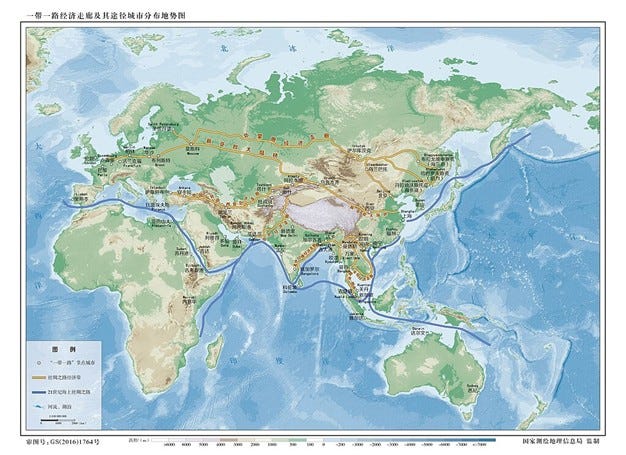
Trump's aggressive tariffs and pursuit of unilateral trade deals have isolated the U.S. economically. The administration's push for "decoupling" from China has backfired in some sectors. While some supply chains have shifted, many allies—including the EU and South Korea—have distanced themselves from this strategy and sought trade normalization with China instead. The lack of a coherent, multilateral economic strategy has allowed China to tighten its grip on global supply chains and expand the influence of its Belt and Road Initiative, an infrastructure program intended to connect China by land and sea to over 150 countries. Here’s a map that shows you this plan. The key is in Chinese but you can figure it out.
Undermining Democracy and the Rule of Law
Trump’s confrontational domestic posture—including crackdowns on protest, political purges in the civil service, and challenges to judicial independence—has undercut the U.S.'s credibility as a democratic leader. China has capitalized on this decline in democratic norms to argue that its authoritarian model is more efficient and stable, especially for countries in the Global South.
Alienating Asian Allies
The administration’s erratic diplomacy and transactional approach to alliances have weakened ties with key Asian partners like Japan, South Korea, and the Philippines. In contrast, China has made inroads with regional diplomacy (e.g., through the Regional Comprehensive Economic Partnership, RCEP) and has used economic leverage to sway ASEAN nations. China is also a founding member of BRICS, a 10-nation coalition made up of Brazil, Russia, India, China, South Africa, Egypt, Ethiopia, Indonesia, Iran, and the UAE which was created in 2010 to counter US economic global influence.
Technology Policy Confusion
Trump’s antagonism toward Big Tech has led to erratic enforcement and regulatory chaos rather than a clear national innovation strategy. Meanwhile, China has continued to invest in AI, quantum computing, and 6G infrastructure. U.S. restrictions on technology exports have driven some countries to adopt Chinese platforms as default options, furthering China's global tech dominance.
Climate Policy Retreat
China has positioned itself as a leader in clean energy investment and international climate cooperation. By reversing U.S. emissions pledges and gutting the Environmental Protection Agency, the Trump administration has given up leadership on an issue central to global governance and 21st-century diplomacy.
Trump’s second term is not only eroding America's soft power and international partnerships, but it is also providing China with multiple openings to present itself as the more reliable and forward-looking global actor. Even countries wary of China’s authoritarianism have begun to hedge by aligning economically and diplomatically with Beijing, while distancing themselves from a United States increasingly seen as unstable, isolationist, and unreliable.
China's surge in soft power—especially as the U.S. retreats from its traditional leadership role—yields several major benefits for Beijing, both strategic and economic. Here’s a breakdown of the key advantages:
Geopolitical Influence Without Military Confrontation
Soft power allows China to expand its influence without provoking direct military responses. Through diplomacy, culture, education, and investment, China builds goodwill and dependency, particularly in the Global South. This enhances its strategic position at a lower cost and risk than hard power,
Global Economic Integration on China’s Terms
As the U.S. pulls back from multilateral economic leadership, China fills the gap with initiatives like the Belt and Road Initiative (BRI) and trade agreements like the Regional Comprehensive Economic Partnership (RCEP).
As more countries adopt Chinese technical standards, integrate into Chinese-led financial systems, and accept loans or infrastructure deals from Chinese firms, China secures critical resources and logistics hubs while locking in long-term economic dependencies.
Narrative Control and Legitimacy
With the U.S. facing internal political instability and democratic backsliding, China presents itself as a model of efficient governance and stability. As China promotes its "authoritarian capitalism" as a viable alternative to Western liberalism, autocratic regimes across the world find validation and prefer Chinese partnerships over Western scrutiny of human rights or democratic reform.
Diplomatic Leverage in International Institutions
Soft power victories help China reshape global norms by elevating its citizens to leadership positions in UN bodies, trade organizations, and regional development banks. Agenda-setting power shifts. Issues like internet governance, development aid, and even human rights get reframed in ways more favorable to China.
Technology and Cultural Ecosystem Expansion
With TikTok, Huawei, and Alibaba expanding globally, China exports not just products but also values, norms, and infrastructure. As countries adopt Chinese apps, surveillance systems, or social credit frameworks, they also begin to reflect elements of China's governance model. In addition, Chinese cinema, pop music, and fashion are increasingly influential, especially in Africa, Southeast Asia, and parts of Europe.
Reduction in U.S.-Led Coalition Effectiveness
As China gains soft power, it weakens the cohesion of U.S.-led alliances. When countries see China as a necessary partner—or benefactor—they are more likely to stay neutral in U.S.-China disputes, reducing Washington’s ability to build unified coalitions on trade, security, or human rights.
Here’s the bottom line: China’s soft power surge amid U.S. retreat offers it a “low-friction” path to global leadership—recasting the global order around Chinese preferences without direct confrontation. It's a strategic win for Beijing, not only expanding its influence but also eroding the appeal of the U.S. model worldwide.
As we saw in this week’s election in Canada, Trump’s go-it-alone strategy (overlaid with a Truth Social campaign of insults, lies, and attacks) can push away even America’s strongest allies.
Here's a quote from the victorious Canadian Prime Minister Mark Carney earlier this week:
"The old relationship we had with the United States, based on deepening integration of our economies and tight security and military cooperation, is over. The system of open global trade anchored by the United States, a system that Canada has relied on since the second World War, a system that, while not perfect, has helped deliver prosperity to our country for decades, is over. These are tragedies, but it's also our new reality. We are over the shock of the American betrayal, but we should never forget the lessons. We have to look out for ourselves and, above all, we have to take care of each other."
We may not be witnessing the end of the American century, but we should take a lesson from Britain. While the U.S. still holds immense global influence, there are signs of decline similar to those that marked the end of the British century. Economic challenges, political instability, and the rise of other powers—especially China—are shifting the balance of power in global geopolitics. Global influence and power are not guaranteed. The United States needs to recognize this.