
Legislating is Complicated

Despite what Musk and the Muskrats are saying, federal spending is a complicated phenomenon, and it’s impossible to look at a few top-line numbers and determine whether any given line item should be cut or retained. Budgeting is the job of Congress – in fact, it is the primary job of Congress. We know that Congress is responsible for passing laws – but what many people don’t realize is that these laws are almost always connected with raising or spending money. When Congress creates a new program, it also provides the associated spending. Congress has to be aware of several terms when they are involved in budgeting.
Authorization Bills are legislation that establishes or continues a federal program or agency and sets funding limits. It defines the scope and purpose of government programs. Authorization bills are handled in subject-specific standing committees. For example, the National Defense Authorization Act (NDAA) authorizes defense-related programs and is handled by the House and Senate Armed Services Committees.
Appropriations Bills are Legislation that provides actual funding for authorized programs. This legislation determines how much money agencies can spend each year. These bills are handled by the Appropriations Committee, which has subcommittees associated with the different government functions. For example, the Defense Appropriations bill would be handled by the Defense subcommittees of the House and Senate Appropriations Committees.
Outlays: This is the actual government spending as funds are disbursed. Outlays occur when agencies spend appropriated funds, which may happen in the same fiscal year or in later years for long-term projects. As an example, if Congress appropriates $10 billion for the construction of military aircraft, actual spending (outlays) might take place over several years. Outlays in any given year are a combination of moneys appropriated in that year and moneys that were appropriated but not spent in previous years.
Outyears: When Congress passes authorization and appropriations bills, they project the estimated costs over the life of the proposed project. For example, a $10 billion military aircraft project authorized in 2025 may result in $2 billion in outlays annually through 2030 – the outyears. Because of changing economic conditions (recession, inflation, or interest rate changes) outyear spending on large budget projects often exceeds initial budget estimates.
Receipts are the money collected by the federal government, mainly from taxes. These tax dollars come from individual income taxes, corporate taxes, payroll taxes (Social Security, Medicare), and Excise taxes (gasoline, alcohol, tobacco). Other revenues come from tariffs, fees, and fines.
Deficit/Surplus: This is the yearly calculation of outlays vs. receipts. A deficit exists when outlays exceed receipts; a surplus is when receipts exceed outlays.
Now let’s imagine the freshman member of Congress. Let’s use Virginia’s Abigail Spanberger as an example; she was elected in 2018 and just stepped down to run for Governor of Virginia in this year’s election. Abigail (I call her Abigail) spent eight years as a CIA operations officer before entering the private sector with a global consulting firm. In 2017, she was appointed to the Virginia Fair Housing Board. She won her seat in Congress in 2018 and was reelected in 2020 and 2022 before deciding to run for Governor.
When she came to the House, she could accurately claim expertise in issues relating to foreign intelligence, as well as exposure to other global and domestic issues through her consulting work. But there were a lot of things she didn’t know about. How could she be expected to cast informed votes about these issues?
And let’s acknowledge that Abigail was arguably more prepared than most people when they are elected to their first term in Congress. Maxwell Frost, elected to Congress at the age of 25 in 2022 and reelected in 2024, had little job experience before coming to Congress. AOC interned for U.S. Senator Ted Kennedy when she was in college, but after college went back to the Bronx, where she worked as a bartender and waitress before working for the Sanders campaign in 2016 and then running for Congress in 2018.
Members of Congress figure out how to vote on legislation by relying on a number of sources:
Staff: Although MOCs often bring members of their campaign staff with them when they come to Capitol Hill, they also rely on a group of professional staff – individuals who have worked on Capitol Hill for years (sometimes for decades), developing subject area expertise as well as knowledge about how to legislate. Hiring good staff people to provide information about specific bills and to liaise with other professional staff is an important step for any incoming MOC.
Other Members: More senior members of the new member’s political party become an important network for a new member. In committee meetings, staff-to-staff communications, and casual conversations, new members come to understand what’s going on. Often, the votes cast by senior members provide guidance (although not necessary instruction) to the new members. Parties send around whip notices (not as much fun as it sounds) to tell the members of their caucus how they would like to have them vote. This can be important; the vote may be on something called “An amendment to the previous amendment to table the amendment,” and a staffer or a senior colleague can help translate this: “If you’re for the bill, you need to vote against this amendment.”
Lobbyists: People from outside of Capitol Hill – famously along K Street in Northwest DC – are more than happy to grab on to a new member of Congress and explain things to them, often offering briefing papers and talking points to the MOC who is still trying to figure out what cloture means. Members are smart enough to recognize that information from lobbyists is self-serving, but are also sometimes desperate enough to accept their input without questioning it.
Constituents: Yeah, yeah, yeah. They’re supposed to represent their constituents. But most of their constituents know less about the bills that the MOCs do. If it’s hard for the MOC to understand the budget terms I presented earlier in this essay, just imagine how hard it is for a constituent.
Fortunately (for the purposes of this essay) Congress has established some entities that will help the newly elected (and all) MOCs navigate the complex world of Congressional Budgeting. That’s what I want to tell you about today, as we’ll be seeing a lot of budget talk over the next few weeks before the government runs out of money (again — don’t you think they could figure out how to avoid this?).
Congressional Budget Office (CBO):
Since 1975, this nonpartisan agency of the Congress has produced independent analyses of budgetary and economic issues to support the Congressional budget process. The agency employs about 275 staff, mostly economists or public policy analysts with advanced degrees. The agency also employs lawyers, IT specialists, editors, and people with other areas of expertise that contributes to the agency’s mission. Specifically, CBO “scores” budget proposals for their impact on the deficit. Here’s a video about the CBO:
Today and tomorrow we’ll be hearing about CBO “scores” for the budget plans coming out of the House and Senate. These nonpartisan analyses are supposed to provide the framework for spending bills; however, MOCs often use them as cudgels to bash their political opponents. The CBO operates out of the Ford House Office Building, at Second and D Street, SW, in Washington. It is about three blocks from the Capitol Building. The agency publishes a blog twice a week or so if you want to know more. Click here to go to the website, including the blog.
Congressional Research Service (CRS)
This organization was created in 1914 as the Legislative Reference Service and renamed the Congressional Research Service. It is housed in the Capitol Hill complex in the James Madison building of the Library of Congress. Its mission is to serve Congress with the highest quality of research, analysis, information, and confidential consultation to let Congress perform its role as a coequal branch of government. Sometimes known as Congress’s “think tank,” it prides itself on the fact that its analyses are confidential, authoritative, objective, and nonpartisan. All queries and exchanges with MOCs are held in the strictest confidence, and the analysts demonstrate rigorous research methodologies. They strive for (and achieve) objectivity. Through their five research divisions (American Law; Domestic Social Policy; Foreign Affairs, Defense, and Trade; Government and Finance; Resources, Science, and Industry).
Luckily for the rest of us, CRS reports have been available to the public since 2018. I put the search term “appropriations” in the search bar at this site and landed on this page:
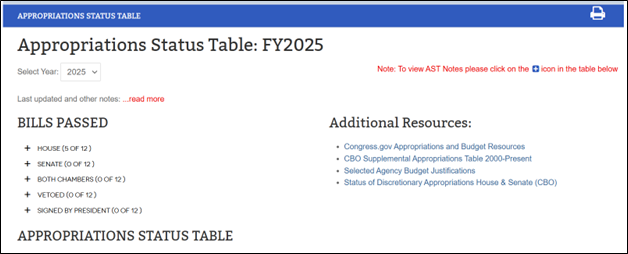
When I clicked on the first link under Additional Resources, this is what popped up:
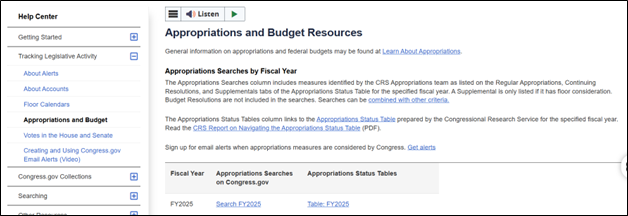
This is so much easier than it was in the 1970s, when I first encountered CRS reports. At that time, reports could be accessed only through a request to a member of Congress. I was able to get some reports, but it was arduous.
This video will give you an overview of the Congressional Research Service.
But there’s more!
Joint Economic Committee
Established in 1946, the Joint Economic Committee and its partner, the President’s Council of Economic Advisors, are tasked with reviewing economic conditions in the country recommending improvements in economic policy. Chairmanship of the Committee alternates between the Senate and House every year. This committee does not produce legislation; rather, it presents economic analyses so that the budgeting committees would have a common economic framework on which to base their spending plans. Here are the Senators serving on this committee for the 119th Congress:
Republicans:
Schmitt, Missouri
Cotton, Arkansas
Budd, North Carolina
McCormick, Pennsylvania
Moody, Florida
Democrats
Hassan, New Hampshire
Klobuchar, Minnesota
Heinrich, New Mexico
Kelly, Arizona
As of this writing, the House has not yet appointed members to this committee for the current Congress, and no committee hearings are scheduled.
You can find more about this committee – including its annual reports and hearing schedules – at this link https://www.jec.senate.gov/public/
Joint Committee on Taxation
Created in 1926 after a Senator believed he had been unfairly targeted by his political opponents and charged with tax violations, this committee operates with an experienced professional staff of about 70 PhD economists, attorneys, and accountants who assist members of the majority and minority parties in both houses of Congress on tax legislation. The Joint Committee is chaired on a rotating basis by the Chairmen of the tax-writing standing committees in Congress: the Senate Finance Committee and the House Ways and Means Committee. During the first session of each Congress, the House has the chair of this committee, and during the second session the Senate has the chair. This committee does not produce legislation; instead, it provides information to the standing (budgetary) committees about the tax implications of their budgetary decisions.
The Joint Committee Staff is closely involved with every aspect of the tax legislative process, including:
Assisting Congressional tax-writing committees and Members of Congress with development and analysis of legislative proposals;
Preparing official revenue estimates of all tax legislation considered by the Congress;
Drafting legislative histories for tax-related bills; and
Investigating various aspects of the Federal tax system.
I have not been able to find information about which members are on this committee as of the 119th Congress. I’m assuming Senator Mike Crapo (R-Idaho) is on it because he is the chairman of the Senate Finance Committee. I’m also assuming that Congressman Jason Smith (R-Missouri) is on it because he chairs the House Ways and Means Committee. But I don’t know who the other members are. You can find information about this committee here.
We should not be too disturbed by the fact that the two Joint Committees have not yet been fully staffed by MOCs for the 119th Congress. The professional staff do all of the work anyway.
So Maxwell Frost, AOC, and the newly elected MAGA car dealer from Oshkosh have ways to access information that will help them legislate wisely. We hope they hired staff who have the requisite knowledge base to understand the sophisticated analyses produced by these entities. We also hope that they are willing to listen to and absorb expertise rather than dismiss it because it produces conclusions they don’t like.
That's a lot of analysis at the MOC's fingertips, if they want to use it. Government is big, complex, and sometimes maddening. Is it perfect? Heck, no. Could it be improved? Marginally, I think. It needs a bit of finesse rather than a sledgehammer. At the rate it's going now, I believe our president is setting the country up to lose power, authority, and standing. We will lose our allies and the good the country has done over the last 80 years will be ignored.
Trump has demonstrated a total lack of knowledge about our government. His whole campaign was based on hatred and revenge , in this case other tax paying Americans. Getting rid of dead wood? No, targeting the new hires because they don't have Civil Service status. The chain saw Musk, that image appeals to Americans and our allies? And all these unemployed Americans that used to earn a living, used to pay taxes, 🤔