
It’s Complicated. Everything’s Complicated

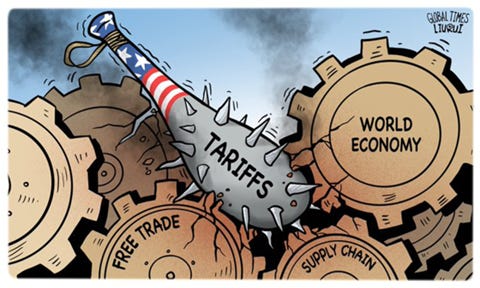
TL/DR: Tariffs are blunt tools that must be wielded deftly to achieve the desired results – global stability, productivity, and efficiency. Trump thinks they’re a sledgehammer. This will not end well. Read this if you want to know more.
Adult humans know that things are often more complicated than they appear. I was in a meeting yesterday where we were talking about functionality on our website, and I suggested something that seemed to me to be a simple fix. Our webmaster said that things are often more complicated than they appear ‘from the outside.’ I accepted her answer because I acknowledge her expertise.
We should not be surprised that government policies are more complicated than they appear. Today I want to talk a little about the complexities of international trade, particularly concerning tariffs. The World Trade Organization (WTO) website provides much information about the history of trade and the evolution of the post-WWII global trade economic system.
A little history is helpful here. The global depression of the 1930s was accompanied by a surge in trade protectionism, infamously including the Smoot-Hawley Tariff Act, which worsened global economic stability by imposing high tariffs. As the world faced the necessity of rebuilding after the devastation brought about by the war, countries needed access to international markets and trade liberalization. Before the war, trade agreements were often bilateral and unpredictable. The General Agreement on Tariffs and Trade (GATT) established a multilateral framework with clear rules to ensure stability and fairness in global trade. Rebuilding war-torn Europe was not an altruistic goal for the United States. As the dominant economic power post-war, the US wanted to expand trade to maintain its own economic growth and counter the spread of communism by integrating the allies into a global market system.
Before it was essentially replaced by the World Trade Organization (WTO) in 1995, GATT went through nine rounds of global trade negotiations – in 1947, 1949, 1951, 1955-56, 1960-62, 1964-67, 1973-79, 1981, and 1986-94. Each of these rounds involved an extended series of discussions of the evolving postwar economic and political order. All of the countries involved in these “rounds” knew that if stability was to be achieved and maintained, compromise was essential.
The final round – the Uruguay Round of 1986-1984) was the most ambitious, as it attempted to extend the trading system into new areas (services and intellectual property) and to reform trade in the agriculture and textiles sectors. The Final Act of the Uruguay Round officially established a successor organization – the World Trade Organization (WTO) – which regulates and facilitates international trade from its headquarters in Geneva, Switzerland. The WTO is the world’s largest international economic organization with 166 members representing over 998% of global trade and global GDP.
The highest decision-making body of the WTO, the Ministerial Conference, usually meets every two years. This group is made up of all members of the WTO (whether countries of customs unions like the European Union) and can make decisions on all matters under any of the trade agreements. The most recent Ministerial Conference (MMC13) was held in Abu Dhabi, UAE, in February and March of 2024.
The WTO operates under a framework of five key principles of trade policy:
Non-discrimination
Most-favored nation treatment
This rule requires that a WTO member must apply the same conditions on all trade with other WTO members (if a WTO member grants some nation a special favor it has to do the same for all other WTO members).
National treatment
This means imported goods sould be treated no less favorably than domestically produced goods once the foreign goods have entered the market. This means that the importing nation can’t tack on non-tariff barriers to trade, like additional mandated markups for the imported goods.
Negotiated reciprocity
This means that countries bargain to ensure they receive meaningful concessions for what they offer.
Trump’s idea of reciprocity does not match the WTO principle. Imagine that. I’ll talk about this in a minute
Binding and enforceable commitments
WTO members enter into multilateral trade agreements which bind signatories to their conditions. Efforts to deviate from these conditions may invoke the WTO dispute settlement procedures
Transparency
WTO members are required to publish their trade regulations, maintain institutions for reviewing administrative decisions affecting trade, respond to other members' requests for information, and notify the WTO of changes in trade policy. This is all part of an effort to improve predictability and stability.
Safety valves
WTI members are allowed to restrict trade to protect the environment, public health, or animal/plant health.
All of this is in the news this week because Trump has proposed tariffs that are outside of the framework of the most recent WTO negotiations. As we have come to expect, Trump does not understand the complexity of the global trade framework so he sees no reason to comply with it. And because he has appointed people who are either as uninformed as he is or are too cowed by him to express disagreement, the United States is following him off of this cliff.
Here's the problem: Trump’s tit-for-tat approach to tariffs is simplistic because the WTO framework emphasizes negotiated reciprocity rather than automatic retaliatory measures. While countries can and do impose countermeasures, WTO principles require that these actions be justified through established mechanisms rather than simple mirroring of tariff reciprocity.
Why is Tit-for-Tat Reciprocity a Violation of WTO Rules?
The most-favored-nation rule means WTO members must apply the same tariffs to all trading partners, except in cases of free trade agreements (like the one between the US/Canada/Mexico) or special WTO-authorized exceptions. A strict “you tariff us, we tariff you” policy violates this principle because it selectively targets specific nations outside of WTO dispute resolution.
The WTO provides a structured legal process for addressing unfair trade practices; unilateral retaliation (as in Trump’s proposed tariffs) is a violation of WTO commitments if not justified through this process.
Even if retaliation is allowed, WTO rules require that countermeasures be proportionate to the harm caused. A proposed 200% tariff on European wines (proposed earlier today) in response to a 50% EU tariff on American whiskey is excessive under WTO norms.
The WTO framework seeks to prevent escalatory trade wars by promoting negotiations. Tit-for-tat tariffs often spiral into broader trade conflicts, hurting both parties economically rather than leading to a balanced resolution.
We know how this plays out. When Trump imposed steel and aluminum tariffs in 2018-19, several WTO members challenged the tariffs at the WTO. In 2022, the WTO ruled against the United States, stating that the tariffs were inconsistent with WTO obligations. The US rejected the findings and appealed the decision. However, the WTO’s appellate body was non-functional at the time (primarily due to the US blocking the appointment of new judges) and the appeal effectively stalled the dispute resolution process, leaving the initial ruling unenforced. This means that the 2018 tariffs remain in effect.
Another thing to understand is that differences in the economies of WTO members significantly affect how specific tariff percentages impact their economies. This impact has several dimensions:
Trade dependency: Smaller economies are more reliant on trade as a percentage of GDP, meaning tariffs can have a disproportionate effect on their economic stability. Larger economies have more diverse domestic markets, so they can absorb tariff shocks better.
High-GDP nations can afford to impose counter-tariffs and negotiate trade deals from a position of strength, while smaller economies often have to accept tariffs or seek dispute resolution through the WTO.
The elasticity of demand for exports also affects how tariffs impact the nation’s economy. If a country exports specialized goods with inelastic demand – meaning that there are few substitutes for the commodity (rare minerals, high-tech components) – tariffs will have less impact. If other countries need the commodity, they’ll pay the increased cost. On the other hand, if a country’s exports are easily substitutable (agricultural products or textiles, for example) tariffs can lead to severe loss in market share.
But here’s the catch: If one country imposes a tariff on another country, the WTO rules may authorize a retaliatory tariff – but a tariff of equivalent value, not an equivalent percentage.
So if the US tariffs on Canada, for example, cause a $20 billion loss in annual Canadian exports to the United States, Canada could impose $20 billion in counter-tariffs. However because of the difference in the GDP of both countries, the value of exports from each country to the other, and the nature of the exports, the Canadian tariff percentage would be higher.
This is getting very complicated. Imagine that.
Trade relationships among the nations of the world are regularly the result of careful negotiations among the countries involved. Trump apparently is unhappy with the most recent negotiated tariff rates decided while Biden was president. Trump is welcome to reopen WTO negotiations regarding tariffs and other trade issues. He is unlikely to do this because a) it is boring and b) it is not good television.
He's such a halfwit