
Human Rights
Sunday Sermonette

The language of the Declaration of Independence (aspirational as it is) says clearly that fundamental rights are bestowed by a Creator, not government, and thus cannot be taken away, surrendered, or transferred. These rights are inherent and universal, making them superior to any human-made laws.
Putting aside for right now what Jefferson meant by a Creator and how that relates to the relationship between government and religion, protection of the basic shared rights that come with being human is the fundamental goal of government, and any government that fails this duty loses its legitimacy and is a proper target for revolution.
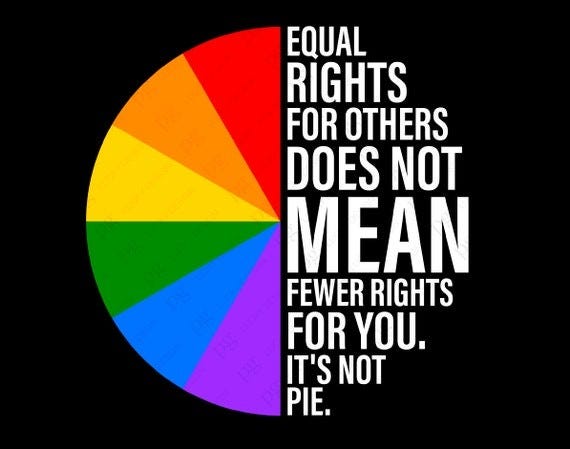
Notice what it does not say. It does not say that these rights are reserved only for citizens or believers in a particular religion. It does not say that people with different skin tones or facial features are eligible for a different (usually lesser) set of rights. It does not say that noncitizens have fewer rights. It says all people, and it means all people.
Rights are not absolute, however.
Governments may temporarily limit rights during war, terrorist attacks, pandemics, or natural disasters. The key principle is that restrictions should be necessary, proportionate, time-limited, and that they should apply equally to all people unless a strong case can be made for unequal treatment.
Governments may restrict the rights of some people if exercising those rights impinges on the rights and freedoms of others. Simple things like noise ordinances fall under this category; so do laws against defamation and limits on speech that incite violence. This is a process of balancing individual liberty vs. social harm.
Governments can regulate how rights are exercised to prevent chaos or violence. They can require permits for large demonstrations, traffic regulations that impact freedom of movement, crowd control at events, and restrictions on weapons in public spaces.
Governments often justify limits on rights to protect national security. This might include surveillance systems, restrictions on publishing classified information, screening at borders and airports, and limitations on accepting political contributions from foreign entities.
Governments can restrict rights to protect community welfare, including vaccination requirements, food safety regulations, drug prohibitions, and age restrictions on alcohol, gambling, or explicit media.
People accused or convicted of crimes may have certain rights limited. These restrictions may include search warrants that permit police entry, bail conditions that limit travel or association, and even imprisonment.
Governments regulate economic activity even though property and contract rights are important. These regulations include zoning laws, environmental regulations, taxes, and eminent domain (the taking of property for government purposes).
In constitutional democracies that recognize the universality of human rights, restrictions are considered legitimate only if they are:
Legal
Necessary
Proportionate
Non-discriminatory
Reviewable
Time-limited
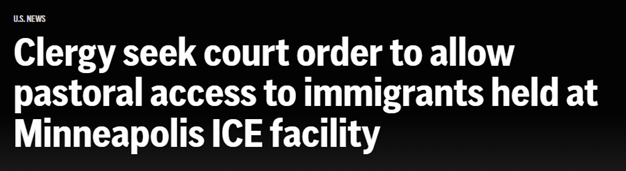
The headline at the top of this essay prompted me to think about this topic today. The story is straightforward – Protestant and Catholic clergy are asking a federal judge to order that they be allowed to minister to immigrants in a holding facility at the headquarters of the Trump administration’s enforcement surge in Minnesota. They’re suing for an injunction requiring Department of Homeland Security officials to allow prompt in-person pastoral visits to all detainees in a local detention facility.
This lawsuit is probably moot at this point, because the surge that created the problem has officially ended, and the temporary restrictions have been eased.
This reminds me of a more complicated problem, however, with policies that appear facially neutral but have disparate effects on different groups. Here are a few examples:
In prisons or other detention facilities, rules like fixed mealtimes, standard grooming rules, uniform worship schedules, and limits on group gatherings sound neutral. But Muslims need to fast during Ramadan or wear beards required by religious beliefs. Jews observing Shabbat are required to refrain from certain activities from Friday sunset to Saturday sunset, including scheduled work assignments or court conflicts. Both Muslims and Jews may find that access to kosher or halal foods will be limited.
In schools, dress codes that prohibit hats may fall afoul of Muslims girls who want to wear a hijab or Jewish boys who want to wear a yarmulke.
Workplace scheduling policies routinely defer to people who want Sundays off, but are less willing to allow Jews to take Saturdays off or Muslims to take Fridays off.
I remember talking about this with my high school students at one point when one kid said something like “If we have to make all of these days into holidays, then the schools will never be open.” He was so close to getting it.
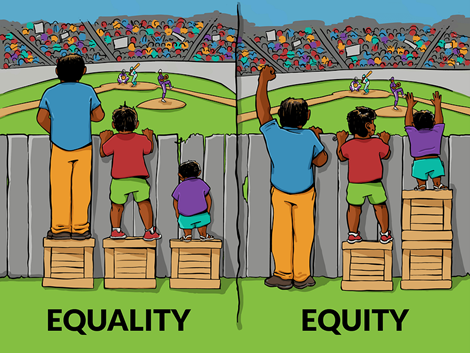
We’ve all seen this image. Equality means treating things that are the same, the same, but treating things that are different, differently. The important question is equality of impact, not equality of intent.