
Horatio Gates issues order excluding Blacks from Continental Army -- Maryland issues currency depicting George III trampling Magna Carta
250 Years Ago

I didn’t write the essay for last week because I was out of town, so I’m catching up this week by writing briefly about two events that occurred 250 years ago this week.
On July 15, 1775, General Horatio Gates, newly appointed Adjutant General of the Continental Army, issued orders that Black men were to be excluded from service in the Continental Army. This decision came at a time when the army, under General George Washington, was still forming in Cambridge, Massachusetts, in the early months of the American Revolution.
Here is the historical background and key details of the event. The Continental Congress created the Continental Army in June of 1775 to coordinate the colonial military effort against Britain. In early July, George Washington was appointed commander-in-chief of the army and went to Boston to assume command. The existing army already included free Black men and some enslaved individuals who had joined in colonial militias – particularly in New England, where Black service in militias had some historical precedent. However, there was no standard policy about the enlistment of Black soldiers, so commanders were forced to improvise.
General Horatio Gates, as Adjutant General, was responsible for the administration and discipline of the Army. Reacting to concerns about discipline and fears about the implications of armed Black men, on July 15 Gates issued the following instruction in his general orders:
“Neither Negroes, Boys unable to bear arms, nor old men unfit to endure the fatigues of the campaign, are to be enlisted.”
This administrative order was issued with Washington’s knowledge and approval, although it was not issued under his name. It was focused primarily on recruitment; it did not automatically discharge Black men already enlisted. This would change over the next year. In October of 1775, the ban would be extended to exclude all Black soldiers, even those currently serving. However, as the manpower crunch began to be felt in the winter of 1775-1776, on December 31, 1775, Washington wrote the Continental Congress to recommend that free Black men who had already served should be allowed to re-enlist, although he did not yet support the enlistment of enslaved men. By 1778, some states were enlisting enslaved men, promising them freedom in return for service. By 1781, the army included thousands of Black troops.
On July 25, 1775, the state of Maryland issued currency depicting George III trampling Magna Carta. The rapidly escalating political crisis between the American colonies and Great Britain, along with the growing need for the colonies to finance military resistance, maintain internal commerce, and operate with some economic autonomy grom Britain, let the colonies to print paper currency. This was driven in part by the scarcity of specie (gold and silver coins) and the inability colonies to impose taxes.
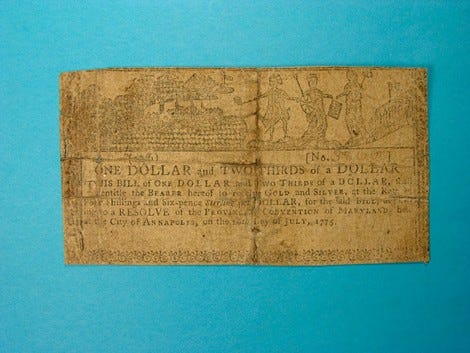
This issuance of currency like this served two purposes – it provided a means of exchange, but it was also a portable form of propaganda in support of the revolutionary cause.