
General Assembly Week 3

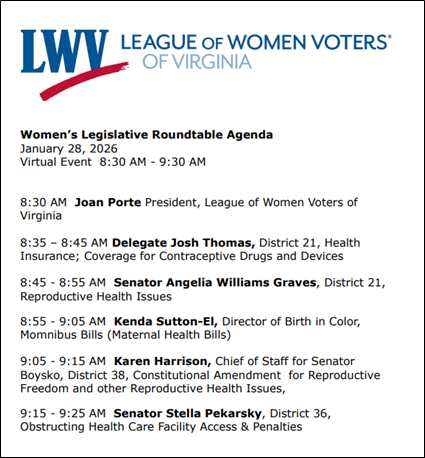
The 2026 session of the Virginia General Assembly got off to a roaring start two weeks ago today. Every Wednesday during the legislative session, I’m planning to attend (via Zoom) the League of Women Voters Legislative Roundtable to keep up-to-date on the major issues before the state legislature this year.
The topic for the first two legislative roundtables was voting rights; today, the topic is Reproductive Freedom, including contraception, maternal health, obstructing access to health care facilities, and overall issues of reproductive health. However, the most significant piece of legislation in this area is a Constitutional Amendment for Reproductive Freedom. That’s what I want to talk about today.
In its 1973 decision in Roe v. Wade, the Supreme Court recognized a constitutional right to reproductive freedom (including abortion under some restrictions). For almost 40 years after this decision, the state of Virginia kept a middle posture, regulating access to abortion but allowing greater freedom than most states across the South.
In 2012, the GOP-led government enacted a requirement for an ultrasound before an abortion under conditions that effectively forced many patients to make two trips to a clinic. The state also increased regulations for abortion providers that reduced the number of providers. Both of these laws made access to abortion more expensive and more difficult, especially in rural parts of the state.
Not much changed for the next few years. But in 2020, when the Democrats gained control of the state government, Virginia passed laws that rolled back earlier restrictions, as the state moved to reduce burdens and expand rather than restrict access. This relaxation of the laws allowed Virginia patients to access at-home abortifacients (like Mifepristone) to terminate an established pregnancy.
After the Dobbs decision in 2022, abortion rights were no longer federally protected the way they had been under Roe. Abortion remained accessible in Virginia, but, without a state constitutional guarantee, these rights were more at risk than before. As expected, in 2023 Republican Governor Youngkin (with the support of Republicans in the state House of Delegates) proposed a ban on abortion after 15 weeks. This ban was rejected by the Democratically-controlled State Senate
In 2024, the General Assembly passed legislation aimed at shielding Virginia providers and patients from out-of-state enforcement actions. Governor Youngkin vetoed multiple shield law measures. However, he did sign a bill limiting warrants and subpoenas for menstrual health data.
Because the Democrats now have control of the state government, a constitutional amendment protecting reproductive freedom is moving through the process. Virginia state law requires that a proposed amendment be approved by the legislature in two successive sessions that are interrupted by a statewide election. This has happened. The amendment was approved in the waning days of 2025 after it was clear that the 2026 legislative session would be controlled by Democrats. The election bore out that prediction, and the General Assembly passed this amendment a second time during the first few days of the 2026 session.
Here’s the text of the amendment:
Section 11-A. Fundamental right to reproductive freedom.
That every individual has the fundamental right to reproductive freedom, including the ability to make and carry out decisions relating to one’s own prenatal care, childbirth, postpartum care, contraception, abortion care, miscarriage management, and fertility care.
An individual’s right to reproductive freedom shall not be, directly or indirectly, denied, burdened, or infringed upon unless justified by a compelling state interest achieved by the least restrictive means.
Notwithstanding the above, the Commonwealth may regulate the provision of abortion care in the third trimester, provided that in no circumstance shall the Commonwealth prohibit an abortion (i) that in the professional judgment of a physician is medically indicated to protect the life or physical or mental health of the pregnant individual or (ii) when in the professional judgment of a physician the fetus is not viable.
The Commonwealth shall not discriminate in the protection or enforcement of this fundamental right.
The Commonwealth shall not penalize, prosecute, or otherwise take adverse action against an individual based on such individual’s own exercise of this fundamental right or such individual’s own actual, potential, perceived, or alleged pregnancy outcomes, including miscarriage, stillbirth, or abortion. The Commonwealth shall not penalize, prosecute, or otherwise take adverse action against any individual for aiding or assisting another individual in exercising such other individual’s right to reproductive freedom with such other individual’s voluntary consent.
For the purposes of this section, a state interest is compelling only if it is for the limited purpose of maintaining or improving the health of an individual seeking care, consistent with accepted clinical standards of care and evidence-based medicine, and does not infringe on that individual’s autonomous decision making.
This section shall be self-executing. Any provision of this section held invalid shall be severable from the remaining portions of the section.
This is pretty straightforward, I think. Based on what I’ve been able to find about similar state constitutional amendments and other legislation across the country, Virginia would be among the states providing the strongest and broadest reproductive rights protections in the United States. It would also be a regional outlier, providing much greater protection of reproductive rights than the rest of the states across the South.
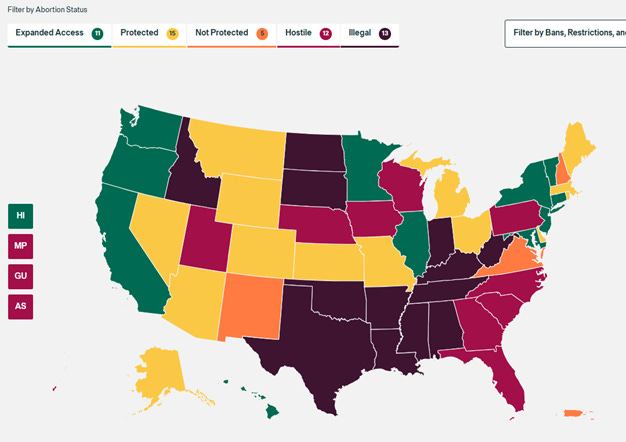
Right now, it appears this constitutional amendment will be on the General Election ballot on November 3, 2026. I wasn’t able to find any current polling on this issue, but in January 2025, two polls showed strong public support for placing the amendment on the ballot, with more than 60% of voters in favor. As the election season heats up over the next year, we can expect to see more polling on this issue.
We should note that other bills related to reproductive rights are under consideration by the General Assembly. Some of these bills fall outside the purview of the Constitutional Amendment, either by establishing regulatory procedures or by filling gaps left by the Amendment's language. Other bills, however, would double down on the Amendment's language, effectively providing a backstop in the event the Amendment is not approved by Virginia voters.
Here is a link to the current Virginia state constitution (ratified in 1971) and all 54 amendments. Unlike in the United States Constitution, the amendments appear within the constitutional provisions they modify rather than at the end of the document. As is common throughout the United States, the Virginia State Constitution, at about 26,400 words, is considerably longer than the United States Constitution (~7,600 words if you include all of the amendments).
As one who is not accustomed to reading content that comes out of governing bodies, I am pleased to see how readable and understandable this amendment is. And, as a pre-Roe woman I am so proud that Virginia may soon be in the very forefront of protecting this important right that more than half our citizens had for nearly 50 years. Now, I hope the voters of Virginia will do the right thing in November.