
Friday Night, No Lights

When I was in high school a thousand or so years ago, the football stadium was the place to see and be seen on Friday nights. That’s no longer true – many things that used to be true are no longer true, and that’s not all bad.
But this headline from Cardinal News (an online news source focused on Southwest and Southside Virginia) tells a story about how small schools in (mostly) rural Virginia are struggling to field a football team.
This article features Auburn High School in Montgomery County, Virginia. This map shows Montgomery County.
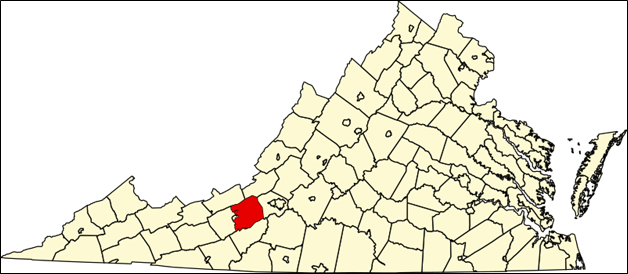
This county is not as isolated as it looks at first glance; it straddles Interstate 81, the main artery through the Shenandoah Valley, and encompasses Blacksburg, the home of Virginia Tech. Auburn High School, however, is at the opposite end of the county from Tech; it is separated by 22 miles and several mountain ridges. The development that characterizes the county on the Tech side of the Interstate hasn’t spread to the side where Auburn High School sits.
The story reports that for the third time in the last four years, Auburn will not complete a varsity football season. Unlike in 2021 and 2022, when the high school halted things halfway through their schedule, school officials have decided to cancel its 2024 varsity season, which was scheduled to begin August 30. This is the first time that there will be no varsity football squad at Auburn since the school began play in 1976.
The problem is that 22 students on the 24-student roster were sophomores and freshmen. Only one junior and one senior came to the first day of practice, and the coaches decided that the freshmen and sophomores would be in physical danger if they had to play against the older members of the teams from other high schools.
Auburn plays in Class 1 – the Virginia High School League’s division for the state’s smallest public schools. Auburn had 381 students on its rolls when school began for this year. With only 70 seniors and 80 juniors, the school simply doesn’t have the student body to support a football squad.
Cumberland High School in Cumberland County (between Richmond and the Blue Ridge Mountains) has also canceled its 2024 varsity season. Two other Virginia schools – Chincoteague (on the Eastern Shore) and Rappahannock County (northwest of Fredericksburg in the Blue Ridge foothills) – are playing eight-man football this year. Mathews High School (on the Middle Peninsula about 45 miles from Williamsburg), which did not have a team in 2022 or 2023, has just five games on its schedule this year. Bland County High School (just off Interstate 81 between Roanoke and Bristol, Virginia) was unable to field a team in 2019 and has not played more than seven games in any of the last three seasons.
Other than the generally low enrollment that makes fielding a team difficult, the coaches couldn’t identify a particular reason why there aren’t more football players in the junior and senior classes. One coach commented that he understood that once one kid said he wasn’t playing, other kids backed out as well in a kind of snowball effect. Another problem is that the football program has experienced difficulty in convincing athletes from the more successful boys’ sports to put on helmets and pads in the fall. Specialization is hurting football, the coach observed.
This year, the school’s varsity coaching staff will work with the junior varsity program, which will play its schedule as planned with the freshmen and sophomores. Th JV team has 46 players on its roster. The coaches feel positive about the number of players in the district from 6th through 10th grades. One coach said he thinks they’ve been losing kids the last couple of years because they’ve had to play them on varsity as freshmen. After they’ve gotten hurt or beat up a bit, they haven’t returned. Stepping back for a year will give the kids an opportunity to grow and mature before they participate in a varsity team next year.
In other essays, I’ve written about the political effects of declining population in rural parts of Virginia and the rest of the country as well. Even since the beginning of the post-Civil War industrialization of America, young people have made their way to the cities for school, jobs, and excitement. Despite the explosion of broadband and cell phone technology that has made it easier to attend school or earn a living in rural America, the lure of the cities still pulls people away from the small towns and farms.
It's not just the athletic teams that have trouble finding students to don their uniforms every season. These communities don’t have enough students to offer a full range of courses in their high schools. Auburn High School has 34 teachers: 7 English, 4 Math, 3 Social Studies, 5 Science, 3 Fine Arts, 6 Career and Technical, 2 Health and PE, and 6 Special Education. A quick look at the course offerings illustrates the dilemma – the school does not have the resources to offer the range of courses available at larger schools. The school system teams with the local community college to offer Dual Enrollment options to its high-performing students, but it’s not the same experience as having the class in the High School building.
The two maps tell the same story.
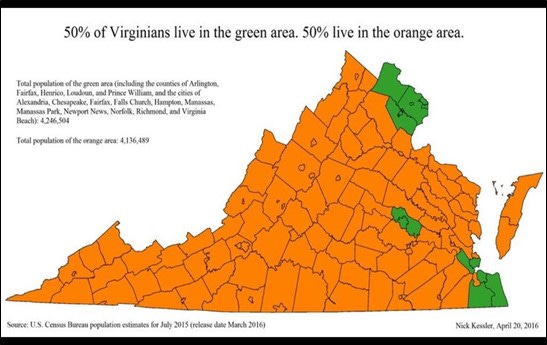
In Virginia, half the population lives in the green areas on the map. These are urban and suburban counties that vote for Democrats. This map is eight years old, but the trend it illustrates is unchanging. These areas are also the fastest growing areas in the state; people are leaving the orange areas to move to the green areas, and people who move to Virginia from other parts of the country or from other countries are much more likely to move to the green areas. The green areas are increasing, not only in relative population but also in political clout.
The map of the United States tells the same story. It is a ten-year-old map, but the trends are continuing.
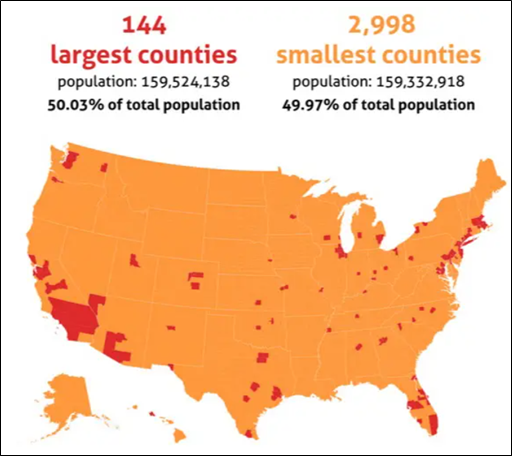
These are the parts of Virginia and of the United States that are most likely to vote for Democrats. As these areas grow, the number of people supporting Democratic party priorities will also grow. The GOP wants to stop this growth, but they won’t be able to do that. As we are seeing this week, the Democratic Party is joyfully accepting its forward-looking role. The GOP, on the other hand, is yearning for a past that they have (quite literally) whitewashed and that will not return, no matter how much they try.
Those Friday night lights are gone. The sooner the GOP realizes this, the sooner the American political party system will begin to heal. I’m not holding my breath.