
Flag Burning

In 1943 – in the middle of the Second World War – the Supreme Court ruled in West Virginia vs. Barnette that students cannot be forced to recite the Pledge of Allegiance. The opinion noted that "If there is any fixed star in our constitutional constellation, it is that no official, high or petty, can prescribe what shall be orthodox in politics, nationalism, religion, or other matters of opinion or force citizens to confess by word or act their faith therein". The Court emphasized that true national unity comes from voluntary expression, not forced conformity. In another part of the opinion, one of the justices noted that the freedom to speak has to include the freedom not to speak.
Over the next several decades, the Court continued to expand the idea of “symbolic speech” as a protected category of expression under the First Amendment. Children in Iowa were allowed to wear armbands protesting the Vietnam War (Tinker vs. Des Moines, 1969) and Gregory Johnson was allowed to burn an American flag outside of the Republican National Convention (Texas v. Johnson, 1984). Other cases confirmed that Americans don’t want the government controlling the opinions they express.
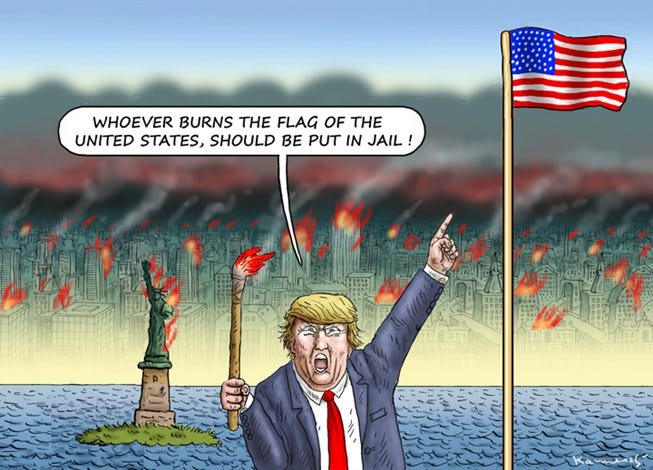
This week, the current Republican President -- who clearly doesn’t understand any of this -- issued an executive order overturning this Supreme Court precedent. Never mind that he doesn’t actually have the power to do this – he does things like this anyway. He issued an executive order laying out a plan to prosecute people who burn the flag. He has no power to enforce this, of course. And flag-burning is not an epidemic. In the 1980s, more flags were burned to protest the Texas ruling (before it went to the Supreme Court) than had been burned in any other type of protest.
I used to talk about this in my high school government class. I have to admit, I messed with my students a bit. Americans respond viscerally to the idea of burning the flag, although this is specifically an American obsession. The United States has a flag code that lays out how the flag should be treated. This lays out instructions about how to discard a tattered or soiled flag – by burning it. I guess this is okay because you’re thinking patriotic thoughts while burning it. Other countries don’t worship their flags like this – when the flag wears out, you use it to wash your car.
During the class when I dealt with this issue, I walked them down the garden path. I always wore flag-themed earrings on this day, and proceeded to drop an earring on the floor and step on it. Was I desecrating the flag? How about something that looked like a flag but didn’t have the correct number of stars or stripes? How about a scarf or tee T-shirt that was flag-themed? What if I made a transparency (you can tell how long ago this was), projected it on a sheet of posterboard, and then scribbled on or burned the posterboard? What if I drew a flag on the sidewalk and then stepped on it or let my dog pee on it? The pièce de résistance of this class every year was when I dragged out a piece of flag-themed fabric that I bought at Joanne’s Fabrics.
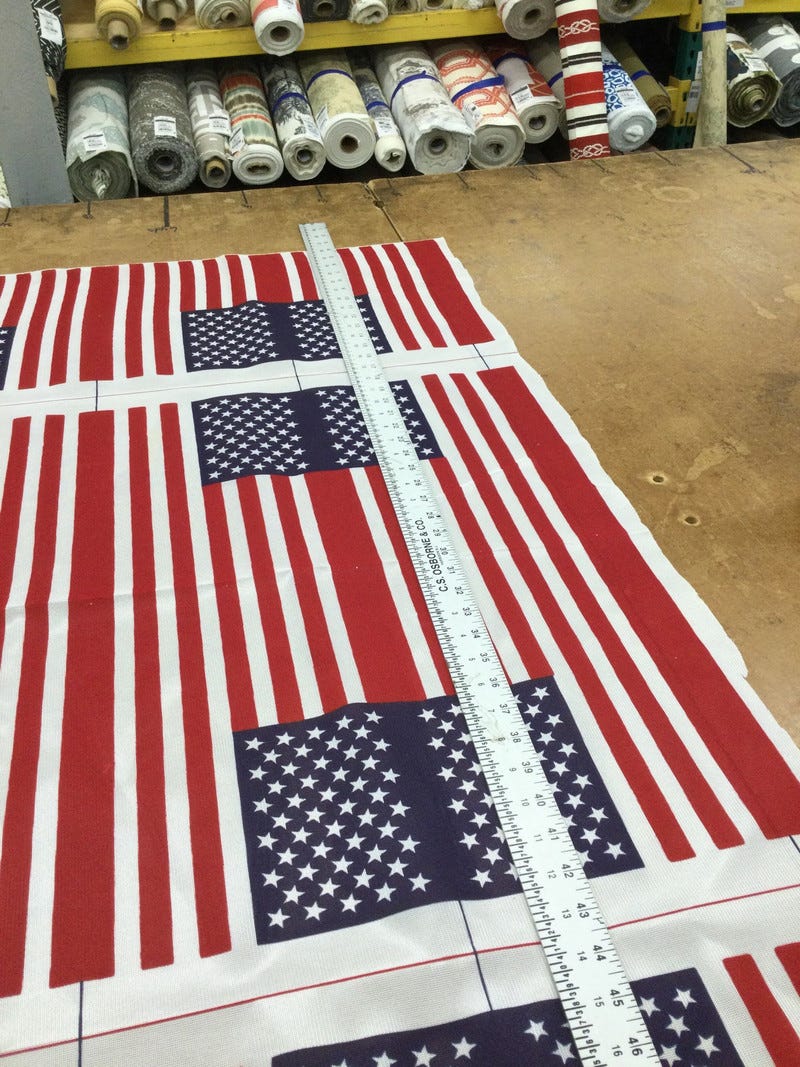
An American flag was printed on one side of the fabric – 13 stripes, 50 stars – and I bought several lengths of the flag. The flag patterns were separated by dashed lines suggesting the place where the fabric could be cut to create multiple flags. As I was talking, I proceeded to drape this piece of fabric around my shoulders, over my head, and around my waist. I waved it in the air and tossed it around the room. Then I intentionally dropped it on the floor – and some of my students gasped (although others chuckled, because they had figured out what I was doing).
Every year, some of my students agreed that the uncut fabric was not a flag, but that if I cut the fabric along the suggested lines, the material would become a flag. I asked them about what would happen if I cut the fabric into flag shapes, made them into pillows, and then sat on them. The ensuing discussions were always entertaining.
Anyway.
There are no laws against burning a flag. The Flag Code is a set of recommendations or suggestions. Violations are not prosecutable. It is not illegal to be unpatriotic, although it is socially unacceptable. Kind of like farting. Americans don’t have to love their country. The usual arguments about prohibiting flag-burning relate to prohibitions against doing things that provoke violent reactions, and that’s what the current Republican president is talking about in his executive order. There is something to be said for this – public order is important. But it is not more important than freedom of expression. This is why it’s constitutionally protected.
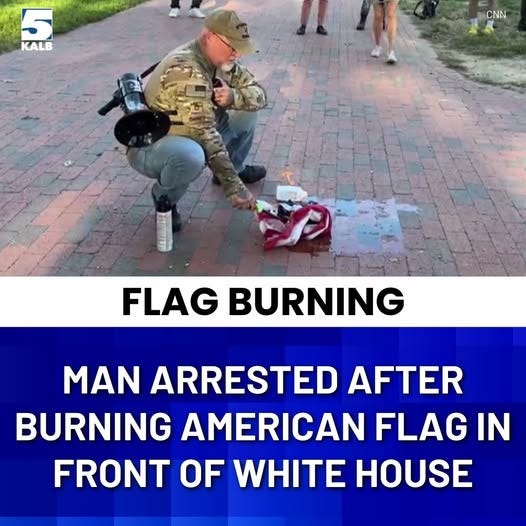
UPDATE: As was totally predictable, someone burned an American flag outside of the White House this morning in protest of the current Republican president’s illegal order. The fact that the offender was a 20-year combat veteran is the icing on the cake. And, again predictably, he was charged with lighting a fire on federal property, because there are no laws against burning the flag. No, not even when the dictator wannabe in the White House issues an order.
The best way to limit flag-burning is to stop doing things that make people want to burn the flag
.
He doesn't own the American flag just like he doesn't own DC or the White House! Patriotism can go too far, it's about our country not Trump.
I wish I could have been a fly on the wall watching you teach that class about the American flag! Good grief. How many items of clothing are printed with the American flag?