
Dump and Jump

I’m writing this on Thursday afternoon, the day before the United States Senate is scheduled to vote on the FY 2025 Continuing Resolution that will keep the government open for the next six months (through the end of the government fiscal year 2025 on September 30).
Let’s review how we got here.
There is an actual budget process. It is documented. You can find a summary of it here. All of the members of the House and Senate have access to it. Between 1977 and 2015 – almost 40 years – the Congress passed the twelve required regular appropriations bills only four times – 1977, 1989, 1995, and 1997. Since 1997, Congress has never completed the appropriations process in regular order, often relying on continuing resolutions and omnibus bills to fund the government.
Let me remind you about how we got to this point:
In January of 2024, congressional leaders reached a $1.59 trillion topline spending agreement for FY 2024.
In March of 2024, Congress passed two “minibus” appropriations packages. (Note: these were not Omnibus (all-inclusive) bills, so they were called “minibus.” Because Congress is nothing if not cute.)
On September 25/26, 2024, the House and Senate passed a Continuation Resolution that would extend government funding until December 20, 2024. As the December 20 deadline approached, Congress passed the American Relief Act, which extended government funding through March 14, 2025 (today, if anyone’s paying attention).
To everyone’s apparent shock, the calendar kept moving as it always does. Congress failed to get its budgeting act together – too busy investigating the Kennedy assassination, wearing MAGA caps, going to DOGE rallies, and investigating the Biden administration, I guess – until March 11 of this week, when the GOP-controlled House narrowly approved a CR through the end of the fiscal year.
Now comes the Dump and Jump™ part of this process. After passing its bill on Tuesday, the House promptly adjourned and everyone went home. They dumped the legislation in the Senate’s lap and jumped on a plane.
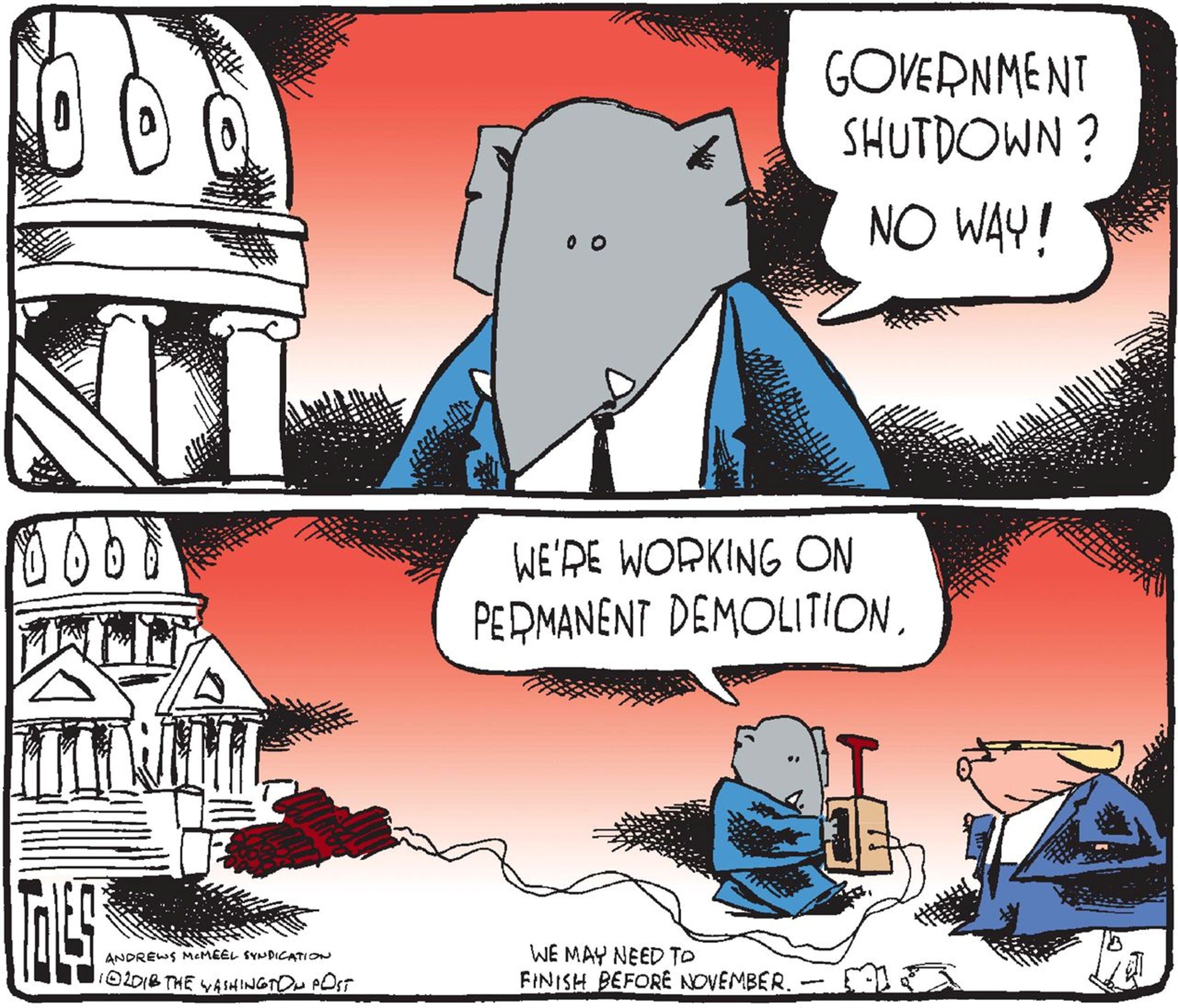
The problem faced by Democrats in the Senate is straightforward. They either support the bill – which keeps the government open but gives Trump the policy (but mostly public relations) win that he wants – or they defeat the bill, which shuts down the government. The GOP has washed their hands of this – they passed a bill, they claim, so if the government shuts down it’s not their fault.
So why don’t the Democrats just pass the bill? A couple of reasons:
The Democrats were excluded from the process of drafting the bill.
It significantly cuts non-defense spending, including education, healthcare, and social services. Although it does not solidify the DOGE slash-and-burn cuts, it includes related cuts.
It increases defense spending.
It cuts significant funding from the operating budget for the District of Columbia, where its status as a territory rather than a state robs it of any independent budgeting power. Republicans like to punish DC any time they can because it has a lot of black folks.
Most significantly, perhaps, it sneaks in a clever statement that cedes power over tariffs – apparently permanently – to the President. Here’s what Heather Cox Richardson wrote about this earlier this week:
The Constitution gives to Congress, not the president, the power to impose tariffs. But the International Emergency Economic Powers Act allows the president to impose tariffs if he declares a national emergency under the National Emergencies Act, which Trump did on February 1. That same law allows Congress to end such a declaration of emergency, but if such a termination is introduced—as Democrats have recently done—it has to be taken up in a matter of 15 days.
But this would force Republicans to go on record as either supporting or opposing the unpopular economic ideology Trump and Musk are imposing. So Republicans just passed a measure saying that for the rest of this congressional session, “each day…shall not constitute a calendar day” for the purposes of terminating Trump’s emergency declaration.
The Republicans’ legislation that a day is not a day seems to prove the truth of Burke’s observation that by trying to force reality to fit their ideology, radical ideologues will end up imposing tyranny in the name of liberty.
In case you think I’m making this up, here’s the language from the rule allowing the bill to come to the floor (every bill has to have a “rule” that sets the terms for debate before it can come to the floor; this is not in the bill itself but it is binding on the House):
SEC. 4. Each day for the remainder of the first session of the 119th Congress shall not constitute a calendar day for purposes of section 202 of the National Emergencies Act (50 U.S.C. 1622) with respect to a joint resolution terminating a national emergency declared by the President on February 1, 2025.
House Democrats had already teed up a piece of legislation that could have led to a repeal of the declaration of national emergency. They filed the bill on March 6, and the 15-day clock would have required a vote within 15 legislative days. Since the GOP controls the House and the Senate, the Republicans could have prevailed on the issue if it had come to the floor. But Republicans would rather not go on record as approving the President’s tariff proposals, as they are expected to generate price increases. However, they are also afraid to vote against his tariff proposals because he has them by the balls. By avoiding having to take a public position on the President’s tariff policy, the Republicans score a PR win.
Let me emphasize this. The House GOP has affirmed President Trump’s February 1 Executive Order declaring a national emergency based on the “extraordinary threat posed by illegal aliens and drugs” and the perceived failures of countries like Canada, Mexico, and China to effectively address the flow of narcotics into the United States. They have ceded to him any power Congress might have to stop this unwise and unwarranted seizure of emergency powers.
So here we are.
The Senate has only two choices: pass or defeat the bill. There is usually an opportunity for the Senate to propose amendments to a House bill (and vice-versa), but not if the House has fled the country gone home.
Throughout the day on Thursday, Senate Democrats generally rallied to the “no” position on the bill. One group of Senate Democrats (led by Washington’s Senator Patty Murray, ranking member of the Senate Appropriations Committee) has called for a one-month CR to allow more time for negotiations on new funding bills, but it is unlikely to go anywhere, for at least two reasons. One, the Democrats do not control either house of Congress, so they have limited bargaining power. Two, the House is not in session, and even if Speaker Mike Johnson decided to work with the Senate on a shorter-term CR (unlikely), it would take several days to get the members of the House back in town from their districts.
The most likely scenario, I think, is that Democrats in the Senate will not support passage of the CR and the process of government shut-down will begin over the weekend. This will mean the suspension of many federal services and require essential employees to work without immediate pay.
We went out to dinner Thursday night. On the way home, we heard that Senate Minority Leader Chuck Schumer is recommending that the Senate Democrats approve the Continuing Resolution, as he believes that forcing a shutdown would play into Trump’s hands. Many members of his caucus are Not Happy. My prediction in the previous paragraph is a little shakier than it was when I first wrote it.
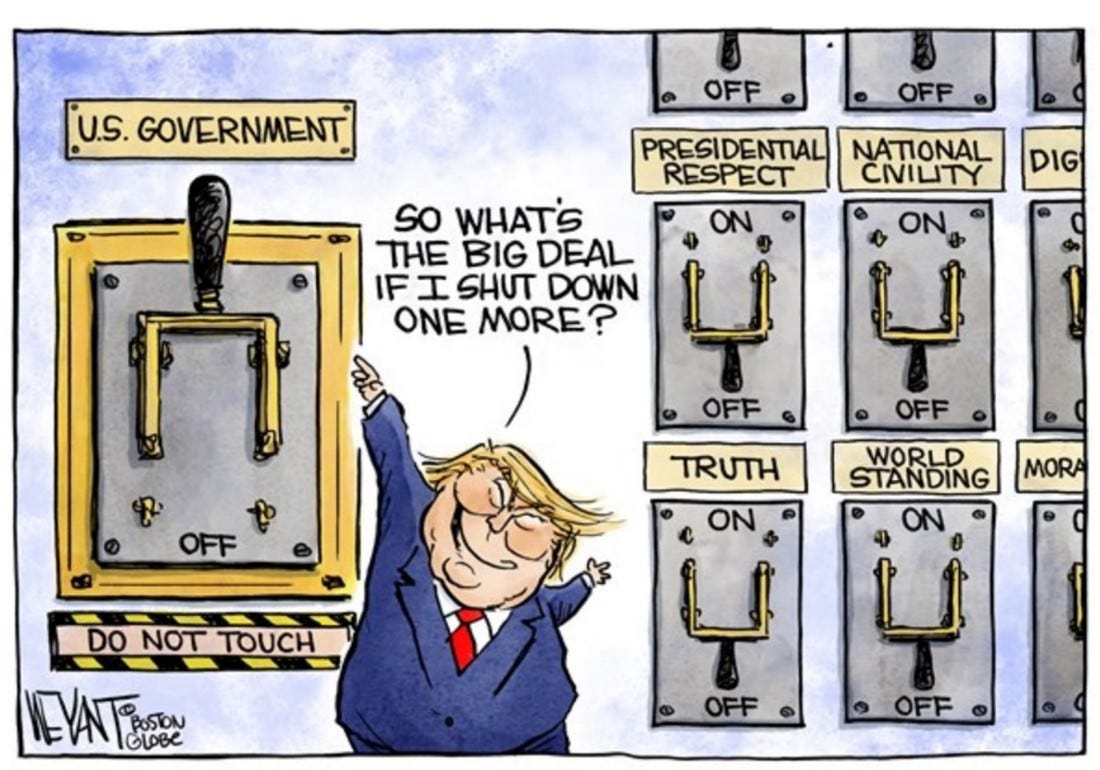
An additional problem for the Democrats, of course, is that shutting down the government is exactly what Trump and DOGE are trying to do. This is why Schumer is arguing against the shutdown.
We have had shutdowns of varying durations in the past:
2019 – 35 days (this was the longest)
1995/96 – 21 days
I have vivid memories of this shutdown. I was teaching in Northern Virginia and the parents of many of my students were involved in this shutdown. From one day to the next, the kids didn’t know if their parents’ jobs were secure or if their families were going to be suddenly uprooted by the need to find work elsewhere. My classes turned into grievance and counseling sessions.
2013 – 16 days
1978 – 11 days
There have been a dozen or so other shutdowns that lasted less than five days.
The difference between these historic shutdowns and the situation we are facing today is that, in the past, the parties on all sides were working to reach an agreement to reopen the government. This week, I’m not sure that Trump will authorize anyone to work with the Democrats to reopen the government. This might be exactly what he is hoping for. Reports from the corridors outside the Senate Democratic caucus meeting late Thursday said that Sen. Kirsten Gillibrand, D-N.Y. could be heard shouting “But this is not a normal shutdown” — warning that shutting down the government is exactly what Trump wants. This is almost certainly what led to Schumer’s flip-flop on this issue.
Good, Anne, good. Karen, your essay is clear, concise and very helpful.
Our country is in grave danger. None of this is going to end well for our country or for any of us.
Great piece, Karen. What are we to do? I've called and written until I'm blue in the face and my nails are tattered. Why don't they (Congress) cancel the tax cut and let that incoming money help to float the boat for a while longer? It's just incredible! The buffoon in chief is set on destroying our country, and if anyone doubts that he is a Russian operative, they have been living in a cave for these past many years.