
Due Proces

Once again, previously obscure and arcane legal terms are in the news. This week, it’s “due process.” Let’s take a look.
The term “due process” appears twice in the United States Constitution:
Fifth Amendment
No person shall be held to answer for a capital, or otherwise infamous crime, unless on a presentment or indictment of a Grand Jury, except in cases arising in the land or naval forces, or in the Militia, when in actual service in time of War or public danger; nor shall any person be subject for the same offence to be twice put in jeopardy of life or limb; nor shall be compelled in any criminal case to be a witness against himself, nor be deprived of life, liberty, or property, without due process of law; nor shall private property be taken for public use, without just compensation.
14th Amendment
No State shall make or enforce any law which shall abridge the privileges or immunities of citizens of the United States; nor shall any State deprive any person of life, liberty, or property, without due process of law; nor deny to any person within its jurisdiction the equal protection of the laws.
It is not accidental that the language of the 14th Amendment duplicates that of the 5th Amendment. Between 1787 and 1868, the United States experienced a situation where the states were allowed to run roughshod over the rights of individuals (including but not limited to enslaved African-Americans) without worrying about the 5th amendment, which applied only to actions of the federal government. The Civil War and the postwar amendments that it motivated changed the United States system of government, which originally had allowed the states to be more powerful than the federal government outside of the few areas of Congressional authority outlined in Article I, Section 8 of the Constitution. The 14th Amendment changed that, binding states under the federal government's authority in ways that had not been true before the war.
First of all, the word “due” simply means “expected” or “required.” It means that everyone should be treated the same under the law. Nothing more and nothing less.
To complicate matters a bit, due process actually comes in two flavors: procedural due process and substantive due process. I’m going to tell you a bit about substantive due process to get it out of the way. It’s extremely important (as you’ll see), but this is not what’s at stake this week.
Substantive due process is complicated and controversial. It accepts that individuals have fundamental rights not listed in the constitution – including the right to privacy, marriage, and family autonomy in raising children. These fall under the penumbra of the language of the 9th Amendment, which says, “The enumeration in the Constitution of certain rights shall not be construed to deny or disparage others retained by the people.” This language was included to address concerns raised during the fight over whether the Constitution should include a Bill of Rights. Some opponents raised the spectre that the listing of some rights might be seen as restrictive. The 9th amendment says “people have other rights even if we didn’t list them here.” Not particularly helpful when one of the favorite hobbies of politically aware Americans is parsing the language of the Founding Fathers to discover the vague notion of original intent.
Conservative Supreme Court Justice Samuel Alito spelled out the current right-wing approach to substantive due process in his opinion in Dobbs v. Jackson Women’s Health Organization, when he essentially said that the right to privacy, enunciated by Justice Blackman in Roe vs. Wade, was made up of whole cloth and that the Supreme Court had to stop making things up. This is all I’m going to say about substantive due process today, but you should be on the lookout for it as we move through the next days, weeks, months, and years as the Roberts Court continues to dismantle many of the due process precedents.
Procedural due process is more important for this week’s discussion. It involves rights embodied in the Bill of Rights as extended to the states through the 14th amendment:
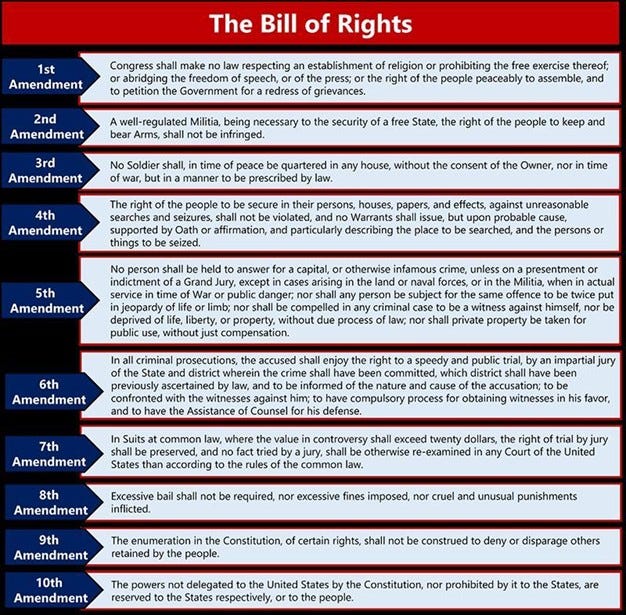
Here’s a quick summary of the most relevant parts of the Bill of Rights when you’re talking about due process:
1st amendment: Freedom of religion, speech, press, assembly, and petition
4th amendment: Freedom from warrantless search and seizure of property
5th amendment: provides for a Grand Jury, protects against double jeopardy and self-incrimination, broadly guarantees due process, and prohibits the taking of private property without compensation
6th amendment: provides for a speedy and public trial by jury, the right to be informed about the charges against an individual, the right to get information about the case against you, and the right to counsel
8th amendment: right to bail and a prohibition on excessive fines or cruel and unusual punishmnent
The courts pretty much didn’t deal with due process questions for the first 150 years or so or the nation’s existence. The 20th century, however, brought attention to these provisions. Over time, the Supreme Court shaped a modern interpretation of the practical meaning of these due process commitments in the face of a rapidly modernizing nation that no longer bore any resemblance to the nation that first ratified these words in 1788.
How does due process apply to the case of Kilmar Abrego Garcia, who was picked up by ICE a couple of weeks ago and sent to be locked up in a Salvadoran prison? The Trump administration claims he is a dangerous gang member whose presence in the United States was illegal and that the best way to deal with him is to cart him away and lock him up somewhere where no one can see him. They also admitted last week that he was picked up due to an administrative error, but that there’s nothing they can do about it.
I call BS.
Trump and his acolytes have, at various times, described Abrego Garcia as a gang member, thug, human trafficker, abusive spouse, and criminal. When asked about this case (again) on Thursday of this week, Trump gave a normal word salad response “I had heard that there were a lot of things about a certain gentleman — perhaps it was that gentleman — that would make that case be a case that’s easily winnable on appeal. So we’ll just have to see. I’m gonna have to respond to the lawyers.” He did not seem to realize that he was describing due process – which means collecting the analyzing evidence before you determine an individual’s guilt or innocence. His total ignorance of the law led him to confirm the Court’s approach — that ABrego Garcia was denied due process.
And we need to dispose of the idea that Abrego Garcia’s immigration status is somehow a bar to due process. Throughout the Constitution, the word “person” or “resident” is used to describe individuals who are served or protected by the provisions of the Constitution. They knew the word “citizen” — they used it once in a narrow context in the 14th Amendment — but they didn’t use it. The Constitution protects everyone who is in the United States, even if he has tattoos and is wearing Chicago Bulls swag.
Two other things happened in this case on Thursday. A three-judge panel from the 4th US Circuit Court of Appeals unanimously refused to suspend a judge’s decision to order sworn testimony from Trump administration officials to determine if they complied with her instruction to facilitate Abrego Garcia’s concern. Their opinion, written by Judge J. Harvie Wilkinson III (appointed to the court by President Reagan) was scathing in its condemnation of the Trump administration’s lack of compliance with a fundamental tenet of the rule of law – due process.
In addition, Maryland Senator Chris Van Hollen managed to meet on Thursday with Abrego Garcia in a hotel in El Salvador. If a US Senator can access Abrego Garcia, so can the Trump administration. If Van Hollen could get him out of jail to have a casual meeting with him in the seemingly pleasant environs of a hotel café, then President Trump (who claims to be more powerful than anyone) can get him home. Governments negotiate with one another all the time to get prisoners home (think Brittany Greiner and dozens of other political prisoners), and the only reason El Salvador is holding Abrego Garcia is because the Trump administration is paying the Salvadoran government to hold him. If Trump continues to look weak in this very visible interaction with a tinpot Salvadoran autocrat, even his MAGA supporters will begin to wonder where the emperor’s clothes are.
There is no reason at all for Abrego Garcia to spend one more hour in the terrorist holding pen in El Salvador. The Trump administration should bargain for his return today.
Oh lord. How about the dead American mother. Come on.