
Dignity
#3 in a series about seven Democratic Virtues

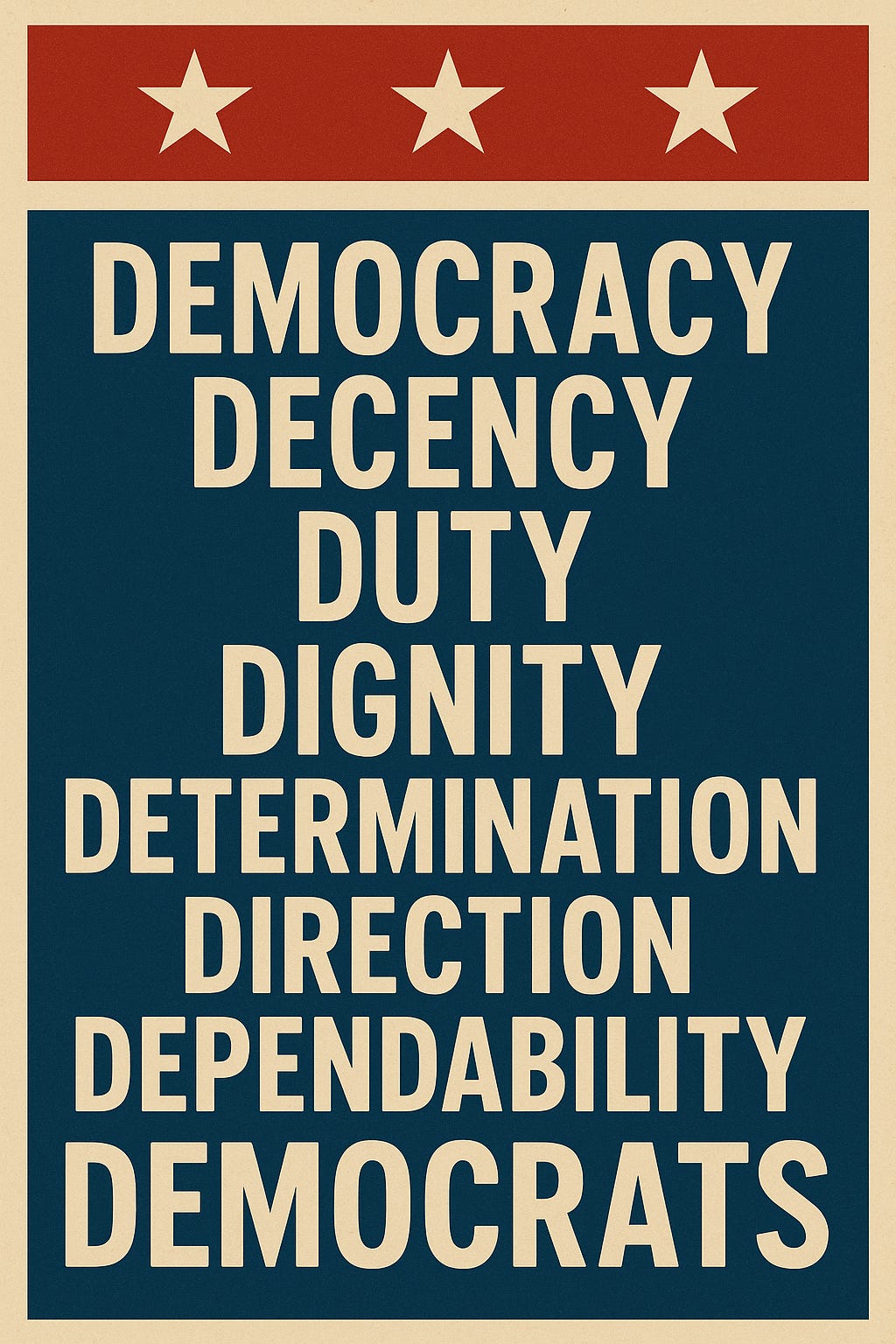
The character traits I’ve written about so far in this series – decency and duty – refer to action. Dignity refers to tone – how you carry yourself and how you interact with people. Dignity is one of the most important qualities we should expect from anyone seeking or serving as President. Remember Tan-Suit-Gate, when President Obama wore a tan suit to work one day? People screamed that it was undignified. Good times.
Dignity means carrying the weight of the office with respect for the Constitution, for the American people, and for the incredible power the office vests in a single individual. A dignified president demonstrates self-control, honesty, and decency, treating others with respect even in moments of disagreement or crisis. He elevates the nation through his conduct rather than dragging it into pettiness or division. At its core, dignity signals that the president understands that the role is not about personal glory or grievance but about serving the common good with steadiness, integrity, and humility.
I don’t even have to say it -- the current Republican president fails to show this character trait in most of his actions. Here are some examples:
Respect for the Office, the Constitution, and the American People.
A dignified President recognizes that the presidency is larger than the individual who holds the office and acts with reverence for democratic institutions and the public trust. This means that he accepts court rulings, even unfavorable ones, and refrains from publicly attacking judges or agencies in order to preserve public confidence in the system.
During Trump’s second term, the administration has launched a “campaign of retribution” – targeting hundreds of individuals, institutions, and organizations perceived as political opponents. Such actions – using government power to punish critics – treat the powers of the presidency and government institutions as personal tools rather than neutral, public-serving offices.
Self-Control and Restraint
A dignified President exercises restraint in words and actions, especially in emotionally charged or high-stakes situations, by remaining measured during moments of crisis (national tragedies, foreign provocations, electoral losses) and addressing the public calmly and deliberately.
Instead of restrained governance, the Trump administration has repeatedly used public threats, aggressive tactics, and “rule by retaliation” (e.g., firings, investigations, punitive executive actions) against critics and dissenters. For example, dozens of career prosecutors and civil-service staff have been removed – sometimes abruptly – from the U.S. Department of Justice (DOJ), reportedly for political reasons. Trump announces policy decisions through overnight social media posts, taking everyone (including his advisors) by surprise. This pattern suggests a readiness to wield power impulsively, rather than be governed by institutional caution.
Honesty
A dignified President speaks truthfully, acknowledge mistakes, and avoid deliberate misinformation by correcting inaccurate statements, releasing factual briefings, answering questions straightforwardly, and avoiding exaggerations that mislead the public.
Trump uses government institutions to target political opponents – law firms, media outlets, universities – often focusing on allegations of political motivation rather than genuine misconduct, raising serious questions about honesty and the legitimacy of claims. Also, the administration’s efforts to punish or intimidate critics (rather than engaging substantively) undermine the idea of transparent, honest governance.
Decency And Respect Toward Others (Including Critics, Institutions, People With Differing Views)
A dignified president treats political opponents, allies, civil servants, foreign leaders, and ordinary citizens with respect and human dignity – listening to their concerns, showing empathy, and refraining from personal attacks.
Trump aggressively attacks law firms, universities, journalists, civil-society groups, and individuals for their political alignment or speech – including freezing funding, threatening legal consequences for unfavorable coverage, or retaliatory investigations. He mocks people he perceives to be without power (and thus not useful to him), including women, racial and religious minorities, and people with disabilities.
Avoidance Of Pettiness And Division – Serving The Common Good Rather Than Personal Grievance
A dignified president focuses on the nation’s welfare rather than on personal slights, vendettas, or partisan score-setting. This means including leaders of the opposition party in major announcements, signing bipartisan legislation, and avoiding framing fellow Americans as enemies.
Trump’s “retribution” campaign undeniably springs from personal and political grievances: critics, perceived enemies, or disfavored institutions are being punished in bulk. Instead of seeking common-ground solutions or bipartisan cooperation, the administration appears to institutionalize vengeance as policy, which deepens division rather than elevating national welfare.
Commitment To The Common Good Over Personal Glory Or Grievance.
A dignified president understands that the presidency is about service, not self-promotion, revenge, or ego gratification. He would decline to intervene in personal legal matters, divest from business conflicts, and prioritize national welfare over personal interests.
By targeting law firms that represent political opponents, penalizing universities, and defunding or threatening institutions because of their perceived ideological leanings — even if they serve educational, legal, or civil-society functions — Trump shows that he prioritizes political advantage over public interest and institutional independence. The purging of career DOJ staff and politicization of law enforcement arguably undermines long-term institutional integrity in favor of short-term political gain.
Steadiness and Stability (Consistent, Principled Decision-Making)
A dignified president engages in calm, consistent decision-making rather than erratic or impulsive behavior, relying on briefings, expert advice, and deliberation before acting on military, economic, or social issues.
Rather than measured, deliberative leadership, the Trump administration’s rapid and sometimes sweeping moves – mass firings (and then rehirings), restructuring DOJ, targeting universities and nonprofits, launching large-scale “retribution” actions – reflect a volatile, unpredictable governing style that departs sharply from traditional norms of procedural stability.
Integrity (Ethical, Non-Corrupt, Respect for the Rule of Law)
A dignified president holds himself accountable, adheres to ethical standards, and avoids corruption by enforcing strict ethics rules for staff, avoiding conflict of interest, and cooperating with judicial or legislative oversight.
Trump’s administration politicizes and weaponizes justice and enforcement agencies – undermining the separation of powers, due process, and traditional norms of prosecutorial independence. The firing of long-standing civil-service prosecutors (e.g. Maurene Comey) without clear cause, reportedly due to familial association or political animus, poses serious concerns about abuse of power and lack of institutional integrity.
Humility (Recognizing Limits, Listening to Experts, Respecting Institutions)
A dignified president recognizes the limits of his own knowledge and power, listens to experts, and acknowledges the gravity of the role. He admits when he does not know something, listens to advice from experts, and gives credit to others for success.
Rather than deferring to institutional norms, longstanding precedent, or independent experts, the Trump administration has centralized power, overridden traditional safeguards, and taken a confrontational approach toward courts, universities, the media, and civil-society organizations – signaling a disregard for both personal and institutional humility.
All of this matters. The shift from “office as public trust” to “office as personal instrument” – via a broad retribution campaign – undermines core democratic norms and erodes public confidence in institutions. Removing institutional constraints and sidelining impartial career civil servants weakens not only the integrity of individual decisions but also the long-term viability of impartial governance. Targeting critics, press, and civil society for political reasons fosters fear, suppresses dissent, and chills free speech. This is all deeply at odds with dignity grounded in respect for others. Frequent use of government power for personal or partisan ends blurs the line between leadership and vendetta, eroding the moral stature of the presidency.

It just gets worse and worse. I think his "decorator" just went thru the White House collection of paintingss and choose those with the biggest, fattest gold frames. I dread seeing what they do to the wonderful new ballroom.