
Determination
#4 In a Series of Democratic Virtues

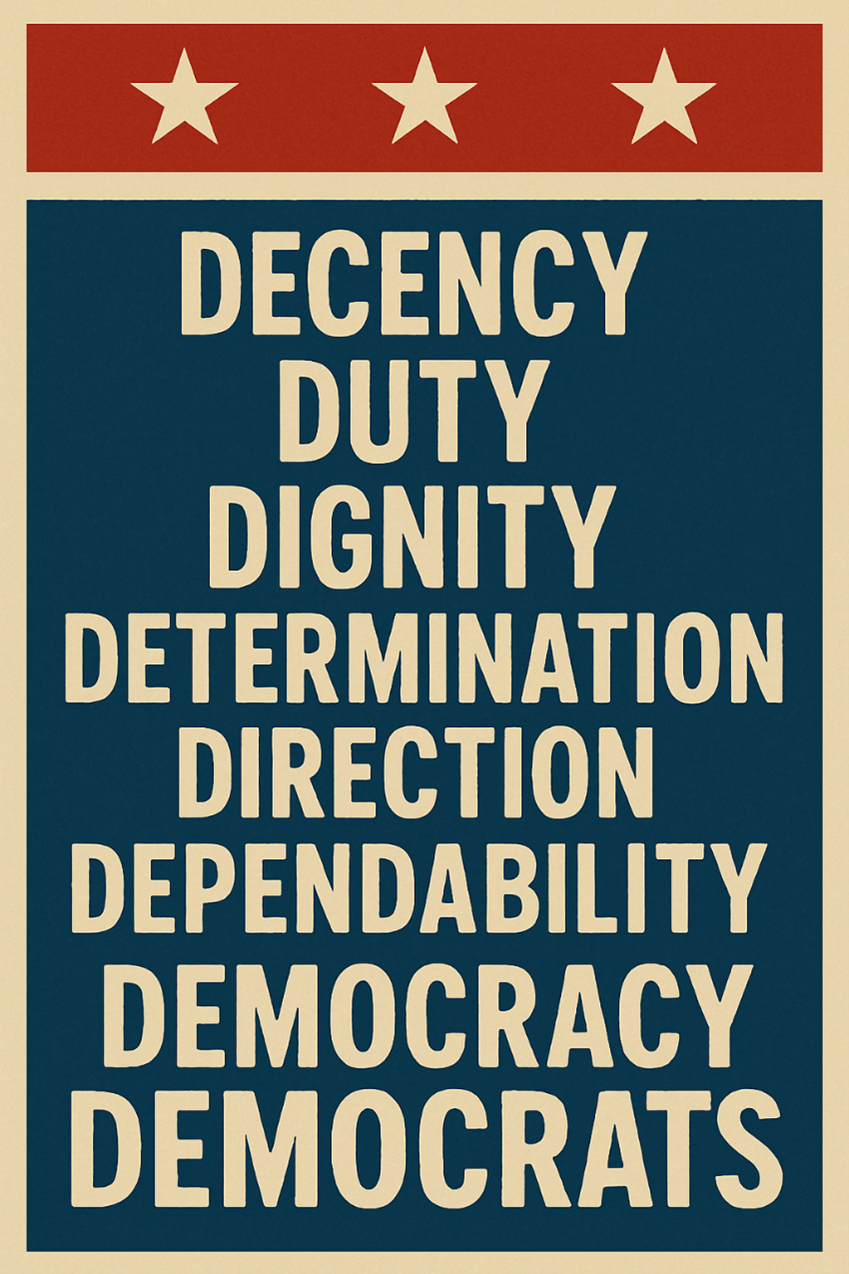
Determination is the steady, disciplined commitment to a goal or responsibility – even (or especially) in the face of obstacles, setbacks, or opposition. For the President of the United States, determination means holding fast to the core mission of serving the country, making difficult decisions even when they’re unpopular, and continuing to work toward long-term outcomes even when the path is challenging, politically costly, or personally uncomfortable. It’s not the same thing as stubbornness; rather, it is purposeful persistence grounded in principles, duty, and the national interest.
There are a lot of reasons why determination is an important character trait for a president:
Presidents have to navigate crises and emergencies like natural disasters, pandemics, wars, or economic downturns. FDR exhibited determination when he fought for his New Deal in the face of fierce political opposition. A nation needs a steady hand that will not abandon critical efforts before they are finished. A President who has determination is able to frame his plans in the context of a clear set of values.
By contrast, the current Republican president makes policy by tweet, reverses his position on issues on a whim, and seems to believe that issuing an Executive Order is the same thing as passing legislation.
Presidents have to be able to follow through on long-term projects. Major national priorities – such as infrastructure modernization, scientific research investment, or public health initiaties – take years to complete. President Eisenhower’s multi-year push to build the Interstate Highway System showed determination.
By contrast, President Trump makes big announcements but soon loses interest, abandoning his projects at the first sign of difficulty or partisan resistance.
Presidents have to be determined to uphold democratic norms and the rule of law, even when it’s politically inconvenient. President Ford pardoned President Nixon because he thought that was the best way to bring about national healing after Watergate – even though he knew he was sacrificing his 1976 reelection. Now, most of us think he was wrong to do this – and people objected at the time – but he stood firm.
By contrast, President Trump is on a constant quest for personal advantage, whether it’s increasing his wealth, expanding his political power, or amplifying his personal fame and visibility to feed his insatiable ego.
Presidents have to be able to resist pressure – both external and internal. President Truman knew this when he desegregated the United States armed forces in the face of intense political backlash. He was willing to sacrifice the 1948 presidential election to achieve this goal.
By contrast, President Trump fades in the face of opposition. His opponents began calling him TACO – Trump Always Chickens Out – because he doesn’t have what might be called ‘the courage of his convictions.’ That’s because he doesn’t have any convictions – well, except for the 34 felony convictions he received while he was out of office. But that’s an entirely different story.
Presidents have to focus on ensuring national security and global stability. They know that this is no longer the 19th century – or even the first half of the 20th century – when nations that attempted to secure global hegemony found themselves in a series of disastrous international wars that killed millions of people and bankrupted the nations of the world. Despite the difficulty involved in working with allies and confronting adversaries through thoughtful economic policy and diplomacy, rather than making things go boom, Presidents with determination are steadfast in pursuit of these ideals.
By contrast, Trump’s America First agenda discounts the importance of diplomacy and rattles sabers at the first sign of disagreement. He’s blowing up boats in the Caribbean and threatening ground invasion of Venezuela. This approach destabilizes the post-World War II international order that had maintained a fragile peace in the face of weapons technology that could destroy us all.
Presidents have to focus on delivering on the promises they made in the campaign. They know that the public is going to hold them accountable – at least at some level – for following through on their promises. The public knows that presidents can’t always achieve everything they promised – there are other branches of government to work with – but they need to see the President making a concerted and serious effort to fulfill his campaign promises.
By contrast, President Trump sees promises as rallying cries and talking points, not obligations. In his campaign, he promised things no one could deliver on – bringing prices down on Day One, for example, or settling regional wars with a phone call.
Presidents should model determination – principled resistance and disciplined follow-through – for the nation. The President of the United States wears a lot of hats – Head of State, Head of Government, Head of his Political Party, Commander in Chief, and so forth – but one of his most important jobs is as Cheerleader in Chief – the person who focuses on building up the collective morale in the face of crises. He inspires resilience in others by modeling all of the characteristics of determination.
By contrast, Trump consistently diminishes people who are facing struggles. He ridicules the disabled, name-calls people who disagree with him, and gives entire communities labels like ‘animals, ‘garbage,’ and ‘criminals.’ He is unwilling to provide government assistance to anyone who disagrees with him (‘blue states’).
The only thing Trump seems determined to do is make himself and his family as wealthy as possible while he can. The clock is ticking on his administration; he is verging on lame-duck status right now, as the Republican Party recognizes that he is a drag on their ambitions. They are beginning to realize that he is not a threat to them, and, because none of them actually like him personally – I mean, what’s there to like? – they’ll dump him like last week’s recycling.