
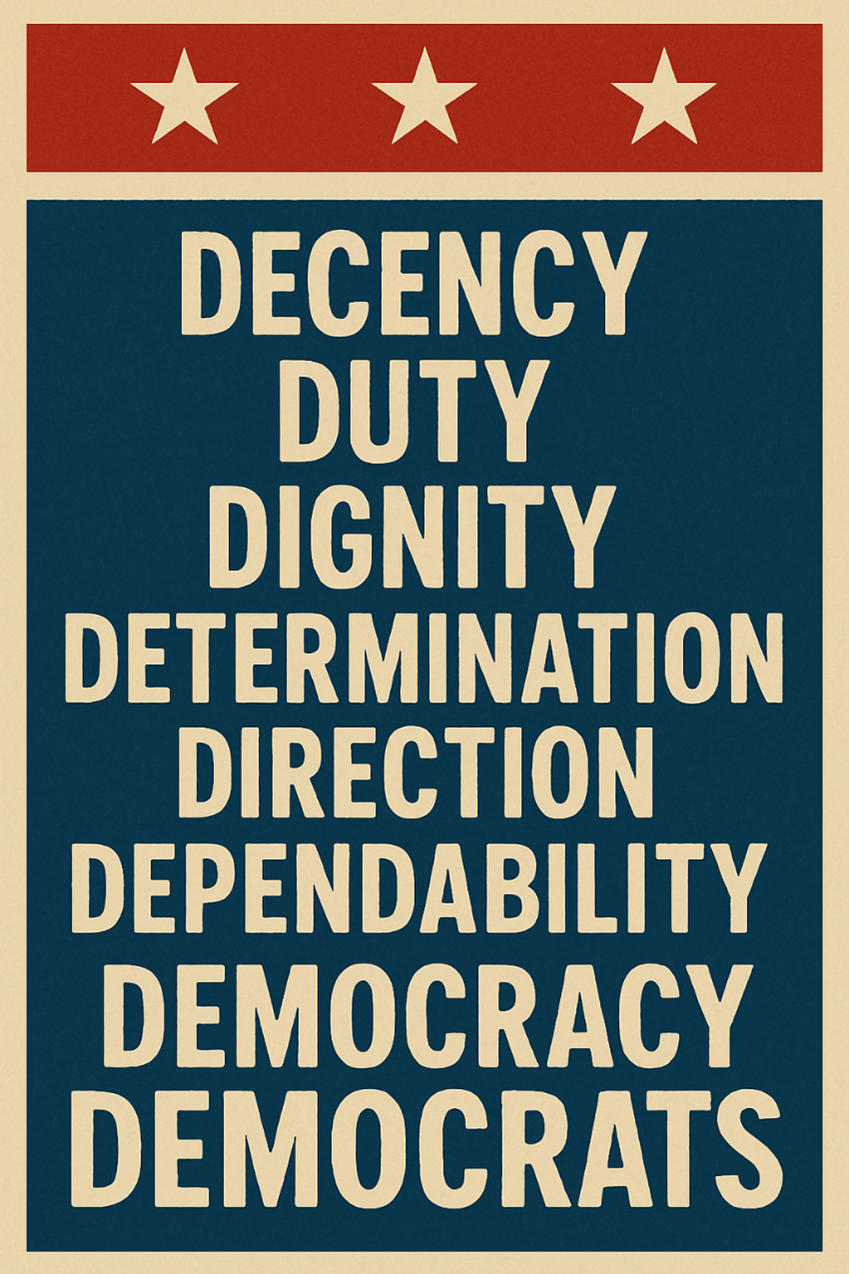
Dependability
#6 in a Series of Democratic Virtues

We all know what it means to rely on someone. In our personal lives, we recognize the people who do what they say they will do, without reminders or constant supervision. When we say, “I can count on you,” we’re expressing trust and confidence. In every organization I’ve ever been part of, the difference between people you can rely on and those you can’t becomes clear very quickly.
That same idea applies to democracy. Dependability – the shared expectation that individuals and institutions will keep their promises – is a core democratic virtue. It reflects the steady fulfillment of civic responsibilities and respect for democratic norms. It also assumes a willingness to be held accountable. A dependable democracy is one in which leaders follow the rules and honor commitments even when doing so is inconvenient or politically costly.
Dependability is not merely a personal trait; it is a public necessity. Democratic systems rely on stability and predictability. They also rely on trust – between citizens and among governing institutions. When dependability erodes, confidence in the system does too.
Several qualities help define what dependability looks like in practice.
Integrity in action
Dependable democratic actors behave in ways that match their stated values and legal obligations. They keep their word. They resist the temptation to bend rules for personal or partisan advantage. Integrity matters because without it, trust dissolves and democratic processes lose their meaning.
The current administration has weakened internal checks by pressuring the Department of Justice to pursue political enemies. It has also asserted presidential control over budgeting and regulatory agencies that Congress intentionally made independent. These actions undermine professional norms and weaken public confidence that democratic principles still guide decision-making.
Predictability under the rule of law
Democracy depends on people and institutions that follow established procedures, even when the outcome is uncertain or unwelcome. A dependable government respects court rulings and election results. It follows constitutional processes and accepts limits on its own authority. This kind of predictability protects democracy from arbitrary rule and gradual authoritarian drift.
The Trump administration exceeded its authority when it deployed National Guard troops in Los Angeles and withheld funds already appropriated by Congress. Courts have rejected these actions, further weakening claims that the administration respects the rule of law.
Responsibility to the public good
Dependability also implies stewardship. It reflects a commitment to protecting the legitimacy and continuity of democratic institutions. That means weighing long-term consequences rather than chasing short-term advantage. It also means acting in ways that preserve public trust.
Instead, the Trump administration has targeted Black and brown communities under the banner of immigration enforcement while ignoring the trauma inflicted on families and neighborhoods. Actions such as bombing boats in international waters and seizing a Venezuelan tanker have raised concerns about escalation and unintended harm. The administration announces that it has solved problems without any evidence that the issues have, in fact, been resolved. When their actions lack a clear justification grounded in the public good, they appear to undermine democratic responsibility rather than uphold it.
Accountability and answerability
Dependable leaders accept scrutiny. They explain their decisions openly, and they acknowledge mistakes and correct them rather than conceal them. They respect institutional checks rather than trying to bypass them. Democracy cannot function when accountability gives way to impunity.
The Trump administration has attempted to conceal evidence of wrongdoing, including materials related to the Epstein files and documentation of military strikes in the Caribbean. It has also disregarded court procedures in order to advance presidential objectives rather than serve justice.
Reliability in a crisis
Moments of stress reveal whether leaders can be counted on. In a crisis, dependable leadership remains steady. It avoids exploiting fear and resists spreading misinformation. Democratic norms are most vulnerable during emergencies, which makes restraint especially important.
President Trump has repeatedly reversed or denied his own statements when they proved false or damaging, even in the face of video evidence. He denies knowing about decisions and actions taken by members of his administration and judges who are loyal to him. And who can forget TACO – Trump Always Chickens Out. Public protests like the “No Kings” demonstrations earlier this year reflect widespread distrust of both the president and his administration.
Reciprocity and mutual trust
Democracy is a shared enterprise. Dependability requires recognizing opponents as legitimate participants rather than enemies. It depends on fair play and an assumption of good faith. Mutual respect is what allows pluralism to survive.
The Trump administration has consistently used inflammatory language toward international allies and domestic opponents alike. The president frequently disparages institutions such as the press and targets entire groups – women, minorities, Democrats, Somalis – with contempt. This approach deepens division instead of building trust.
Commitment to truth and shared facts
Finally, dependability rests on honesty. Democratic debate requires respect for evidence and a willingness to correct false claims. Independent journalism and transparent information are essential to maintaining a shared reality.
Yet the Trump administration has repeatedly issued misleading or contradictory statements about military actions, immigration, economic conditions, legislation, Congress, and the courts. When truth becomes optional, democratic dependability collapses.
Dependability is crucial to the maintenance of democracy:
It enables trust, the basic currency of democratic life.
It ensures stability, allowing citizens to plan, deliberate, and compromise.
It protects minority rights because dependable actors follow the rules even when it is inconvenient.
It safeguards transitions of power, the most delicate moment in any democracy.
It strengthens legitimacy, helping citizens believe the system works fairly.
Without dependability – among citizens, elected officials, and institutions – democracy becomes unpredictable, unstable, and vulnerable to manipulation or authoritarian tendencies.
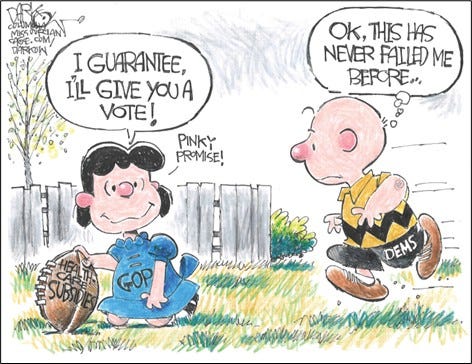
A note about this political cartoon, which has achieved meme status.
We usually read this cartoon as a story about gullibility: Charlie Brown never learns, and Lucy always wins. But that reading lets Lucy off too easily. Charlie Brown isn’t foolish because he believes Lucy; he’s principled because he believes in norms. He acts on the assumption that promises mean something, that repeated experience should eventually produce mutual obligation, and that even after betrayal, there is value in behaving as if good faith still matters.
Lucy, by contrast, isn’t savvy in any admirable sense. She isn’t clever because she anticipates Charlie Brown’s trust; she is amoral because she exploits it. Her “pinkie promise” isn’t a mistake or a misunderstanding — it’s a tool. She understands the norm well enough to weaponize it, mimicking trustworthiness precisely because she has no intention of honoring it.
In this light, Charlie Brown isn’t the one trapped in a cycle of failure. He is the one attempting to keep a shared moral framework alive in the face of someone who refuses to participate in it. Lucy’s power comes not from insight, but from her willingness to step outside the rules while relying on everyone else to keep following them.
The tragedy isn’t that Charlie Brown keeps believing. It’s that the system only works if most people act like Charlie Brown, and it collapses when too many people decide to act like Lucy.
Excellent. Your “series” is valuable.