
Decency
Seven Democratic Virtues -- #1

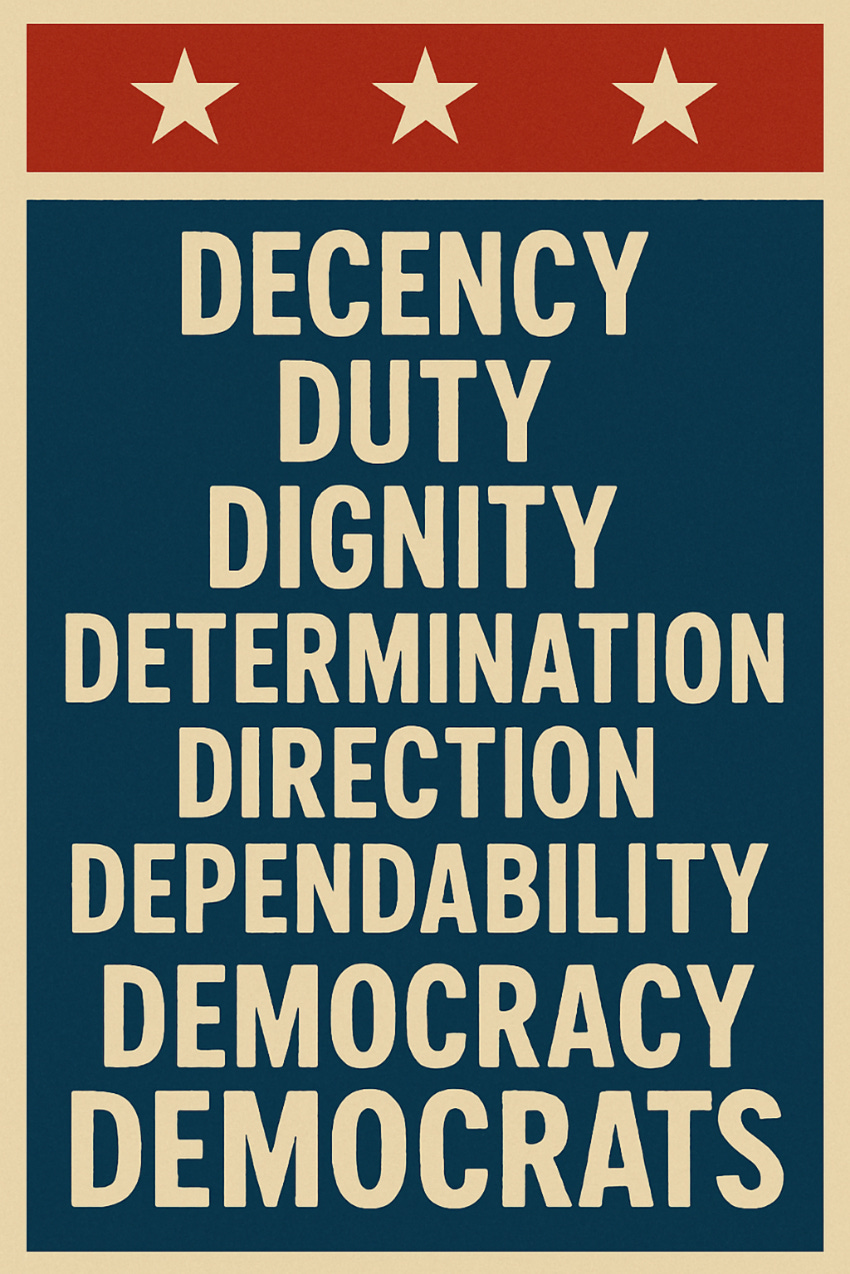
Last week, I wrote about the seven virtues that could form the base of the Democratic Party’s campaigns for the foreseeable future. The items on my original list all began with the letter “C.” At the request of a reader, I redid the list so that all items start with “D.” This works well — it generally encompasses the same habits of mind and has the added benefit of matching the word “Democrats.”
Over the next couple of weeks, I’m planning to devote a series of essays to each of these virtues, explaining what public life would look like if each virtue were observed and contrasting this vision to what we’re seeing under the leadership of the current Republican party, in all branches of government and at both the national and state levels. If Democrats run campaigns that stick to these themes – and there are enough themes that the campaigns can be very different from one another and still present a coherent picture of what the party stands for – they will present a compelling message to voters.
A recent conversation with some friends (because I have friends who think about these things) reminded me that achieving these virtues is a journey, not a destination. By focusing on these virtues, we are seeking “happiness” in its 18th-century sense. To the people who declared independence and wrote the Constitution, the pursuit of happiness was embodied in what people did, not how they felt. Many of the people we consider Founding Fathers — Benjamin Franklin comes to mind — made lists of virtues they sought to achieve, and then spent their lives working toward those goals. We could emulate them.
The topic for today is “Decency.” I’m reminded of the words of Joseph N. Welch, chief counsel for the U.S. Army during the Army-McCarthy hearings during the 1954 Red Scare that ensued from Senator Joseph McCarthy’s claims that the State Department was filled with Communists. As a reminder – this was part of a wave of anti-communism that also generated the House Un-American Activities Committee, which led in turn to widespread blacklists and prosecutions for suspicious political activity. Senator McCarthy had attacked a lawyer who worked in Welch’s law firm (a lawyer who was not even on his legal team for the hearings) for being a member of “the Communist-front organization, the National Lawyers Guild.” This is Welch’s famous response:
“Let us not assassinate this lad further, Senator. You’ve done enough. Have you no sense of decency, sir? At long last, have you left no sense of decency?”
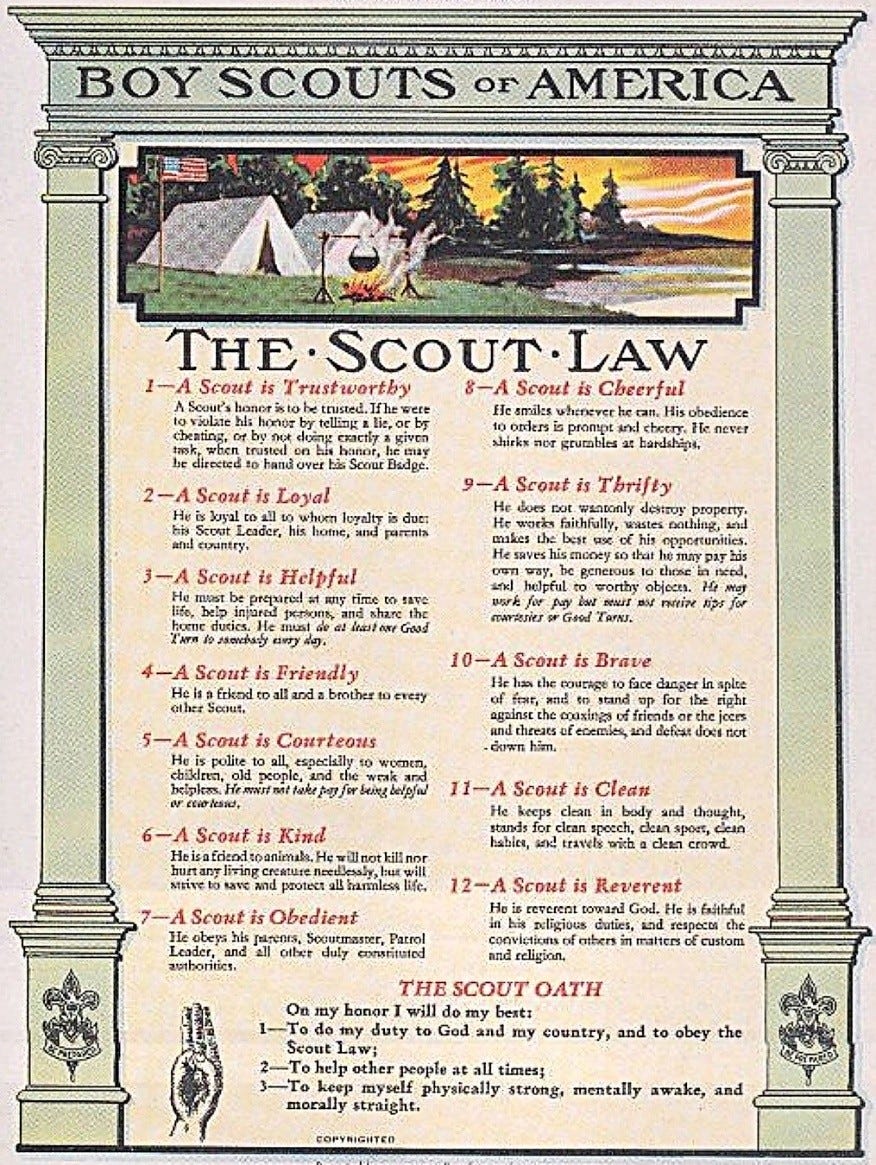
I’ve referred to the Boy Scout law several times in this series of essays – in part because it encapsulates a secular set of values that define somehow who knows how to act.
I’m reminded of one Christmas when my extended family gathered at my parents’ house. My nephews (ages probably 8 and 6 or thereabouts) were on a bit of a sugar high, shall we say, and their father chastised them by saying, “Can y’all act like you've been somewhere?”
That’s it. Most of us have been brought up to observe some behavioral norms – maybe applied in church or at your grandmother’s house, but we all know what it means to act like we’ve been somewhere.
I looked at this list a bit and found a few interesting things:
Trustworthy
The small print says that if a scout lies, cheats, or fails to follow through on a promise, he could be kicked out of the organization. In other words, actions have consequences, and accountability should be the norm.
Loyal
The scout is expected to be loyal to all to whom loyalty is due. The words “is due” are important here.
Helpful
The scout is expected to do one good turn (I’ve always heard “one good deed”) each day. Yes, really.
Friendly
The scout is a friend to all, not just to people who are useful to him.
Courteous
The scout is polite to all. The italicized print offers this admonition: The scout must not take pay for being friendly or courteous.
Kind
Oddly, the text seems to refer primarily to a scout being friendly to animals and not killing or harming people. I think this is an unnecessarily restrictive definition of kindness.
Obedient
The scout is expected to obey all duly constituted authorities. There is no mention of unlawful orders, although I think the words “duly constituted” are doing a lot of work here.
Cheerful
A scout does not grumble when things do not go his way. And certainly not in public or in front of reporters.
Thrifty
The scout works faithfully, doesn’t waste money, and doesn’t wantonly destroy property. He saves his money so he can pay his own way, be generous to those in need, and support worthy projects.
Brave
The scout dares to face physical danger and stand up for what is right in the face of opposition from friends or enemies. Even in the face of a possible mean Tweet.
Clean
The scout keeps his body and mind clean, stands for clean speech, clean sport, and clean habits, and hangs out with a clean crowd of friends. Another way to say this is that we are known by the company we keep. Trump supporters may not be corrupt misogynist racist narcissistic felons, but they are willing to be identified with people who are.
Reverent
The scout is faithful to his religious convictions and respects the religious convictions and customs of others.
We all recognize that the current Republican president would not have made it in the Boy Scouts. Is this unusual? You be the judge. Aaron on Scouting, identified as the Official Site of Scouting Magazine, says the following about recent Presidents:
Boy Scouts:
Kennedy
Ford (Eagle Scout)
Biden
Cub Scouts:
Clinton
Bush (his mother was the Den Mother)
Obama (in Indonesia)
Supporters of Scouting
Wilson (signed the BSA’s charter in 1916)
Eisenhower (served on the BSA Executive Board; his son John was a Boy Scout; scouts who wear their uniforms get free admission to the Eisenhower Presidential Library, Museum, and Boyhood Home in Kansas)
Johnson (organized an Explorer post for Congressional pages)
To be fair, Trump paid $7 for Don Jr. to join the scouts in 1989, and he gave an address at the 2017 Scout jamboree in West Virginia. Here’s an excerpt from the speech he gave that day:
I’ll tell you a story that’s very interesting for me when I was young. There was a man named William Levitt, Levittowns, you have some here, you have some in different states … And he was a very successful man. He was a homebuilder, became an unbelievable success, and got more and more successful …
And he sold his company for a tremendous amount of money. At the time especially, this was a long time ago, sold his company for a tremendous amount of money. And he went out and bought a big yacht and he had a very interesting life. I won’t go any more than that because you’re Boy Scouts, I’m not going to tell you what he did – should I tell you? Should I tell you? Oh, you’re Boy Scouts, but you know life, you know life. So, look at you, who would think this is the Boy Scouts, right?
So he had a very interesting life, and the company that bought his company was a big conglomerate. And they didn’t know anything about building homes, and they didn’t know anything about picking up the nails and the sawdust and selling it, and the scraps of wood … So they called William Levitt up and they said, would you like to buy back your company and he said yes, I would. He so badly wanted it, he got bored with this life of yachts and sailing and all of the things he did in the south of France and other places … But what happened is he bought back his company and he bought back a lot of empty land … and in the end he failed and he failed badly. Lost all of his money. He went personally bankrupt, and he was now much older.
And I saw him at a cocktail party and it was very sad. Because the hottest people in New York were at this party. It was the party of Steve Ross. Steve Ross, he was one of the great people. He came up and discovered – really founded – Time Warner, and he was a great guy. He had a lot of successful people at the party. And I was doing well so I got invited to the party.
That’s some good boyscouting right there.
The Boy Scout oath also provides a good basis for decency:
On my Honor, I will do my best:
To do my duty to God and my country, and to obey the Boy Scout Law
To help other people at all times
To keep myself physically strong, mentally awake, and morally straight
Also pretty good guidance.
The same group of friends reminded me yesterday that the Girl Scouts take a similar oath. My brother was not a Girl Scout, and neither was I, so I never memorized the Girl Scout equivalent, but here they are.
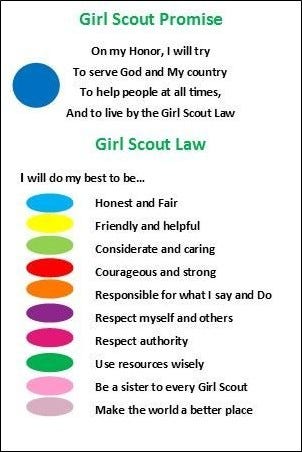
I particularly like two parts of the Girl Scout Law:
Being responsible for what I say and do.
Not blaming everyone except yourself or gaslighting people into believing that you didn’t say or do things that they literally have recordings of you saying and doing.
Making the world a better place.
Not just America.
The United States lives in the broader world and cannot isolate itself from global events. After the 1929 crash of the American stock market and the subsequent global depression, it became common to say “When America sneezes, the World gets a cold.” In the 2st century, however, nations of the world have become more interdependent. Global supply chains, energy markets dominated by OPEC, European financial instability, global pandemics, and climate disruptions all impact the United States.
The point of all of this is that we all know what it means to be a decent human being. I mean, would you hire any member of this administration to babysit your children? And yet, the Republicans think that these folks are just the right people to lead the United States of America. If Democrats emphasize decency, their campaigns will be rooted in something so obvious that it will be hard for the Republicans to counter them.
Another excellent essay, Karen. Thank you.
“No matter how noble the objective of government, if it blurs decency and kindness, cheapens human life, and breeds ill will and suspicion, it is an evil government.” Eric Hoffer