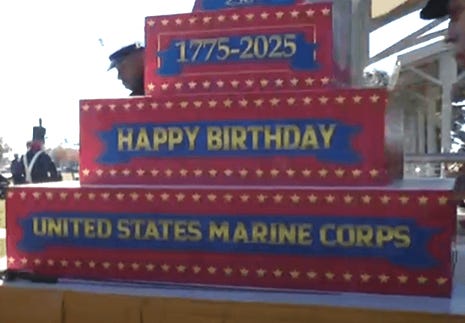
Continental Marines Established
250 Years Ago

By the autumn of 1775, the war for American independence had expanded beyond Massachusetts. Colonial forces were besieging Boston, and Congress had begun to coordinate a unified military response. British naval superiority was a pressing concern – Royal Navy ships could blockade ports, attack coastal towns, and transport troops anywhere along the Atlantic seaboard. The colonies had no organized navy to counter this.
In October, the Continental Congress began debating how to intercept British supply ships and defend American trade. On October 13, it authorized the fitting out of two armed vessels to cruise for munitions ships bound for the British army in North America. As plans for naval warfare developed, Congress recognized that these ships would require specialized troops for shipboard security, boarding actions, and amphibious. These roles were traditionally filled by marines in European navies; the term first came into use in the 17th century in both France and Britain.
On November 10, 1775, the Continental Congress passed the following resolution (written by John Adams):
Resolved, That two Battalions of marines be raised, consisting of one Colonel, two Lieutenant Colonels, two Majors, and other officers as usual in other regiments; and that they consist of an equal number of privates with other battalions; that particular care be taken, that no persons be appointed to office, or enlisted into said Battalions, but such as are good seamen, or so acquainted with maritime affairs as to be able to serve for and during the present war with Great Britain and the Colonies; unless dismissed by Congress; that they be distinguished by the names of the First and Second Battalions of Marines, and that they be considered as part of the number which the Continental Army before Boston is ordered to consist of.
The two battalions were initially intended to be drawn from George Washington’s army for the planned invasion of Halifax, Nova Scotia, which was the main British reinforcement and supply point. In reality, only one battalion was formed by December of 1775.
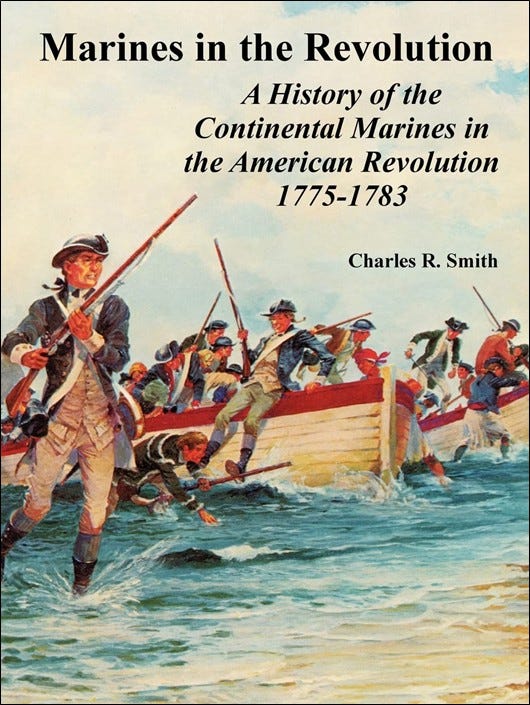
Marines were used to carry out amphibious landings and raids during the Revolution, including landing twice in Nassau in the Bahamas to capture naval supplies from the British. In December of 1776, the Continental Marines were tasked to join Washington’s army at Trenton to slow the progress of British troops southward toward New Jersey, although Washington was unsure what to do with these forces at first. He then added the Marines to a brigade of Philadelphia militia that assisted in the American victory at Princeton.
In 1778, a Marine detachment sailed down the Mississippi River to secure New Orleans and keep British traders out, and also engaged in a battle against British Loyalists on the shore of Lake Ponchartrain. Later in 1778, a Marine detachment accompanying John Paul Jones made two raids on British soil.
When the war ended in 1783, the Continental Marines were disbanded when the Continental Navy was abolished. The Navy and Marines would be reconstituted in 1798, as tensions with France heated up, although Congress had already authorized building six frigates in 1794.
Although the Continental Marines did not play a decisive role in the American Revolution, the modern Marine Corps acknowledges the 1775 formation of this military body as its birthday.