
Construction Supervisor in Chief
Weekend Update

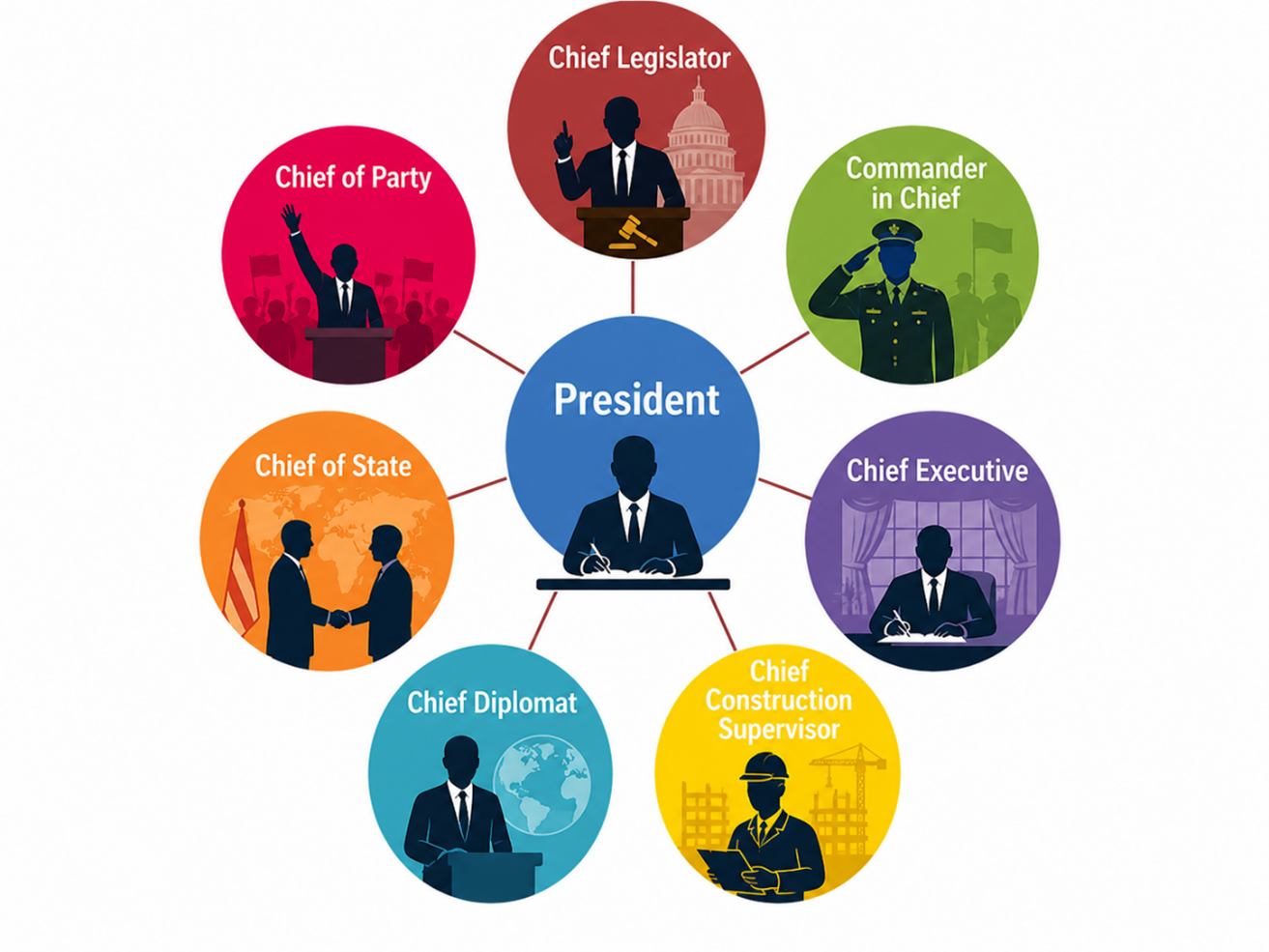
When government teachers begin their unit on the Executive Branch, they often use a diagram like this one – showing the various roles the President is expected to play in the American political system. Some of these are constitutional, like Commander in Chief and Chief Executive. Others have grown from the original framework of the constitution, like Chief Legislator and Chief of Party. Modern politics has added more roles – Chief Communicator, for example, and Mourner in Chief. Every President has been good at some of these jobs and not so good at others.
Here’s a brief description of a president’s responsibilities in these areas, followed by my assessment about Trump’s affinity for that part of the job.
Chief legislator: The President is expected to take the lead in proposing legislation and then working with Congress to get the legislation passed. This was not part of the Constitutional expectations for this job, but it has become an important part of what effective presidents do.
Trump prefers to issue executive orders. They don’t have the force of law, of course, but he doesn’t care. He gets to announce something Big and sign a piece of paper with his scrawly signature.
Commander in Chief: As Harry Truman put it, this is where “the buck stops.” The president does not have direct operational control over military forces, but he is responsible for setting the strategic objectives and the tone of military service in the country.
Trump’s idea of military strategy begins and ends with blowing things up and killing people.
Chief Executive: The President sits atop a complex administrative structure that has grown out of the constitutional language that allows the President to have official advisors. He is expected to provide policy guidance that is then carried out by his politically appointed leaders of career bureaucrats within the federal government.
Trump doesn’t care about how the federal government is supposed to work. He thinks that all government employees work for him and that administrative procedures developed under other presidents are suggestions, not requirements.
Chief of State: The President represents the nation at official events. From important events like the recent state dinner where the president hosted King Charles III, to the rite of throwing out the first pitch at a baseball game, the president represents all of us.
Other than Construction Supervisor in Chief, this is Trump’s favorite job. He gets to go places where people fawn over him and play military marches when he arrives and departs. He gets to host people at the White House and travel places in nice planes. He gets to be the grand marshal of parades and preside over the White House Easter Egg Roll.
Chief of Party: The President is expected to be the spokesman for his political party. When a party does not hold the office of president, its national chairman may serve in this role, as may certain party leaders in various official or unofficial positions. The party’s platform is supposed to represent the policy preferences of its presidential nominee and incumbent.
Trump doesn’t care about the Republican Party except for its role in elevating him to power and keeping him there. He doesn’t care about traditional GOP positions on issues. If anyone in the party criticizes him, he announces that they are no longer Republicans.
Chief Diplomat: The President establishes both the policy and tone of the country’s diplomatic interactions with other nations. He appoints ambassadors and lesser officials to represent the country abroad and serves as the chief communicator with other world leaders.
Trump doesn’t have a tactful bone in his body. He scolds and berates other heads of state in person and over the telephone. He violates protocol (in part, because he doesn’t understand that someone else might actually be more important than him). He truly does not believe that other nations are sovereign entities who are free to reject his bullying and mockery.
Each president focuses on the roles he plays best and delegates (or ignores) other roles. Because he can switch hats without telling us, he may sometimes appear to be wearing one hat while he’s actually wearing a different hat. Are his proposals good for the country or good for his party? And so forth.
In most countries, the Chief of State is a different person from the Chief of Executive. In the UK, for example, King Charles III can come to Washington as Chief of State (a ceremonial position with no power) and interact pleasantly with the President, while the UK Prime Minister Keir Starmer (Chief Executive) argues with the President over NATO policy. These are two separate things.
You may have noted that there’s an additional circle for the powers of the President in the diagram above: Chief Construction Supervisor. This is a new role that Trump has created for himself. He clearly likes it more than he likes any of the other traditional jobs a president is expected to do. Let’s review the construction projects he is focused on:
His ballroom/whatever in place of the East Wing of the White House
His Memorial Arch at the entrance to Arlington Cemetery
Painting the bottom of the reflecting pool between the Lincoln Memorial and the Washington Monument
His National Garden of American Heroes (between the National Mall and the Potomac River near Haines Point.
Planned renovation of the Kennedy Center
Changes at the White House—paving over the Rose Garden, changing other external elements
Gold, gold, everywhere in the White House
Renovating the bathroom attached to the Lincoln bedroom
There are probably more, but this will do.
It seems like these projects are the only parts of being president that he enjoys. Staff members report that he wants to talk about these projects all the time. He dons a hard hat and walks the construction sites. Remember seeing him on the roof of the White House? It’s hard to quantify how regularly he veers onto these topics, but a Washington Post report recently noted that he has mentioned the White House ballroom in roughly 1/3 of his public appearances and social media posts thus far in 2026 – nearly as often as healthcare and affordability. We can extrapolate from this to say that the number of times he mentions his construction projects is at least “more” than 1/3 of the times he communicates with the press and public.
He cares about these projects much more than he cares about any other part of being President. The other things – war, inflation, for example – bore him. And he is Not To Be Bored.
Like Rumpole of the Bailey's wife, He Who Must Be Obeyed.