
Constitution Day

After a contentious summer in Philadelphia, the 55 delegates to the Constitutional Convention signed the new Constitution for the United States of America on this day in 1787. Delegates from 12 states (Rhode Island did not attend) originally met to amend the Articles of Incorporation; however, from the first session it was clear that the goal of the meeting would be to draft a new system of government.
I won’t go into the precarious balancing act that led to the creation and ratification of this document. You can Google that. Today I want to talk about how Americans commemorate this day. It seems particularly appropriate as we watch the current Republican president and his allies try to spin the nation’s founding document to meet their specific (and mostly financial) needs.
I’ve mentioned VPAP (Virginia Public Access Project) before in these essays. This free online source of news about Virginia pops up as a daily newsletter in my email every morning, but today I received an additional email.
Every year, my teacher colleagues and I were required to offer something constitution-based on September 17. That was easy for me in my history and government classes; my friends who taught calculus or chemistry had a tougher time finding an angle to incorporate this into their lesson plans.
Although VPAP was founded in 1997, I wasn’t aware of it until 2017 or so, as I began to focus on politics. I don’t know how long it has been producing the Civic Navigator, but I know I would have found it useful in the classroom.
The email tells me that this resource is “packed with versatile prompts for grades 4-12, including foundational questions to build core knowledge, research prompts to spark curiosity and independent inquiry, and opportunities to create an expanded version of the visual.
It also tells me how this aligns with the Virginia Standards of Learning. It also offers teachers the opportunity to explore other educator resources as election day approaches in Virginia. You may not know this, but Virginia is electing its statewide officers (governor, lieutenant governor, and attorney general) and all 100 members of its House of Delegates this year. Early voting begins this Friday, September 19. I clicked on the “Explore Educator Resources” link and found dozens of lesson plan ideas for all grade levels. Here’s an example of what one of these lesson plans looks like.
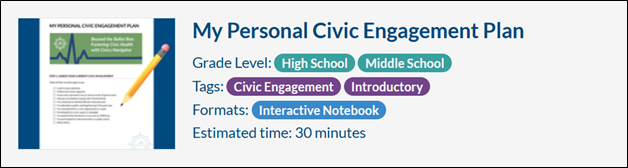
Here’s the link to its “Comparing Constitutions” resource if you want to take a look. . This is the opening graphic.
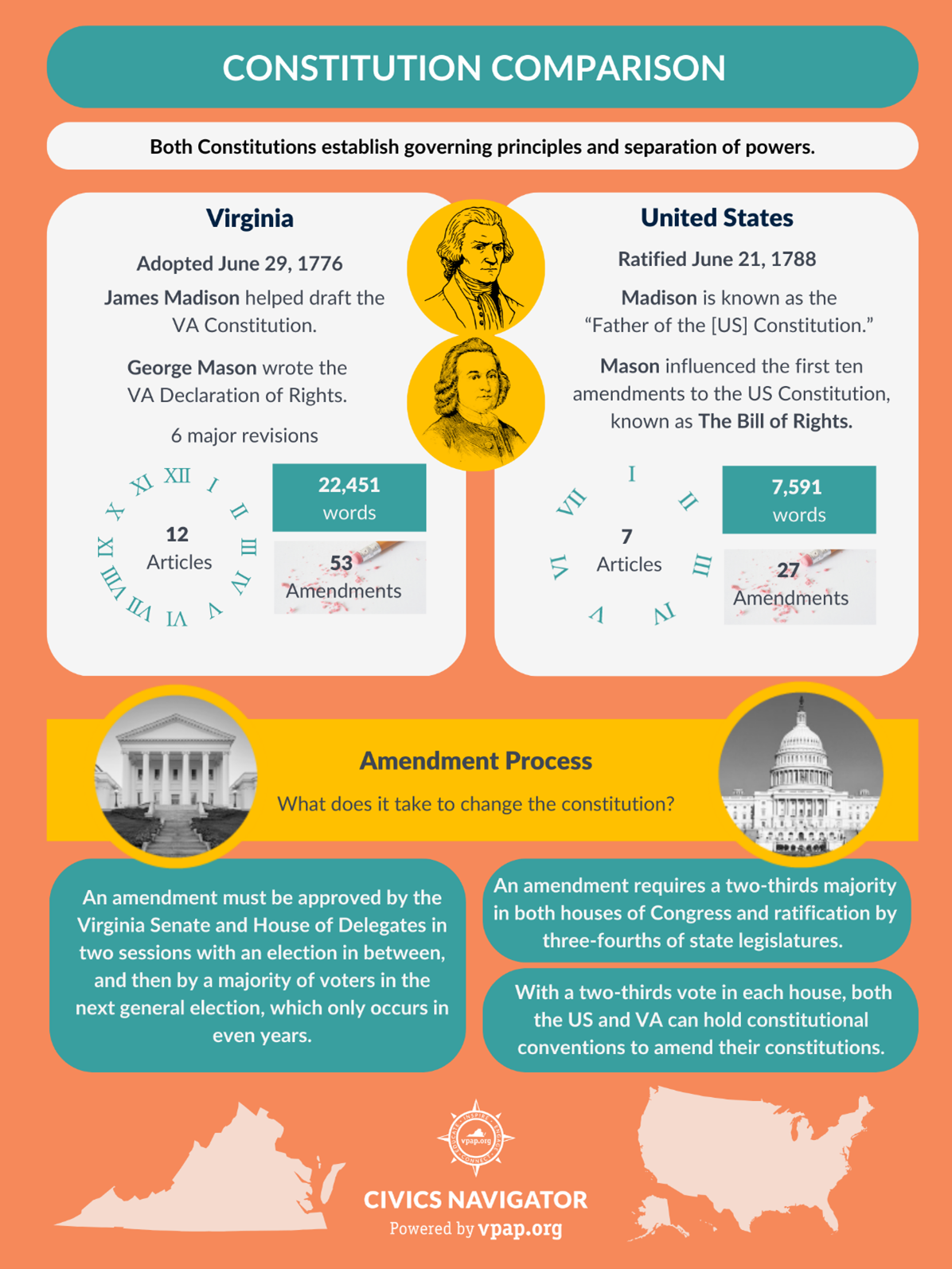
Further down the page, the website provides a link to an interactive notebook created as a Google slideshow. Teachers who have the time and bandwidth to incorporate this into their instruction can have their students download the slideshow and work through it to answer questions on their own copy of the slides. The directions note that this can take anywhere from ten minutes for one of the slides to a full class period or block for all of the slides. Here’s the link to the Google slideshow.
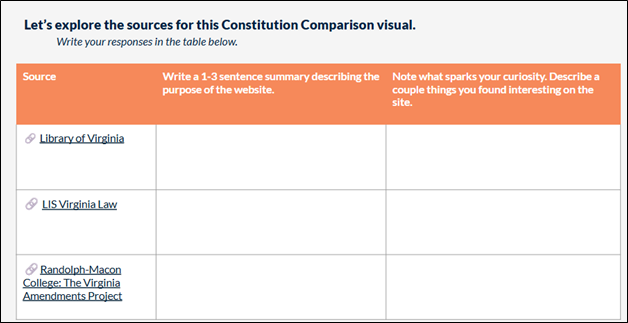
For my AP high school students, I would have enjoyed having them use these two slides to access some primary sources related to this lesson.
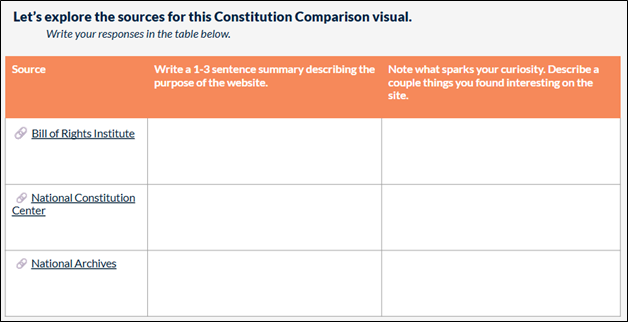
Teachers are encouraged to address variations in learning styles – you know, the visual learner vs. auditory learner vs. reading/writing vs. kinesthetic learner thing. This set of activities includes ideas for students with different learning styles.
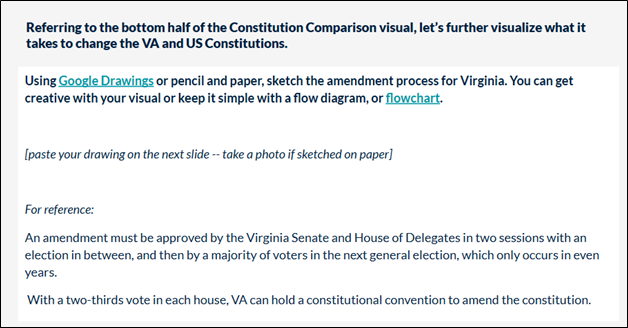
And this slide, which encourages expanded research, would have been fun as well.
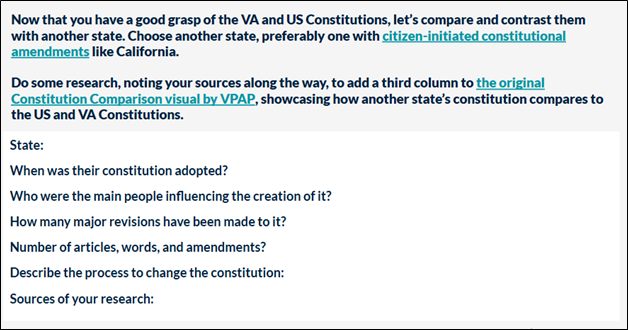
All of this would have worked really well – in a class of 10 students or so. Or in a home-school environment. In a class of 30+ students, this is what is more likely to happen.
At least a few students will not have their Chromebooks (or whatever) handy, or they won’t be able to log in. At least some of these students will be lying about this.
At least a few students will have to go to the bathroom while you’re setting up this lesson. If you let them go, they’ll miss the instructions. If you don’t let them go, they’ll attempt to engage you in debate. Just like the current Republican president, their only goal is “delay, delay, delay” so they don’t have to do something they don’t want to do.
The most compliant students will zip through this and begin to exhibit symptoms of boredom (heads down, talking with their friends who may not have begun this activity, much less finished it, and so forth).
The students who are functionally illiterate will not be able to navigate the simplest instructions and will (a) need constant help or (b) shut down.
Some students will exhibit malicious compliance – following the directions but creating borderline obscene drawings etc. if given the opportunity to do so.
At least five students will announce loudly that “this is stupid.”
Here are some things that could happen (ask me how I know this):
An unannounced fire drill. Fun fact: high school students, who are generally not led outside the way younger students are, frequently get lost during a fire drill, returning 10 minutes after everyone else has returned and reporting that some unnamed administrator or teacher wouldn’t let them come in the right door or something.
Vomiting. There’s always vomiting. This is followed by a scramble of students attempting to escape both the vomit and the stench. Custodians are called to help with the cleanup. The sick student asks to go to the bathroom or nurse. The best friend of the sick student says they have to go along.
A random bell will ring. Students begin to leave class as an administrator comes on the loudspeaker, telling everyone to ignore the bell.
A bug, bee, or spider will invade the classroom. Mayhem ensues.
It will start to snow. Attention is lost for the rest of the class period. Students begin to ask if school will end early because of the snow.
Here’s the serious part of all of this. The problems of the American educational system are not the result of a lack of knowledge about how to teach or a lack of creativity among the teachers and the people who design curriculum. I think these lesson plans are all wonderful and I would have loved to use them.
The problem is a lack of funding. As I mentioned earlier, lesson plans like this work only in small class settings. Research consistently shows that the optimum class size is somewhere between 12-20 students. This would be lower in the elementary grades (more individual attention to learning skills is required) and slightly higher in the upper grades (where students enjoy interacting with a larger number of peers). This would require building more schools.
Research also shows that students benefit from having more than one adult in the room. A teacher can be delivering instruction, for example, while another adult circulates in the room to assist students or help them stay on task. There were times when I drafted a colleague during her planning period to serve as the “roving pointer” in my classroom when we went to the computer lab. I couldn’t supervise 30 students by myself. I couldn’t ask for this help very often, so I didn’t go to the computer lab as often as I would have liked to. Now, students in many schools are issued Chromebooks, creating a constant computer lab setting in the classroom. Teachers need help to manage this.
One story to close this out. When I was working the polls as an election worker a couple of years ago, I got into a conversation with another election worker about the increase in our local real estate taxes that had just been announced. She was complaining about the increase in taxes, but I told her I didn’t mind this because it meant the value of our property had increased and because the additional taxes would be funneled into the school system. She was aghast – she said she had never met anyone who enjoyed paying higher taxes, and, besides, she didn’t want to give more money to the schools until they “shaped up.”
Sure. And the floggings will continue until morale improves.
All thos stuff that goes in in a high school classroom, and those who don't teach will think you are exaggerating. Ha!