
Conditional Sovereignty?

My earliest foreign policy memory is the Hungarian crisis of 1956. I was nine years old at the time, but I remember seeing the newspaper headlines and newsreels about the refugee crisis this created.
My second foreign policy memory is watching Sputnik make its way across the night sky in 1957.
The third foreign policy memory is the Cuban Missile Crisis of 1962. This event has been memorialized in a number of scholarly books and one blockbuster film -- 13 Days – which reminded us all of this series of events when it came out in 2000.
The historical connection between the United States and Cuba goes back centuries and has always been troublesome. At the end of the Seven Year War (known as the French and Indian War in the United States) in 1763, the treaty could have awarded Cuba to Britain. Britain had controlled Havana for almost a year at the end of the war, and early treaty negotiations would have awarded Cuba to Britain permanently. But Britain chose to keep Florida rather than Cuba in the treaty that ended the war. Cuba remained under the control of Spain.
In the late 19th century, Cuba was the focal point of repeated independence struggles against Spain, culminating in the Spanish-American War (1898), after which Spain ceded the island to the United States, which became the dominant external power. Although Cuba formally gained independence in 1902, the Platt Amendment allowed Washington to intervene in Cuban affairs and maintain a naval base at Guantánamo, ensuring that Cuban politics and economics remained closely tied to U.S. strategic and commercial interests through the early 20th century.
The instability generated by the period of American influence in Cuba led to the authoritarian regime of Batista in the 1930s; he was returned to power through a military coup in 1952, canceling elections, suppressing political opposition, and relying on US economic dominance. This led directly to the rise of a revolutionary movement under Fidel Castro, which triumphed in 1959 as Batista fled and Castro and his movement took over the country. Castro was not explicitly a communist at first, but in the emerging Cold War world, Russia was an obvious partner for a nation that wished to distance itself from the United States. As Castro undertook more radical steps – nationalization of foreign-owned industries, land reform and redistribution, suppression of political dissent, and expansion of state control over the economy - the United States imposed trade embargoes. This pushed Cuba even more in the direction of the Soviet Union, leading to the 1961 Bay of Pigs Invasion and 1962 Cuban Missile Crisis.
What makes Cuba strategically relevant again is not its economic strength or military power, but its location at the intersection of several emerging pressures in international politics. Renewed great-power rivalry has turned even small states into potential leverage points, particularly when they sit close to a major power’s coastline or along critical migration and maritime routes. As the United States focuses on conflicts in Europe and the Middle East and on long-term competition with China, developments in Cuba – whether economic cooperation with external rivals, intelligence activity, or migration surges – can force Washington to divert attention and resources. In this sense, Cuba’s significance today lies less in what it can do on its own than in how others can use it to test the limits of American influence in its own hemisphere.
The United States Department of Justice has formed a working group in South Florida to investigate potential charges against Cuban governmental officials. The aim of this working group (which includes officials from the Treasury Department, the FBI, the DEA, and the State Department) is to examine drug trafficking, sanctions violations, immigration crimes, and other federal offenses. Specifically, the focus is indicting Raúl Castro on charges related to the 1996 shoot-down of planes operated by the exile group “Brothers to the Rescue,” which killed four people. Some lawmakers argue that Raúl Castro personally ordered the attack; however, earlier indictments in that case targeted intelligence officials rather than Cuba’s top leadership. In addition, the accused individuals remain in Cuba and beyond US jurisdiction.
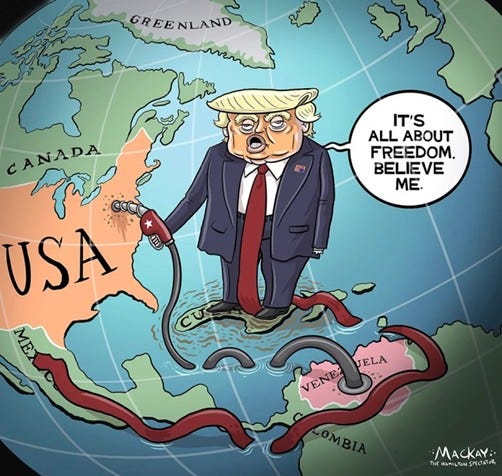
Beyond the obvious geopolitical, military, and economic problems such an effort would create, its broader significance lies in framing adversarial governments as criminal enterprises rather than diplomatic counterparts. In pursuing these activities, the Trump administration is ignoring the foundational element of the modern world – national sovereignty.
Trump’s approach might be framed as a doctrine of “conditional sovereignty.” For most of the modern era, the international system has rested on a core diplomatic premise: states possess sovereignty simply by existing. Since the mid-20th century – especially after the founding of the United Nations – this has meant formal recognition that borders should not be altered by force and that governments should not be removed by external actors.
What appears to be evolving, however, is a more elastic understanding:
Sovereignty is increasingly treated not as an absolute right but as a status that can be limited, overridden, or ignored if a state is deemed dangerous, illegitimate, or strategically inconvenient. Ukraine is the most obvious example of where this doctrine is being rolled out. Trump is on Puiin’s side in this conflict
This shift does not arise from one country alone. It reflects several overlapping trends.
Security threats blur borders. Because modern threats – terrorism, cyberattacks, nuclear proliferation, and transnational crime – are not easily contained within national boundaries, governments argue that they have to act pre-emptively to forestall attacks rather than defensively once an attack has occurred. Targeted strikes against strategic resources or individual leaders work alongside covert operations and sanctions regimes, for example, to normalize action inside another country without its consent.
In addition, the return of a great-powers rivalry worldview established a hierarchical view of sovereignty in which smaller states become bargaining chips or demonstration sites rather than valued coequal partners.
This leads to the increasing use of legal instruments as geopolitical tools. Just as the Trump regime is employing the Department of Justice to punish his political opponents inside the United States, it is using the same tools to go after international actors he perceives as enemies. This blurs the line between foreign policy, intelligence gathering, and criminal justice. When a powerful country like the United States decides to use its power punitively and without regard for norms of national sovereignty, the result is an unstable transitional era in the world order. The consequences of such instability are, by their very nature, unpredictable and prone to subnational and international violence as nations jockey for position in an uncertain world.
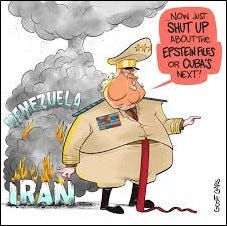
This is all enabled by the domestic crises Trump is facing — most immediately, the ongoing drip-drip-drip of the Epstein files. He is willing to start a global conflict to avoid accountability for his association with the disgraced pedophile. Cuba is handy.
As I noted earlier in this essay, Cuba has tended to matter most during periods of global transition – from the imperial rivalries of the eighteenth century to the superpower confrontation of the Cuban Missile Crisis. Its renewed prominence today suggests that the world may once again be entering a phase in which geography, ideology, and security fears combine to weaken long-standing diplomatic norms. If sovereignty becomes increasingly conditional, islands like Cuba are unlikely to remain peripheral. Instead, they become early indicators of how far major powers are willing to go to redefine the rules of the international order.
good analysis. Conditional seems more like a use and then dump strategy.
It’s always something….. I’m going for a walk to listen to the birds…..