
AI

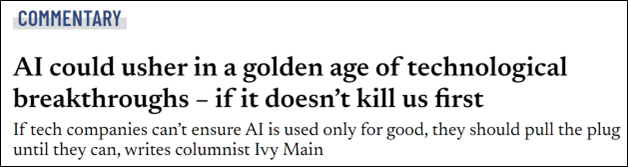
This is the headline of an op-ed in the online newspaper, Virginia Mercury. I receive this in my email inbox every morning. For context, this is how Virginia Mercury describes itself on its website: “The Virginia Mercury is an independent, nonprofit online news organization covering state government and policy. The Mercury launched in 2018 to bring a fresh perspective to coverage of the state’s biggest political and policy issues and fill the gaps in statehouse reporting created by a shrinking media industry.”
This headline caught my attention because I have been playing around with AI for the past six months or so. Back on March 22 of this year, I wrote about the technical challenges of the growing importance of Artificial Intelligence. Here’s the link to that article in case it escaped your notice.
Today I want to dwell a bit on how I’ve been using two AI platforms: ChatGPT and Microsoft Copilot.
I made my first foray into ChatGPT when we were visiting our son Kevin and his family in Georgia last Christmas. I was doing a bit of writing in the family room one day when Kevin came by and we started talking. I asked him if he had ever used ChatGPT and he responded that he had. I then asked him to help me set up my account. It was easy-peasy. I didn’t actually need his help to do it. After becoming accustomed to the platform, I began to incorporate it into my daily work.
NOTE: One limitation of the basic (free) version of ChatGPT is that it does not include information from the past couple of years. I don’t know if the paid upgraded version offers more recent information.
The first question I asked ChatGPT was “Give me an outline of a 1-hour class on race relations between 1865 and 1900.” This was in December of 2023, and I was working on a class I was planning to teach for the Osher program in the spring semester. The answer I got was very useful – it outlined the topics to be covered and suggested some time constraints.
So one question, I think, is whether this was “cheating” in some fashion. I don’t think so, and here’s why. I already had a pretty good grasp of the history of this time period, so I could evaluate this outline pretty easily. It didn’t tell me what to say about each item on the outline, but it did give me an approach that might work. There were parts of the approach I didn’t like, so I didn’t use them.
Was I cheating? Discuss.
A few weeks later I asked the platform to give me some information about the relationship between the economy and presidential reelection for an essay I was working on. Once again, ChatGPT gave me an idea of the questions to ask – about economic performance, consumer confidence, unemployment rates, inflation, “pocketbook” voting, the timing of economic changes, and global economic factors. I used those questions to dig into the issue a bit more. It was useful.
I have also asked the program to give me a 7-line PowerPoint slide on a specific topic. It did, and although I didn’t use it exactly as written, I based my slide on the suggestion.
Later, I discovered that ChatGPT functionality had improved so that it would transcribe an image of a newspaper article I uploaded. It did a reasonably good job, although it got a bit creative when a part of the image was difficult to read. Then I uploaded an old photo and asked it to describe and analyze the image.
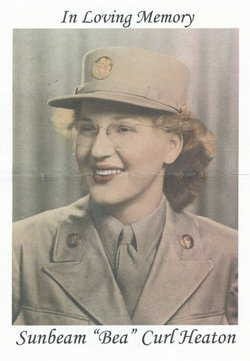
This is the image I uploaded. My instructions were “Analyze this photo of a woman, including her age, her uniform, and when this picture may have been taken.”
Here’s the ChatGPT response:
The photo shows a woman named Sunbeam "Bea" Curl Heaton. Based on her appearance and uniform, let's analyze the details:
Age:
The woman appears to be in her mid to late 20s or early 30s. This is an estimation based on her facial features and overall appearance in the photo.
Uniform:
The uniform she is wearing is a World War II-era U.S. military uniform. The style and design are consistent with what women in the U.S. Army or Army Air Forces (WAC - Women's Army Corps) wore during the 1940s.
The hat with the emblem and the buttons on the jacket are indicative of military attire from that period.
Timeframe:
Given the uniform style and the fact that it is a memorial photo, it is likely that this picture was taken during World War II, which lasted from 1939 to 1945. The quality and coloration of the photo also suggest it is from the 1940s, though it has been preserved or colorized for the memorial.
Context:
The text "In Loving Memory" indicates this is a memorial photo, commemorating her life and service.
The use of her nickname "Bea" and the formal photograph suggest she was honored for her contributions, likely related to her military service.
In summary, Sunbeam "Bea" Curl Heaton is pictured in a World War II-era U.S. military uniform, and the photo was likely taken during the 1940s when she was in her mid to late 20s or early 30s. This image has been used for her memorial, signifying her remembered service.
How well did the program do? I already knew who this was. Bea was born in 1919, she served as an Army nurse (in the Woman’s Army Corps) in 1944. So Chat GPT was pretty accurate as to her age and military service. This could be useful in identifying the time period and other details of an old photo that I maybe couldn’t identify.
I decided to try it.
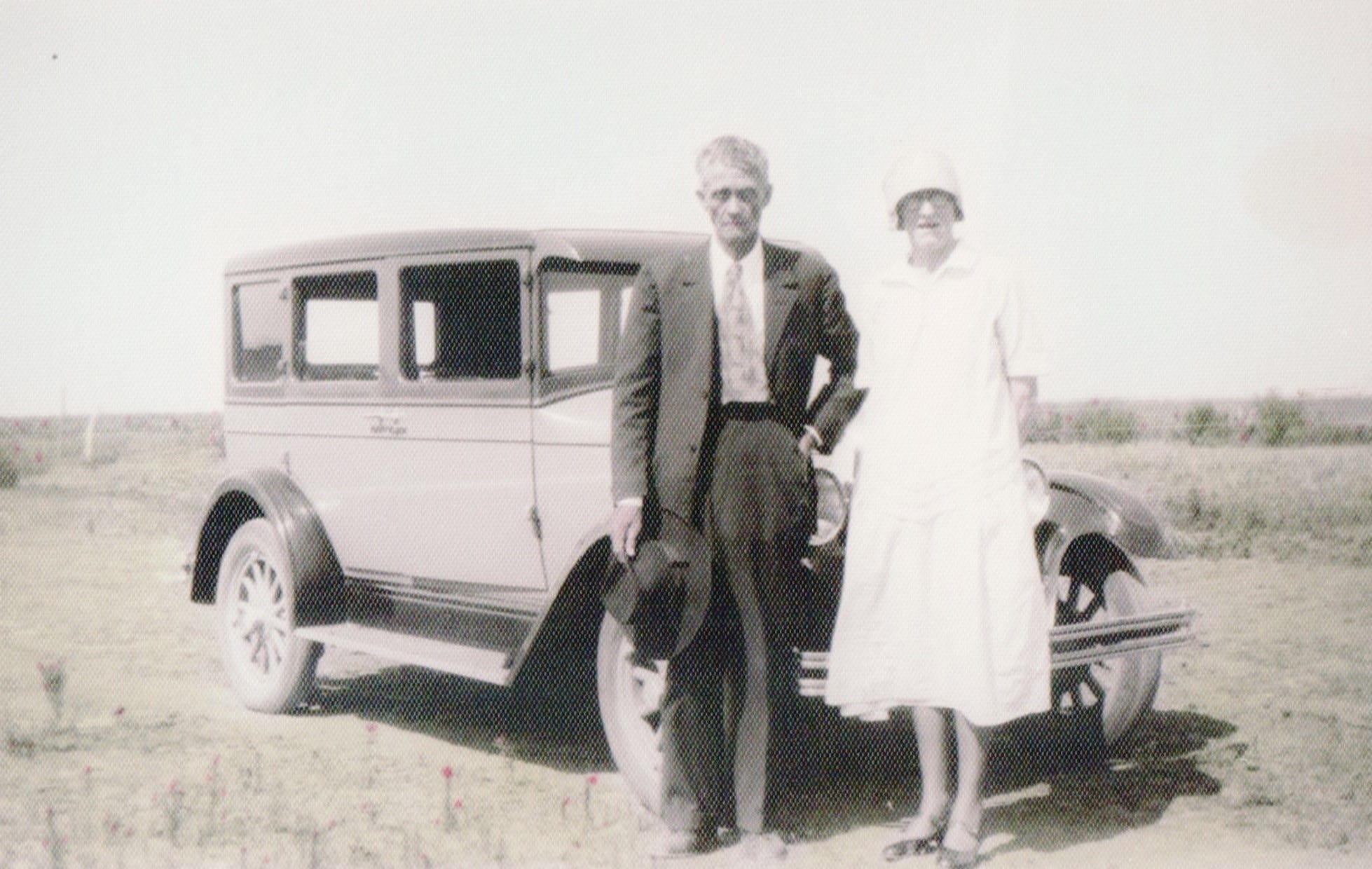
This was in a box of photos I inherited when my mother died. I didn’t know who these people were, so I uploaded it to ChatGPT with the instruction “Describe and analyze this photo, including the time period, make and model of the car, and ages of the individuals in the photo.”
Here’s the response I got:
The photo features a man and a woman standing next to an automobile. Here's a detailed analysis:
Time Period
Clothing and Car Style: The attire of both individuals, along with the style of the car, suggests that this photo was taken in the late 1920s or early 1930s. The woman's dress and hat are indicative of the flapper style popular in the 1920s, while the man's suit is also characteristic of that era.
Automobile
Make and Model: The car appears to be a Ford Model A, which was manufactured from 1927 to 1931. This can be identified by the distinct shape, the design of the windows, and the overall style of the vehicle.
Ages of Individuals
Man: The man looks to be in his 30s to 40s. His hairstyle and attire are consistent with men's fashion of the late 1920s and early 1930s.
Woman: The woman appears to be in her 20s to 30s. Her dress and cloche hat are typical of women's fashion in the same time frame.
Context and Setting
Location: The setting appears to be a rural or semi-rural area, judging by the open field and lack of urban structures in the background. The presence of the car and the individuals' attire suggests that they may be posing for a special occasion or simply capturing a moment with their vehicle, which was likely a significant possession during that period.
In summary, the photo likely dates from the late 1920s to early 1930s and features a Ford Model A. The individuals in the photo are likely in their late 20s to early 40s, dressed in period-appropriate clothing, standing in a rural or semi-rural setting.
This doesn’t really help me very much, to be honest. But I have other unidentified photos so I’ll probably try them at some point.
I continued to use ChatGPT off and on until the Microsoft Copilot icon appeared on the taskbar of my laptop one morning. It looks like this. Do you have it?

I decided to test Copilot to see how it compared to ChatGPT. I found that I liked it – in part because it was just one click away, and also because it was able to provide more current information. Another reason I liked it was that it provided direct access to the online sources it had ”consulted.” Here’s an example of what I mean
I asked the question “How did sharecropping work.?” This was part of a series of questions I had posed, and I found that the program learned what I was interested in from my previous questions. It gave me a good answer, and then told me its sources:
Source: Conversation with Copilot, 7/10/2024
(1) Sharecropping: Definition and Dates | HISTORY. https://www.history.com/topics/black-history/sharecropping.
(2) Sharecropping - New Georgia Encyclopedia. https://www.georgiaencyclopedia.org/articles/history-archaeology/sharecropping/.
(3) Sharecropping - Wikipedia. https://en.wikipedia.org/wiki/Sharecropping.
I like the first source – a conversation it had with itself. The next couple of sources tell me it didn’t dive deeply into the topic, but it gave me a couple of places to go to find out more. I’ve figured out that Copilot does a blazing-fast Google search (or Bing, because it’s Microsoft), sorts out the wheat from the chaff, and gives me the wheat. Probably.
I also asked Copilot to write me a poem about genealogy for inclusion in a book I was working on. Here’s the poem it wrote:
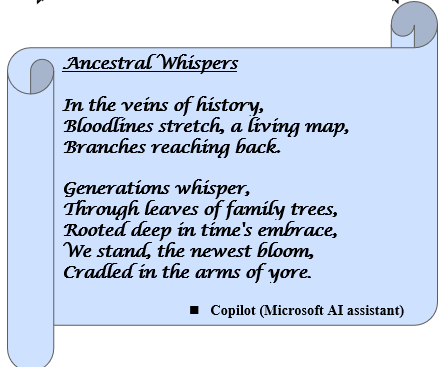
It initially gave me only the poem, without a title. So I asked it for a title, which it provided. It’s not a poem for the ages, but it’s not the worst poem I’ve ever read.
I also asked it to tell me a genealogy joke. Here’s how it responded:
Certainly! Here’s a light-hearted genealogy joke for you:
Why did the genealogist break up with their partner?
Because they couldn’t find any roots in the relationship! 😄
Feel free to ask for more jokes or anything else you’d like to know! 🌟
So, that’s not funny. Siri or Alexa do a better job of telling a joke.
I have also seen that AI has invaded the Facebook search bar and I now have an AI app on my phone.
I have a lot of thoughts but no conclusions about where AI will take us. I’m just glad I’m not teaching high school these days. It was bad enough when kids copied information wholesale from websites. I don’t know how teachers will be able to verify if something was written by a 17-year-old or by AI – even if the teachers find the time and resources to do it. I see two immediate options – teachers will simply avoid making assignments to write something outside of class, or they will require that essays be handwritten. This second option raises two additional problems, of course. Handwritten essays are much harder (and more time-consuming) to read and evaluate, and many kids can’t write in cursive. I have two very bright grandchildren. One of them can write in cursive but his handwriting looks like that of his parents – both of them doctors with the requisite terrible handwriting. The other writes beautiful cursive – she is the designated writer for family cards and so forth. I don’t know what to make of this.