
A Quick Historical Note

As Americans are coming to terms with the fact that the current Republican president authorized an attack on Iran yesterday, I want to provide a quick historical note on how the current state of affairs came to be.
Iran is one of the world’s oldest continuous civilizations, dating back to 4000 BC. Its history has been dominated by a succession of empires, leading to its emergence as a proto-constitutional monarchy at the beginning of the 20th century. In 1925, Shah Reza Pahlavi assumed control of the country; the Pahlavi era lasted until 1979.
Before World War II, the Shah established a classical authoritarian regime, emphasizing nationalism, secularism, and militarism while imposing strict censorship and supporting state propaganda. His reign also pushed reforms, including encouraging western clothing; the hijab was banned in 1936, and men and women were allowed to congregate freely.
The Russians and the British invaded Iran in August 1941 in response to the Iranian government’s refusal to expel German residents from Iran. The Iranian army was easily defeated, and Iran became the major conduit of allied Lend-Lease aid to the Soviet Union. The allies were most interested in the Irania oil fields. The Shah was deposed during the occupation and was replaced with his son, Mohammad Reza Pahlavi.
At the Tehran Conference of 1943, the allies issued the Tehran Declaration, which guaranteed Iran's post-war independence and boundaries. Although the Soviets did not withdraw immediately when the war ended, they had left by the middle of 1946.
The new young Shah initially allowed parliament to hold a lot of power. Elections were held, although corruption meant that Parliament would be chronically unstable, with six prime ministers in the four years between 1947 and 1951.
A political crisis in the early 1950s threatened the Shah’s regime. In 1951, the sitting Prime Minister, Mohammed Mosaddeq, presided over a parliamentary vote to nationalize the British-owned oil industry. Iran’s oil fields were the primary reason other countries were interested in Iran; when the Iranian government threatened to remove this source of revenue, Britain began to apply pressure, including an economic blockade, to reverse the policy. Mosaddeq continued the nationalization policy; he was briefly removed from power in 1952, but a popular uprising supporting him forced the Shah to reappoint him to his position. In turn, he forced the Shah into a brief exile in August of 1953 after a failed military coup.
Shortly after this, a successful coup led by the CIA and Britain's MI6 –bolstered by a propaganda campaign designed to turn the population against Mosaddeq – forced Mosaddeq from office. He was tried and convicted of treason, but he was sentenced only to house arrest while his foreign minister was executed. Army general Fazlollah Zahedi, who had been the front man for the coup effort, succeeded him as prime minister and suppressed opposition to the Shah.
From 1953 until 1979, Iran was ruled by the autocratic Shah while the nation operated under an agreement with an international consortium of foreign companies that ran the Iranian oil facilities for the next 25 years under a profit-sharing agreement. During the late 1950s and early 1960s, Iran moved closer to the West, joining the Baghdad Pact and receiving military and economic aid from the United States. The Shah’s regime initiated a series of reforms, including land reform, that generated an unprecedented growth rate fueled by Iran’s vast petroleum reserves.
Internally, the Shah’s regime became increasingly militant against internal dissent, with the internal security service, the SAVAK, playing a violently active role. Under this pressure, leftist groups emerged, contributing to the overthrow of the Shah during the 1978-79 Iranian revolution, which replaced the monarchy led by the Shah with an Islamic republic under Ayatollah Ruhollah Khomeini, whose 1979 return from exile in France signaled this change.
In January of 1979, during this revolution, the Shah left the country for exile after strikes and demonstrations paralyzed the country. Iran officially became an Islamic Republic on April 1, 1979, after Iranians overwhelmingly approved a national referendum.
When the Shah went into exile in early 1979, he came to the United States for cancer treatment. He had been diagnosed with leukemia in 1974, and, while US intelligence and government officials were aware of his condition, it was not publicly disclosed at the time. This apparent support for the Shah, coupled with the US complicity in overthrowing the Mosaddeq regime in 1953, led to the Iran hostage crisis, which began on November 4, 1979, two weeks after the Shah arrived in New York.
Succeeding events in Iran destabilized the world – and American politics – for decades. Iran and Iraq fought a bloody war from 1980 through 1988 after Iraqi leader Saddam Hussein attempted to take Iranian oil fields while Iran was weakened by its internal political crisis. This war shifted alliances in the Middle East, fueling further instability and the rise of Islamist movements in other countries.
The Iranian hostage crisis also destabilized American politics. It was the major reason for President Carter’s defeat by Ronald Reagan in the 1980 presidential election, and from 1980 forward, countering Islamist forces in the world became a major focus of American politics. Two attacks on New York’s World Trade Center – an unsuccessful one in 1993 and the one we all remember on September 11, 2001 – galvanized the United States to pursue its anti-Islam efforts.
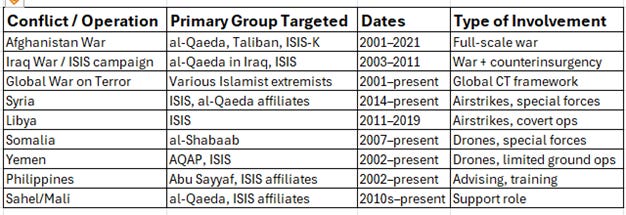
This table gives a brief overview of the relevant series of events.
The Ayatollah Khomeini died in 1989, but not before appointing a 25-man Constitutional Reform Council that named then-president Ali Khamenei as the next Supreme Leader. Khamenei still leads Iran today.
Thank you!
Thanks! Praying.